Thank you for visiting SNEWPapers!
Sign up free
Story
September 13, 1917
The Raymer Enterprise
Raymer, New Raymer, Weld County, Colorado
What is this article about?
United States Department of Agriculture provides guidance on raising spring pigs through summer, emphasizing pasture, grain supplements, exercise, sanitation, water, shelter, and a mineral mixture for healthy growth and profitability.
Clipping
OCR Quality
98%
Excellent
Full Text
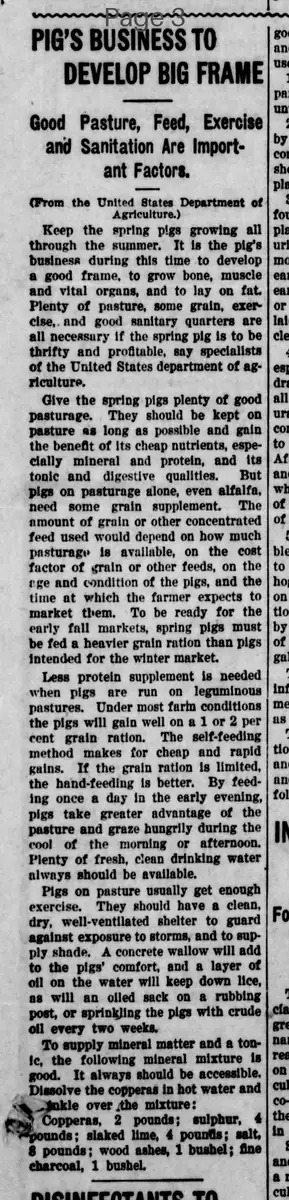
PIG'S BUSINESS TO DEVELOP BIG FRAME
Good Pasture, Feed, Exercise and Sanitation Are Important Factors.
(From the United States Department of Agriculture.)
Keep the spring pigs growing all through the summer. It is the pig's business during this time to develop a good frame, to grow bone, muscle and vital organs, and to lay on fat. Plenty of pasture, some grain, exercise, and good sanitary quarters are all necessary if the spring pig is to be thrifty and profitable, say specialists of the United States department of agriculture.
Give the spring pigs plenty of good pasturage. They should be kept on pasture as long as possible and gain the benefit of its cheap nutrients, especially mineral and protein, and its tonic and digestive qualities. But pigs on pasturage alone, even alfalfa, need some grain supplement. The amount of grain or other concentrated feed used would depend on how much pasturage is available, on the cost factor of grain or other feeds, on the age and condition of the pigs, and the time at which the farmer expects to market them. To be ready for the early fall markets, spring pigs must be fed a heavier grain ration than pigs intended for the winter market.
Less protein supplement is needed when pigs are run on leguminous pastures. Under most farming conditions the pigs will gain well on a 1 or 2 per cent grain ration. The self-feeding method makes for cheap and rapid gains. If the grain ration is limited, the hand-feeding is better. By feeding once a day in the early evening, pigs take greater advantage of the pasture and graze hungrily during the cool of the morning or afternoon.
Plenty of fresh, clean drinking water always should be available. Pigs on pasture usually get enough exercise. They should have a clean, dry, well-ventilated shelter to guard against exposure to storms, and to supply shade. A concrete wallow will add to the pigs' comfort, and a layer of oil on the water will keep down lice, as will an oiled sack on a rubbing post, or sprinkling the pigs with crude oil every two weeks.
To supply mineral matter and a tonic, the following mineral mixture is good. It always should be accessible. Dissolve the copperas in hot water and sprinkle over the mixture:
Copperas, 2 pounds; sulphur, 4 pounds; slaked lime, 4 pounds; salt, 8 pounds; wood ashes, 1 bushel; fine charcoal, 1 bushel.
Good Pasture, Feed, Exercise and Sanitation Are Important Factors.
(From the United States Department of Agriculture.)
Keep the spring pigs growing all through the summer. It is the pig's business during this time to develop a good frame, to grow bone, muscle and vital organs, and to lay on fat. Plenty of pasture, some grain, exercise, and good sanitary quarters are all necessary if the spring pig is to be thrifty and profitable, say specialists of the United States department of agriculture.
Give the spring pigs plenty of good pasturage. They should be kept on pasture as long as possible and gain the benefit of its cheap nutrients, especially mineral and protein, and its tonic and digestive qualities. But pigs on pasturage alone, even alfalfa, need some grain supplement. The amount of grain or other concentrated feed used would depend on how much pasturage is available, on the cost factor of grain or other feeds, on the age and condition of the pigs, and the time at which the farmer expects to market them. To be ready for the early fall markets, spring pigs must be fed a heavier grain ration than pigs intended for the winter market.
Less protein supplement is needed when pigs are run on leguminous pastures. Under most farming conditions the pigs will gain well on a 1 or 2 per cent grain ration. The self-feeding method makes for cheap and rapid gains. If the grain ration is limited, the hand-feeding is better. By feeding once a day in the early evening, pigs take greater advantage of the pasture and graze hungrily during the cool of the morning or afternoon.
Plenty of fresh, clean drinking water always should be available. Pigs on pasture usually get enough exercise. They should have a clean, dry, well-ventilated shelter to guard against exposure to storms, and to supply shade. A concrete wallow will add to the pigs' comfort, and a layer of oil on the water will keep down lice, as will an oiled sack on a rubbing post, or sprinkling the pigs with crude oil every two weeks.
To supply mineral matter and a tonic, the following mineral mixture is good. It always should be accessible. Dissolve the copperas in hot water and sprinkle over the mixture:
Copperas, 2 pounds; sulphur, 4 pounds; slaked lime, 4 pounds; salt, 8 pounds; wood ashes, 1 bushel; fine charcoal, 1 bushel.
What sub-type of article is it?
Agricultural Advice
Farming Guide
What keywords are associated?
Pig Farming
Spring Pigs
Pasture
Grain Feed
Sanitation
Mineral Mixture
Usda Advice
Story Details
Story Details
Advice on developing spring pigs' frame through pasture, grain supplements, exercise, sanitation, water, shelter, and mineral mixture for thriftiness and profitability.