Thank you for visiting SNEWPapers!
Sign up free
Letter to Editor
January 6, 1819
Daily National Intelligencer
Washington, District Of Columbia
What is this article about?
Extract of a letter from a constituent to a Member of Congress, published in the National Intelligencer, critiquing money shortages from specie exports to East India trade. Opposes issuing paper currency or banning specie exports as quackery; urges bank discount curtailment and patience for economic recovery from over-issued currency.
Clipping
OCR Quality
98%
Excellent
Full Text
National Intelligencer.
Extract of a letter to a Member of Congress from one of his constituents.
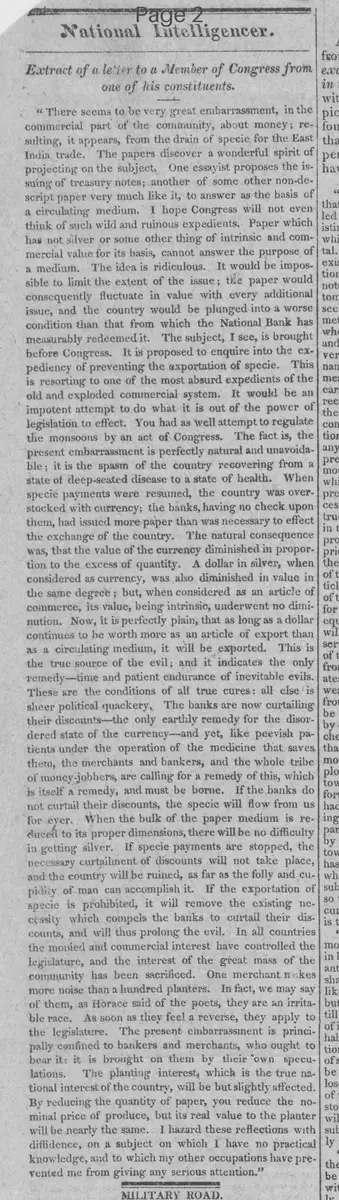
"There seems to be very great embarrassment, in the commercial part of the community, about money; resulting, it appears, from the drain of specie for the East India trade. The papers discover a wonderful spirit of projecting on the subject. One essayist proposes the issuing of treasury notes; another of some other non-descript paper very much like it, to answer as the basis of a circulating medium. I hope Congress will not even think of such wild and ruinous expedients. Paper which has not silver or some other thing of intrinsic and commercial value for its basis, cannot answer the purpose of a medium. The idea is ridiculous. It would be impossible to limit the extent of the issue; the paper would consequently fluctuate in value with every additional issue, and the country would be plunged into a worse condition than that from which the National Bank has measurably redeemed it. The subject, I see, is brought before Congress. It is proposed to enquire into the expediency of preventing the exportation of specie. This is resorting to one of the most absurd expedients of the old and exploded commercial system. It would be an impotent attempt to do what it is out of the power of legislation to effect. You had as well attempt to regulate the monsoons by an act of Congress. The fact is, the present embarrassment is perfectly natural and unavoidable; it is the spasm of the country recovering from a state of deep-seated disease to a state of health. When specie payments were resumed, the country was overstocked with currency; the banks, having no check upon them, had issued more paper than was necessary to effect the exchange of the country. The natural consequence was, that the value of the currency diminished in proportion to the excess of quantity. A dollar in silver, when considered as currency, was also diminished in value in the same degree; but, when considered as an article of commerce, its value, being intrinsic, underwent no diminution. Now, it is perfectly plain, that as long as a dollar continues to be worth more as an article of export than as a circulating medium, it will be exported. This is the true source of the evil; and it indicates the only remedy—time and patient endurance of inevitable evils. These are the conditions of all true cures: all else is sheer political quackery. The banks are now curtailing their discounts—the only earthly remedy for the disordered state of the currency—and yet, like peevish patients under the operation of the medicine that saves them, the merchants and bankers, and the whole tribe of money-jobbers, are calling for a remedy of this, which is itself a remedy, and must be borne. If the banks do not curtail their discounts, the specie will flow from us forever. When the bulk of the paper medium is reduced to its proper dimensions, there will be no difficulty in getting silver. If specie payments are stopped, the necessary curtailment of discounts will not take place, and the country will be ruined, as far as the folly and cupidity of man can accomplish it. If the exportation of specie is prohibited, it will remove the existing necessity which compels the banks to curtail their discounts, and will thus prolong the evil. In all countries the monied and commercial interest have controlled the legislature, and the interest of the great mass of the community has been sacrificed. One merchant makes more noise than a hundred planters. In fact, we may say of them, as Horace said of the poets, they are an irritable race. As soon as they feel a reverse, they apply to the legislature. The present embarrassment is principally confined to bankers and merchants, who ought to bear it: it is brought on them by their own speculations. The planting interest, which is the true national interest of the country, will be but slightly affected. By reducing the quantity of paper, you reduce the nominal price of produce, but its real value to the planter will be nearly the same. I hazard these reflections with diffidence, on a subject on which I have no practical knowledge, and to which my other occupations have prevented me from giving any serious attention."
Extract of a letter to a Member of Congress from one of his constituents.
"There seems to be very great embarrassment, in the commercial part of the community, about money; resulting, it appears, from the drain of specie for the East India trade. The papers discover a wonderful spirit of projecting on the subject. One essayist proposes the issuing of treasury notes; another of some other non-descript paper very much like it, to answer as the basis of a circulating medium. I hope Congress will not even think of such wild and ruinous expedients. Paper which has not silver or some other thing of intrinsic and commercial value for its basis, cannot answer the purpose of a medium. The idea is ridiculous. It would be impossible to limit the extent of the issue; the paper would consequently fluctuate in value with every additional issue, and the country would be plunged into a worse condition than that from which the National Bank has measurably redeemed it. The subject, I see, is brought before Congress. It is proposed to enquire into the expediency of preventing the exportation of specie. This is resorting to one of the most absurd expedients of the old and exploded commercial system. It would be an impotent attempt to do what it is out of the power of legislation to effect. You had as well attempt to regulate the monsoons by an act of Congress. The fact is, the present embarrassment is perfectly natural and unavoidable; it is the spasm of the country recovering from a state of deep-seated disease to a state of health. When specie payments were resumed, the country was overstocked with currency; the banks, having no check upon them, had issued more paper than was necessary to effect the exchange of the country. The natural consequence was, that the value of the currency diminished in proportion to the excess of quantity. A dollar in silver, when considered as currency, was also diminished in value in the same degree; but, when considered as an article of commerce, its value, being intrinsic, underwent no diminution. Now, it is perfectly plain, that as long as a dollar continues to be worth more as an article of export than as a circulating medium, it will be exported. This is the true source of the evil; and it indicates the only remedy—time and patient endurance of inevitable evils. These are the conditions of all true cures: all else is sheer political quackery. The banks are now curtailing their discounts—the only earthly remedy for the disordered state of the currency—and yet, like peevish patients under the operation of the medicine that saves them, the merchants and bankers, and the whole tribe of money-jobbers, are calling for a remedy of this, which is itself a remedy, and must be borne. If the banks do not curtail their discounts, the specie will flow from us forever. When the bulk of the paper medium is reduced to its proper dimensions, there will be no difficulty in getting silver. If specie payments are stopped, the necessary curtailment of discounts will not take place, and the country will be ruined, as far as the folly and cupidity of man can accomplish it. If the exportation of specie is prohibited, it will remove the existing necessity which compels the banks to curtail their discounts, and will thus prolong the evil. In all countries the monied and commercial interest have controlled the legislature, and the interest of the great mass of the community has been sacrificed. One merchant makes more noise than a hundred planters. In fact, we may say of them, as Horace said of the poets, they are an irritable race. As soon as they feel a reverse, they apply to the legislature. The present embarrassment is principally confined to bankers and merchants, who ought to bear it: it is brought on them by their own speculations. The planting interest, which is the true national interest of the country, will be but slightly affected. By reducing the quantity of paper, you reduce the nominal price of produce, but its real value to the planter will be nearly the same. I hazard these reflections with diffidence, on a subject on which I have no practical knowledge, and to which my other occupations have prevented me from giving any serious attention."
What sub-type of article is it?
Informative
Persuasive
Reflective
What themes does it cover?
Economic Policy
Commerce Trade
What keywords are associated?
Specie Export
Paper Currency
Bank Discounts
Economic Recovery
National Bank
East India Trade
Treasury Notes
What entities or persons were involved?
Member Of Congress
Letter to Editor Details
Recipient
Member Of Congress
Main Argument
opposes issuing paper currency without intrinsic value or prohibiting specie exports as ineffective and ruinous; argues that current money shortages are a natural recovery from over-issued currency, remedied only by bank curtailment of discounts and patient endurance.
Notable Details
Compares Economic Recovery To A Medical Cure
References National Bank Redemption
Quotes Horace On Irritable Poets Applied To Merchants
Contrasts Merchant And Planting Interests