Thank you for visiting SNEWPapers!
Sign up free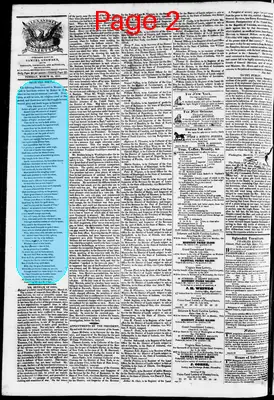
Poem
March 30, 1830
Phenix Gazette
Alexandria, Virginia
What is this article about?
Introduction from Moore's work attributes the poem 'The Prayer of Nature' to Byron, written in 1806 at age 18, revealing his early religious creed and internal struggle between piety and doubt. The poem is a devotional invocation to God, rejecting organized religion and finding divine presence in nature, seeking forgiveness and guidance.
Clipping
OCR Quality
95%
Excellent
Full Text
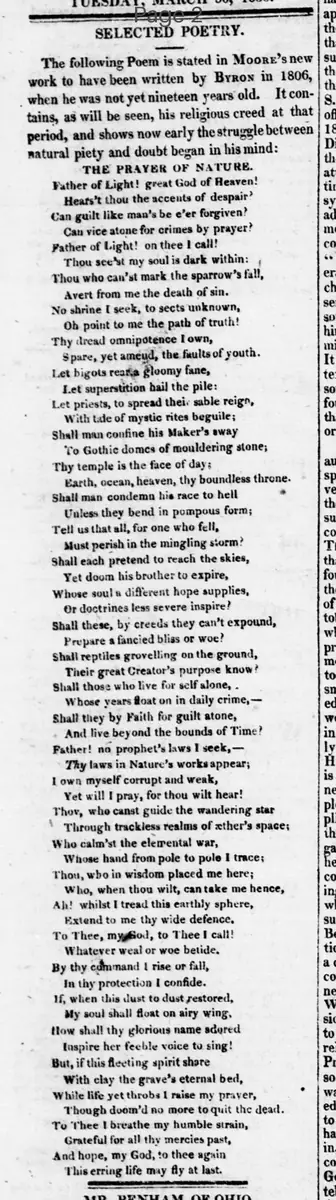
SELECTED POETRY.
The following Poem is stated in Moore's new work to have been written by Byron in 1806, when he was not yet nineteen years old. It contains, as will be seen, his religious creed at that period, and shows how early the struggle between natural piety and doubt began in his mind:
THE PRAYER OF NATURE.
Father of Light! great God of Heaven!
Hear'st thou the accents of despair?
Can guilt like man's be e'er forgiven?
Can vice atone for crimes by prayer?
Father of Light! on thee I call!
Thou see'st my soul is dark within:
Thou who can'st mark the sparrow's fall,
Avert from me the death of sin.
No shrine I seek, to sects unknown,
Oh point to me the path of truth!
Thy dread omnipotence I own,
Spare, yet amend, the faults of youth.
Let bigots rear, a gloomy fane,
Let superstition hail the pile:
Let priests, to spread their sable reign,
With tale of mystic rites beguile;
Shall man confine his Maker's sway
To Gothic domes of mouldering stone?
Thy temple is the face of day;
Earth, ocean, heaven, thy boundless throne.
Shall man condemn his race to hell
Unless they bend in pompous form;
Tell us that all, for one who fell,
Must perish in the mingling storm?
Shall each pretend to reach the skies,
Yet doom his brother to expire,
Whose soul a different hope supplies,
Or doctrines less severe inspire?
Shall these, by creeds they can't expound,
Prepare a fancied bliss or woe?
Shall reptiles grovelling on the ground,
Their great Creator's purpose know?
Shall those who live for self alone,
Whose years float on in daily crime,-
Shall they by Faith for guilt atone,
And live beyond the bounds of Time?
Father! no prophet's laws I seek,-
Thy laws in Nature's works appear;
I own myself corrupt and weak,
Yet will I pray, for thou wilt hear!
Thou, who canst guide the wandering star
Through trackless realms of aether's space;
Who calm'st the elemental war,
Whose hand from pole to pole I trace;
Thou, who in wisdom placed me here,
Who, when thou wilt, can take me hence,
Ah! whilst I tread this earthly sphere,
Extend to me thy wide defence,
To Thee, my God, to Thee I call!
Whatever weal or woe betide,
By thy command I rise or fall,
In thy protection I confide.
If, when this dust to dust restored,
My soul shall float on airy wing,
How shall thy glorious name adored
Inspire her feeble voice to sing!
But, if this fleeting spirit share
With clay the grave's eternal bed,
While life yet throbs I raise my prayer,
Though doom'd no more to quit the dead.
To Thee I breathe my humble strain,
Grateful for all thy mercies past,
And hope, my God, to thee again
This erring life may fly at last.
The following Poem is stated in Moore's new work to have been written by Byron in 1806, when he was not yet nineteen years old. It contains, as will be seen, his religious creed at that period, and shows how early the struggle between natural piety and doubt began in his mind:
THE PRAYER OF NATURE.
Father of Light! great God of Heaven!
Hear'st thou the accents of despair?
Can guilt like man's be e'er forgiven?
Can vice atone for crimes by prayer?
Father of Light! on thee I call!
Thou see'st my soul is dark within:
Thou who can'st mark the sparrow's fall,
Avert from me the death of sin.
No shrine I seek, to sects unknown,
Oh point to me the path of truth!
Thy dread omnipotence I own,
Spare, yet amend, the faults of youth.
Let bigots rear, a gloomy fane,
Let superstition hail the pile:
Let priests, to spread their sable reign,
With tale of mystic rites beguile;
Shall man confine his Maker's sway
To Gothic domes of mouldering stone?
Thy temple is the face of day;
Earth, ocean, heaven, thy boundless throne.
Shall man condemn his race to hell
Unless they bend in pompous form;
Tell us that all, for one who fell,
Must perish in the mingling storm?
Shall each pretend to reach the skies,
Yet doom his brother to expire,
Whose soul a different hope supplies,
Or doctrines less severe inspire?
Shall these, by creeds they can't expound,
Prepare a fancied bliss or woe?
Shall reptiles grovelling on the ground,
Their great Creator's purpose know?
Shall those who live for self alone,
Whose years float on in daily crime,-
Shall they by Faith for guilt atone,
And live beyond the bounds of Time?
Father! no prophet's laws I seek,-
Thy laws in Nature's works appear;
I own myself corrupt and weak,
Yet will I pray, for thou wilt hear!
Thou, who canst guide the wandering star
Through trackless realms of aether's space;
Who calm'st the elemental war,
Whose hand from pole to pole I trace;
Thou, who in wisdom placed me here,
Who, when thou wilt, can take me hence,
Ah! whilst I tread this earthly sphere,
Extend to me thy wide defence,
To Thee, my God, to Thee I call!
Whatever weal or woe betide,
By thy command I rise or fall,
In thy protection I confide.
If, when this dust to dust restored,
My soul shall float on airy wing,
How shall thy glorious name adored
Inspire her feeble voice to sing!
But, if this fleeting spirit share
With clay the grave's eternal bed,
While life yet throbs I raise my prayer,
Though doom'd no more to quit the dead.
To Thee I breathe my humble strain,
Grateful for all thy mercies past,
And hope, my God, to thee again
This erring life may fly at last.
What sub-type of article is it?
Ode
Hymn
What themes does it cover?
Religious Faith
Nature Seasons
What keywords are associated?
Byron
Prayer Of Nature
Religious Creed
Natural Piety
Doubt
God
Faith
Nature Temple
What entities or persons were involved?
Byron
Poem Details
Title
The Prayer Of Nature.
Author
Byron
Subject
Religious Creed In 1806
Key Lines
Father Of Light! Great God Of Heaven!
Hear'st Thou The Accents Of Despair?
Can Guilt Like Man's Be E'er Forgiven?
Can Vice Atone For Crimes By Prayer?
Thy Temple Is The Face Of Day;
Earth, Ocean, Heaven, Thy Boundless Throne.