Thank you for visiting SNEWPapers!
Sign up free
Editorial
September 22, 1830
Morning Star
Limerick, York County, Maine
What is this article about?
This editorial expounds the fourth principle of the doctrine of Christ from Hebrews 6:2 as the laying on of hands for ordaining church officers like bishops and deacons, distinguishing it from the now-ceased practice of imparting the Holy Ghost or miracles in the apostolic age. It argues this principle is essential for church order and Christian growth.
Clipping
OCR Quality
95%
Excellent
Full Text
THE FOURTH PRINCIPLE OF THE DOCTRINE OF CHRIST.
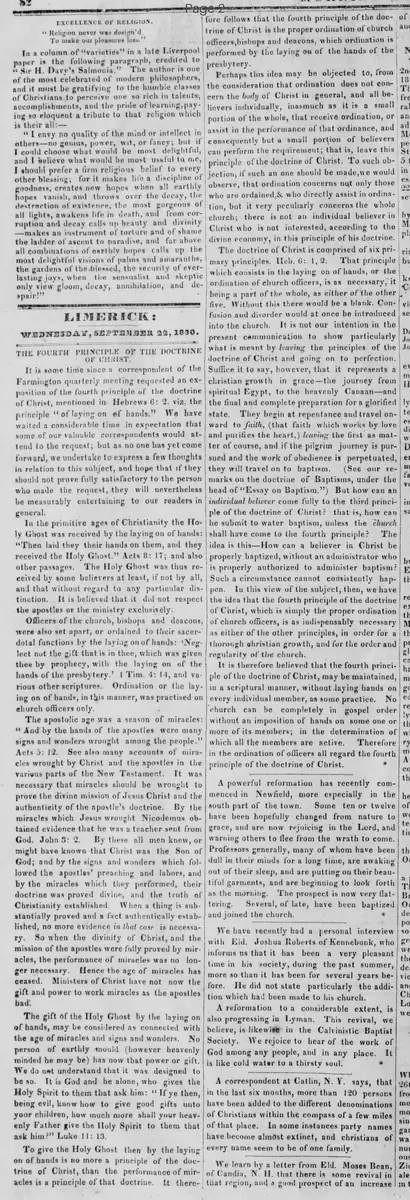
It is some time since a correspondent of the Farmington quarterly meeting requested an exposition of the fourth principle of the doctrine of Christ, mentioned in Hebrews 6:2, viz. the principle "of laying on of hands." We have waited a considerable time in expectation that some of our valuable correspondents would attend to the request; but as no one has yet come forward, we undertake to express a few thoughts in relation to this subject, and hope that if they should not prove fully satisfactory to the person who made the request, they will nevertheless be measurably entertaining to our readers in general.
In the primitive ages of Christianity the Holy Ghost was received by the laying on of hands: "Then laid they their hands on them, and they received the Holy Ghost." Acts 8:17; and also other passages. The Holy Ghost was thus received by some believers at least, if not by all, and that without regard to any particular distinction. It is believed that it did not respect the apostles or the ministry exclusively.
Officers of the church, bishops and deacons, were also set apart, or ordained to their sacerdotal functions by the laying on of hands: "Neglect not the gift that is in thee, which was given thee by prophecy, with the laying on of the hands of the presbytery." 1 Tim. 4:14, and various other scriptures. Ordination or the laying on of hands, in this manner, was practised on church officers only.
The apostolic age was a season of miracles: "And by the hands of the apostles were many signs and wonders wrought among the people." Acts 5:12. See also many accounts of miracles wrought by Christ and the apostles in the various parts of the New Testament. It was necessary that miracles should be wrought to prove the divine mission of Jesus Christ and the authenticity of the apostle's doctrine. By the miracles which Jesus wrought Nicodemus obtained evidence that he was a teacher sent from God. John 3:2. By these all men knew, or might have known that Christ was the Son of God; and by the signs and wonders which followed the apostles' preaching and labors, and by the miracles which they performed, their doctrine was proved divine, and the truth of Christianity established. When a thing is substantially proved and a fact authentically established, no more evidence in that case is necessary. So when the divinity of Christ, and the mission of the apostles were fully proved by miracles, the performance of miracles was no longer necessary. Hence the age of miracles has ceased. Ministers of Christ have not now the gift and power to work miracles as the apostles had.
The gift of the Holy Ghost by the laying on of hands, may be considered as connected with the age of miracles and signs and wonders. No person of earthly mould (however heavenly minded he may be) has now that power or gift. We do not understand that it was designed to be so. It is God and he alone, who gives the Holy Spirit to them that ask him: "If ye then, being evil, know how to give good gifts unto your children, how much more shall your heavenly Father give the Holy Spirit to them that ask him?" Luke 11:13.
To give the Holy Ghost then by the laying on of hands is no more a principle of the doctrine of Christ, than the performance of miracles is a principle of that doctrine. It therefore follows that the fourth principle of the doctrine of Christ is the proper ordination of church officers, bishops and deacons, which ordination is performed by the laying on of the hands of the presbytery.
Perhaps this idea may be objected to, from the consideration that ordination does not concern the body of Christ in general, and all believers individually, inasmuch as it is a small portion of the whole, that receive ordination, or assist in the performance of that ordinance, and consequently but a small portion of believers can perform the requirement; that is, leave this principle of the doctrine of Christ. To such objection, if such an one should be made, we would observe, that ordination concerns not only those who are ordained, & who directly assist in ordination, but it very peculiarly concerns the whole church; there is not an individual believer in Christ who is not interested, according to the divine economy, in this principle of his doctrine.
The doctrine of Christ is comprised of six primary principles. Heb. 6:1,2. That principle which consists in the laying on of hands, or the ordination of church officers, is as necessary, it being a part of the whole, as either of the other five. Without this there would be a blank. Confusion and disorder would at once be introduced into the church. It is not our intention in the present communication to show particularly what is meant by leaving the principles of the doctrine of Christ and going on to perfection. Suffice it to say, however, that it represents a christian growth in grace—the journey from spiritual Egypt, to the heavenly Canaan—and the final and complete preparation for a glorified state. They begin at repentance and travel onward to faith, (that faith which works by love and purifies the heart,) leaving the first as matter of course, and if the pilgrim journey is pursued and the work of obedience is perpetuated, they will travel on to baptism. (See our remarks on the doctrine of Baptisms, under the head of "Essay on Baptism.") But how can an individual believer come fully to the third principle of the doctrine of Christ? that is, how can he submit to water baptism, unless the church shall have come to the fourth principle? The idea is this—How can a believer in Christ be properly baptized, without an administrator who is properly authorized to administer baptism? Such a circumstance cannot consistently happen. In this view of the subject, then, we have the idea that the fourth principle of the doctrine of Christ, which is simply the proper ordination of church officers, is as indispensably necessary as either of the other principles, in order for a thorough christian growth, and for the order and regularity of the church.
It is therefore believed that the fourth principle of the doctrine of Christ, may be maintained, in a scriptural manner, without laying hands on every individual member, as some practice. No church can be completely in gospel order without an imposition of hands on some one or more of its members; in the determination of which all the members are active. Therefore in the ordination of officers all regard the fourth principle of the doctrine of Christ.
It is some time since a correspondent of the Farmington quarterly meeting requested an exposition of the fourth principle of the doctrine of Christ, mentioned in Hebrews 6:2, viz. the principle "of laying on of hands." We have waited a considerable time in expectation that some of our valuable correspondents would attend to the request; but as no one has yet come forward, we undertake to express a few thoughts in relation to this subject, and hope that if they should not prove fully satisfactory to the person who made the request, they will nevertheless be measurably entertaining to our readers in general.
In the primitive ages of Christianity the Holy Ghost was received by the laying on of hands: "Then laid they their hands on them, and they received the Holy Ghost." Acts 8:17; and also other passages. The Holy Ghost was thus received by some believers at least, if not by all, and that without regard to any particular distinction. It is believed that it did not respect the apostles or the ministry exclusively.
Officers of the church, bishops and deacons, were also set apart, or ordained to their sacerdotal functions by the laying on of hands: "Neglect not the gift that is in thee, which was given thee by prophecy, with the laying on of the hands of the presbytery." 1 Tim. 4:14, and various other scriptures. Ordination or the laying on of hands, in this manner, was practised on church officers only.
The apostolic age was a season of miracles: "And by the hands of the apostles were many signs and wonders wrought among the people." Acts 5:12. See also many accounts of miracles wrought by Christ and the apostles in the various parts of the New Testament. It was necessary that miracles should be wrought to prove the divine mission of Jesus Christ and the authenticity of the apostle's doctrine. By the miracles which Jesus wrought Nicodemus obtained evidence that he was a teacher sent from God. John 3:2. By these all men knew, or might have known that Christ was the Son of God; and by the signs and wonders which followed the apostles' preaching and labors, and by the miracles which they performed, their doctrine was proved divine, and the truth of Christianity established. When a thing is substantially proved and a fact authentically established, no more evidence in that case is necessary. So when the divinity of Christ, and the mission of the apostles were fully proved by miracles, the performance of miracles was no longer necessary. Hence the age of miracles has ceased. Ministers of Christ have not now the gift and power to work miracles as the apostles had.
The gift of the Holy Ghost by the laying on of hands, may be considered as connected with the age of miracles and signs and wonders. No person of earthly mould (however heavenly minded he may be) has now that power or gift. We do not understand that it was designed to be so. It is God and he alone, who gives the Holy Spirit to them that ask him: "If ye then, being evil, know how to give good gifts unto your children, how much more shall your heavenly Father give the Holy Spirit to them that ask him?" Luke 11:13.
To give the Holy Ghost then by the laying on of hands is no more a principle of the doctrine of Christ, than the performance of miracles is a principle of that doctrine. It therefore follows that the fourth principle of the doctrine of Christ is the proper ordination of church officers, bishops and deacons, which ordination is performed by the laying on of the hands of the presbytery.
Perhaps this idea may be objected to, from the consideration that ordination does not concern the body of Christ in general, and all believers individually, inasmuch as it is a small portion of the whole, that receive ordination, or assist in the performance of that ordinance, and consequently but a small portion of believers can perform the requirement; that is, leave this principle of the doctrine of Christ. To such objection, if such an one should be made, we would observe, that ordination concerns not only those who are ordained, & who directly assist in ordination, but it very peculiarly concerns the whole church; there is not an individual believer in Christ who is not interested, according to the divine economy, in this principle of his doctrine.
The doctrine of Christ is comprised of six primary principles. Heb. 6:1,2. That principle which consists in the laying on of hands, or the ordination of church officers, is as necessary, it being a part of the whole, as either of the other five. Without this there would be a blank. Confusion and disorder would at once be introduced into the church. It is not our intention in the present communication to show particularly what is meant by leaving the principles of the doctrine of Christ and going on to perfection. Suffice it to say, however, that it represents a christian growth in grace—the journey from spiritual Egypt, to the heavenly Canaan—and the final and complete preparation for a glorified state. They begin at repentance and travel onward to faith, (that faith which works by love and purifies the heart,) leaving the first as matter of course, and if the pilgrim journey is pursued and the work of obedience is perpetuated, they will travel on to baptism. (See our remarks on the doctrine of Baptisms, under the head of "Essay on Baptism.") But how can an individual believer come fully to the third principle of the doctrine of Christ? that is, how can he submit to water baptism, unless the church shall have come to the fourth principle? The idea is this—How can a believer in Christ be properly baptized, without an administrator who is properly authorized to administer baptism? Such a circumstance cannot consistently happen. In this view of the subject, then, we have the idea that the fourth principle of the doctrine of Christ, which is simply the proper ordination of church officers, is as indispensably necessary as either of the other principles, in order for a thorough christian growth, and for the order and regularity of the church.
It is therefore believed that the fourth principle of the doctrine of Christ, may be maintained, in a scriptural manner, without laying hands on every individual member, as some practice. No church can be completely in gospel order without an imposition of hands on some one or more of its members; in the determination of which all the members are active. Therefore in the ordination of officers all regard the fourth principle of the doctrine of Christ.
What sub-type of article is it?
Moral Or Religious
What keywords are associated?
Laying On Of Hands
Doctrine Of Christ
Ordination
Holy Ghost
Miracles
Church Officers
Apostolic Age
Baptism
What entities or persons were involved?
Apostles
Bishops
Deacons
Presbytery
Jesus Christ
Editorial Details
Primary Topic
Exposition Of The Fourth Principle Of The Doctrine Of Christ: Laying On Of Hands For Ordination
Stance / Tone
Theological Explanation Supporting Ordination As Essential Church Principle
Key Figures
Apostles
Bishops
Deacons
Presbytery
Jesus Christ
Key Arguments
Holy Ghost Received By Laying On Of Hands In Primitive Christianity But Not Exclusive To Ministry
Church Officers Ordained By Laying On Of Hands As In 1 Timothy 4:14
Age Of Miracles Ceased After Proving Christ's Divinity And Apostles' Doctrine
Laying On Of Hands For Holy Ghost Tied To Miracles, No Longer Practiced
Fourth Principle Is Ordination Of Officers, Essential For Church Order And Believer's Baptism
Ordination Concerns Entire Church Body, Not Just Officers