Thank you for visiting SNEWPapers!
Sign up free
Editorial
July 11, 1846
The New Era
Portsmouth, Virginia
What is this article about?
Editorial advocating for merit-based promotions from the ranks in the U.S. Army during Rio Grande battles, criticizing unequal rewards for privates versus officers and proposing reforms inspired by Napoleon.
Clipping
OCR Quality
98%
Excellent
Full Text
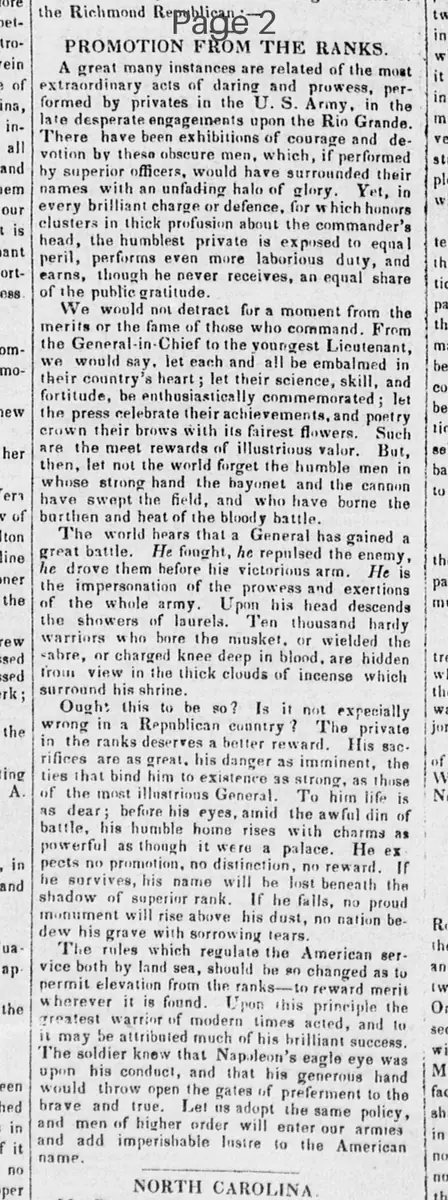
PROMOTION FROM THE RANKS.
A great many instances are related of the most extraordinary acts of daring and prowess, performed by privates in the U. S. Army, in the late desperate engagements upon the Rio Grande.
There have been exhibitions of courage and devotion by these obscure men, which, if performed by superior officers, would have surrounded their names with an unfading halo of glory. Yet, in every brilliant charge or defence, or which honors clusters in thick profusion about the commander's head, the humblest private is exposed to equal peril, performs even more laborious duty, and earns, though he never receives, an equal share of the public gratitude.
We would not detract for a moment from the merits or the fame of those who command. From the General-in-Chief to the youngest Lieutenant, we would say, let each and all be embalmed in their country's heart; let their science, skill, and fortitude, be enthusiastically commemorated; let the press celebrate their achievements, and poetry crown their brows with its fairest flowers. Such are the meet rewards of illustrious valor. But, then, let not the world forget the humble men in whose strong hand the bayonet and the cannon have swept the field, and who have borne the burthen and heat of the bloody battle.
The world hears that a General has gained a great battle. He fought, he repulsed the enemy, he drove them before his victorious arm. He is the impersonation of the prowess and exertions of the whole army. Upon his head descends the showers of laurels. Ten thousand hardy warriors who bore the musket, or wielded the sabre, or charged knee deep in blood, are hidden from view in the thick clouds of incense which surround his shrine.
Ought this to be so? Is it not especially wrong in a Republican country? The private in the ranks deserves a better reward. His sacrifices are as great, his danger as imminent, the ties that bind him to existence as strong, as those of the most illustrious General. To him life is as dear; before his eyes, amid the awful din of battle, his humble home rises with charms as powerful as though it were a palace. He expects no promotion, no distinction, no reward. If he survives, his name will be lost beneath the shadow of superior rank. If he falls, no proud monument will rise above his dust, no nation bedew his grave with sorrowing tears.
The rules which regulate the American service both by land sea, should be so changed as to permit elevation from the ranks—to reward merit wherever it is found. Upon this principle the greatest warrior of modern times acted, and to it may be attributed much of his brilliant success. The soldier know that Napoleon's eagle eye was upon his conduct, and that his generous hand would throw open the gates of preferment to the brave and true. Let us adopt the same policy, and men of higher order will enter our armies and add imperishable lustre to the American name.
A great many instances are related of the most extraordinary acts of daring and prowess, performed by privates in the U. S. Army, in the late desperate engagements upon the Rio Grande.
There have been exhibitions of courage and devotion by these obscure men, which, if performed by superior officers, would have surrounded their names with an unfading halo of glory. Yet, in every brilliant charge or defence, or which honors clusters in thick profusion about the commander's head, the humblest private is exposed to equal peril, performs even more laborious duty, and earns, though he never receives, an equal share of the public gratitude.
We would not detract for a moment from the merits or the fame of those who command. From the General-in-Chief to the youngest Lieutenant, we would say, let each and all be embalmed in their country's heart; let their science, skill, and fortitude, be enthusiastically commemorated; let the press celebrate their achievements, and poetry crown their brows with its fairest flowers. Such are the meet rewards of illustrious valor. But, then, let not the world forget the humble men in whose strong hand the bayonet and the cannon have swept the field, and who have borne the burthen and heat of the bloody battle.
The world hears that a General has gained a great battle. He fought, he repulsed the enemy, he drove them before his victorious arm. He is the impersonation of the prowess and exertions of the whole army. Upon his head descends the showers of laurels. Ten thousand hardy warriors who bore the musket, or wielded the sabre, or charged knee deep in blood, are hidden from view in the thick clouds of incense which surround his shrine.
Ought this to be so? Is it not especially wrong in a Republican country? The private in the ranks deserves a better reward. His sacrifices are as great, his danger as imminent, the ties that bind him to existence as strong, as those of the most illustrious General. To him life is as dear; before his eyes, amid the awful din of battle, his humble home rises with charms as powerful as though it were a palace. He expects no promotion, no distinction, no reward. If he survives, his name will be lost beneath the shadow of superior rank. If he falls, no proud monument will rise above his dust, no nation bedew his grave with sorrowing tears.
The rules which regulate the American service both by land sea, should be so changed as to permit elevation from the ranks—to reward merit wherever it is found. Upon this principle the greatest warrior of modern times acted, and to it may be attributed much of his brilliant success. The soldier know that Napoleon's eagle eye was upon his conduct, and that his generous hand would throw open the gates of preferment to the brave and true. Let us adopt the same policy, and men of higher order will enter our armies and add imperishable lustre to the American name.
What sub-type of article is it?
Military Affairs
What keywords are associated?
Army Promotion
Enlisted Soldiers
Merit Reward
Rio Grande Battles
Napoleon Policy
What entities or persons were involved?
U. S. Army
Privates
Generals
Napoleon
Editorial Details
Primary Topic
Promotion From The Ranks In The U.S. Army
Stance / Tone
Advocacy For Merit Based Rewards And Promotions For Enlisted Soldiers
Key Figures
U. S. Army
Privates
Generals
Napoleon
Key Arguments
Privates Perform Extraordinary Acts Of Daring In Battles On The Rio Grande Deserving Equal Recognition
Current System Unfairly Favors Officers With Glory While Obscuring Enlisted Men's Contributions
In A Republican Country, Privates Deserve Better Rewards For Equal Sacrifices And Dangers
Rules Of American Military Service Should Change To Allow Elevation From Ranks Based On Merit
Napoleon's Policy Of Promoting Brave Soldiers Led To Success And Should Be Adopted