Thank you for visiting SNEWPapers!
Sign up free
Editorial
March 23, 1849
Vermont Phœnix
Brattleboro, Bellows Falls, Ludlow, Windham County, Windsor County, Vermont
What is this article about?
Editorial exhorting women to scorn and shun 'rakes'—dissolute men who seduce and ruin innocent females—advocating moral courage to treat seducers with contempt to reform society and protect virtue.
Clipping
OCR Quality
88%
Good
Full Text
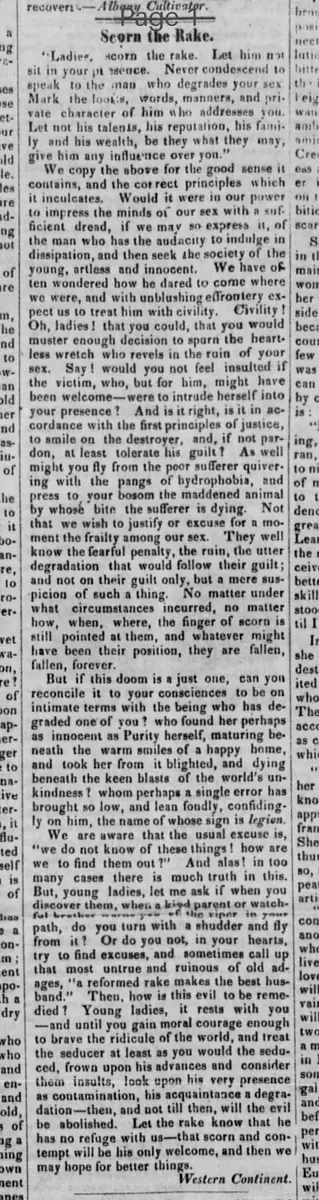
Scorn the Rake.
"Ladies, scorn the rake. Let him not sit in your presence. Never condescend to speak to the man who degrades your sex. Mark the looks, words, manners, and private character of him who addresses you. Let not his talents, his reputation, his family and his wealth, be they what they may, give him any influence over you."
We copy the above for the good sense it contains, and the correct principles which it inculcates. Would it were in our power to impress the minds of our sex with sufficient dread, if we may so express it, of the man who has the audacity to indulge in dissipation, and then seek the society of the young, artless and innocent. We have often wondered how he dared to come where we were, and with unblushing effrontery expect us to treat him with civility. Civility! Oh, ladies! that you could, that you would muster enough decision to spurn the heartless wretch who revels in the ruin of your sex. Say! would you not feel insulted if the victim, who, but for him, might have been welcome—were to intrude herself into your presence? And is it right, is it in accordance with the first principles of justice, to smile on the destroyer, and, if not pardon, at least tolerate his guilt? As well might you fly from the poor sufferer quivering with the pangs of hydrophobia, and press to your bosom the maddened animal by whose bite the sufferer is dying. Not that we wish to justify or excuse for a moment the frailty among our sex. They well know the fearful penalty, the ruin, the utter degradation that would follow their guilt; and not on their guilt only, but a mere suspicion of such a thing. No matter under what circumstances incurred, no matter how, when, where, the finger of scorn is still pointed at them, and whatever might have been their position, they are fallen, fallen forever.
But if this doom is a just one, can you reconcile it to your consciences to be on intimate terms with the being who has degraded one of you? who found her perhaps as innocent as Purity herself, maturing beneath the warm smiles of a happy home, and took her from it blighted, and dying beneath the keen blasts of the world's unkindness? whom perhaps a single error has brought so low, and leaning fondly, confidingly on him, the name of whose sign is legion. We are aware that the usual excuse is, "we do not know of these things! how are we to find them out?" And alas! in too many cases there is much truth in this. But, young ladies, let me ask if when you discover them, when a kind parent or watchful friend warns you of the viper in your path, do you turn with a shudder and fly from it? Or do you not, in your hearts, try to find excuses, and sometimes call up that most untrue and ruinous of old adages, "a reformed rake makes the best husband." Then, how is this evil to be remedied? Young ladies, it rests with you—and until you gain moral courage enough to brave the ridicule of the world, and treat the seducer at least as you would the seduced, frown upon his advances and consider them insults, look upon his very presence as contamination, his acquaintance a degradation—then, and not till then, will the evil be abolished. Let the rake know that he has no refuge with us—that scorn and contempt will be his only welcome, and then we may hope for better things.
"Ladies, scorn the rake. Let him not sit in your presence. Never condescend to speak to the man who degrades your sex. Mark the looks, words, manners, and private character of him who addresses you. Let not his talents, his reputation, his family and his wealth, be they what they may, give him any influence over you."
We copy the above for the good sense it contains, and the correct principles which it inculcates. Would it were in our power to impress the minds of our sex with sufficient dread, if we may so express it, of the man who has the audacity to indulge in dissipation, and then seek the society of the young, artless and innocent. We have often wondered how he dared to come where we were, and with unblushing effrontery expect us to treat him with civility. Civility! Oh, ladies! that you could, that you would muster enough decision to spurn the heartless wretch who revels in the ruin of your sex. Say! would you not feel insulted if the victim, who, but for him, might have been welcome—were to intrude herself into your presence? And is it right, is it in accordance with the first principles of justice, to smile on the destroyer, and, if not pardon, at least tolerate his guilt? As well might you fly from the poor sufferer quivering with the pangs of hydrophobia, and press to your bosom the maddened animal by whose bite the sufferer is dying. Not that we wish to justify or excuse for a moment the frailty among our sex. They well know the fearful penalty, the ruin, the utter degradation that would follow their guilt; and not on their guilt only, but a mere suspicion of such a thing. No matter under what circumstances incurred, no matter how, when, where, the finger of scorn is still pointed at them, and whatever might have been their position, they are fallen, fallen forever.
But if this doom is a just one, can you reconcile it to your consciences to be on intimate terms with the being who has degraded one of you? who found her perhaps as innocent as Purity herself, maturing beneath the warm smiles of a happy home, and took her from it blighted, and dying beneath the keen blasts of the world's unkindness? whom perhaps a single error has brought so low, and leaning fondly, confidingly on him, the name of whose sign is legion. We are aware that the usual excuse is, "we do not know of these things! how are we to find them out?" And alas! in too many cases there is much truth in this. But, young ladies, let me ask if when you discover them, when a kind parent or watchful friend warns you of the viper in your path, do you turn with a shudder and fly from it? Or do you not, in your hearts, try to find excuses, and sometimes call up that most untrue and ruinous of old adages, "a reformed rake makes the best husband." Then, how is this evil to be remedied? Young ladies, it rests with you—and until you gain moral courage enough to brave the ridicule of the world, and treat the seducer at least as you would the seduced, frown upon his advances and consider them insults, look upon his very presence as contamination, his acquaintance a degradation—then, and not till then, will the evil be abolished. Let the rake know that he has no refuge with us—that scorn and contempt will be his only welcome, and then we may hope for better things.
What sub-type of article is it?
Moral Or Religious
Social Reform
Feminism
What keywords are associated?
Rake
Seduction
Moral Reform
Women's Virtue
Social Scorn
Female Protection
Dissipation
Editorial Details
Primary Topic
Urging Women To Scorn Rakes And Seducers
Stance / Tone
Strongly Moralistic Exhortation
Key Arguments
Scorn The Rake And Refuse Him Civility Or Influence.
Treat Seducers With Contempt As You Would Their Victims.
Tolerating Rakes Is Unjust And Inconsistent With Punishing Fallen Women.
Women Must Gain Moral Courage To Reform Society By Shunning Dissolute Men.
Excuses Like 'Reformed Rake Makes The Best Husband' Are Ruinous.
Rakes' Presence Is Contamination; Their Advances Are Insults.