Thank you for visiting SNEWPapers!
Sign up free
Editorial
August 28, 1893
Evening Journal
Wilmington, New Castle County, Delaware
What is this article about?
An editorial defends the traditional idiom 'had rather' against a teacher's caution, tracing its origins to Chaucer and criticizing modern purism, citing the Century Dictionary's support. From the Hartford Courant.
Clipping
OCR Quality
98%
Excellent
Full Text
"Had Rather" and "Would Rather."
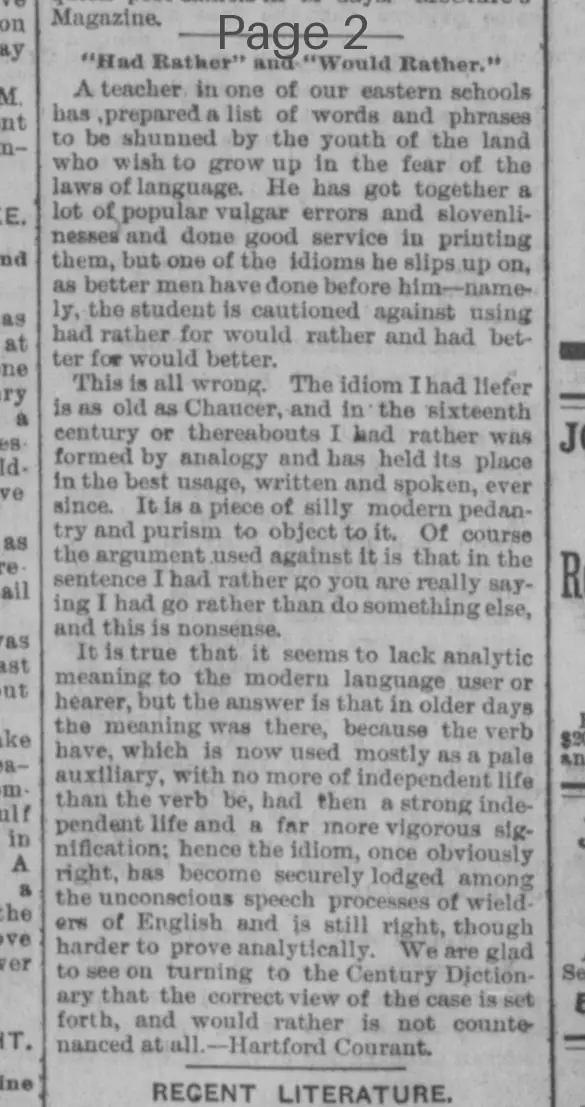
A teacher in one of our eastern schools has prepared a list of words and phrases to be shunned by the youth of the land who wish to grow up in the fear of the laws of language. He has got together a lot of popular vulgar errors and slovenlinesses and done good service in printing them, but one of the idioms he slips up on, as better men have done before him—namely, the student is cautioned against using had rather for would rather and had better for would better. This is all wrong. The idiom I had rather is as old as Chaucer, and in the sixteenth century or thereabouts I had rather was formed by analogy and has held its place in the best usage, written and spoken, ever since. It is a piece of silly modern pedantry and purism to object to it. Of course the argument used against it is that in the sentence I had rather go you are really saying I had go rather than do something else, and this is nonsense. It is true that it seems to lack analytic meaning to the modern language user or hearer, but the answer is that in older days the meaning was there, because the verb have, which is now used mostly as a pale auxiliary, with no more of independent life than the verb be, had then a strong independent life and a far more vigorous signification; hence the idiom, once obviously right, has become securely lodged among the unconscious speech processes of wielders of English and is still right, though harder to prove analytically. We are glad to see on turning to the Century Dictionary that the correct view of the case is set forth, and would rather is not countenanced at all.—Hartford Courant.
A teacher in one of our eastern schools has prepared a list of words and phrases to be shunned by the youth of the land who wish to grow up in the fear of the laws of language. He has got together a lot of popular vulgar errors and slovenlinesses and done good service in printing them, but one of the idioms he slips up on, as better men have done before him—namely, the student is cautioned against using had rather for would rather and had better for would better. This is all wrong. The idiom I had rather is as old as Chaucer, and in the sixteenth century or thereabouts I had rather was formed by analogy and has held its place in the best usage, written and spoken, ever since. It is a piece of silly modern pedantry and purism to object to it. Of course the argument used against it is that in the sentence I had rather go you are really saying I had go rather than do something else, and this is nonsense. It is true that it seems to lack analytic meaning to the modern language user or hearer, but the answer is that in older days the meaning was there, because the verb have, which is now used mostly as a pale auxiliary, with no more of independent life than the verb be, had then a strong independent life and a far more vigorous signification; hence the idiom, once obviously right, has become securely lodged among the unconscious speech processes of wielders of English and is still right, though harder to prove analytically. We are glad to see on turning to the Century Dictionary that the correct view of the case is set forth, and would rather is not countenanced at all.—Hartford Courant.
What sub-type of article is it?
Education
What keywords are associated?
Had Rather
Would Rather
Language Idiom
Grammar Pedantry
English Usage
Historical Linguistics
What entities or persons were involved?
Chaucer
Hartford Courant
Century Dictionary
Editorial Details
Primary Topic
Defense Of The Idiom 'Had Rather' Against Modern Pedantry
Stance / Tone
Supportive Of Traditional English Usage, Critical Of Purism
Key Figures
Chaucer
Hartford Courant
Century Dictionary
Key Arguments
The Idiom 'Had Rather' Dates To Chaucer And Has Been In Best Usage Since The Sixteenth Century
Objections To 'Had Rather' Are Silly Modern Pedantry
The Phrase Formed By Analogy And Retains Validity Despite Analytic Challenges
In Older English, 'Have' Had Stronger Independent Meaning, Justifying The Idiom
The Century Dictionary Supports 'Had Rather' And Rejects 'Would Rather'