Thank you for visiting SNEWPapers!
Sign up free
Editorial
March 5, 1847
The Liberator
Boston, Suffolk County, Massachusetts
What is this article about?
Editorial in the Liberator argues that abstaining from slave-produced goods like cotton, sugar, and rice should not be a moral test for abolitionists, as it's impractical and diverts from vital anti-slavery efforts. Respects individual consciences but criticizes hypocrisy among some Quakers while praising sincere abstainers.
Clipping
OCR Quality
98%
Excellent
Full Text
PRODUCTS OF SLAVE LABOR.
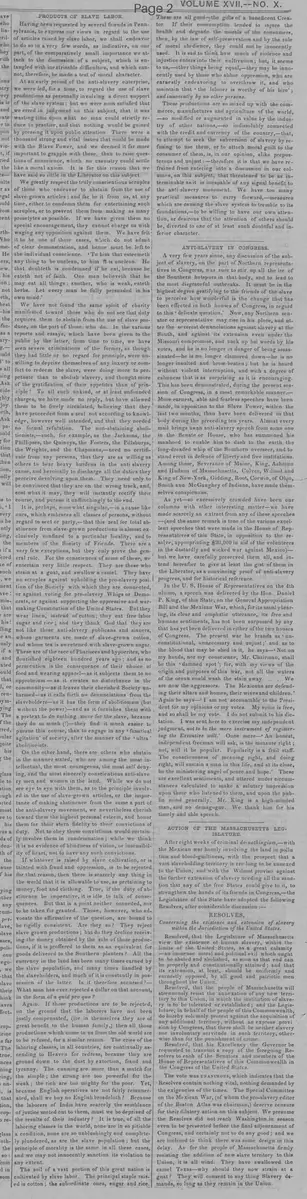
Having been requested by several friends in Pennsylvania, to express our views in regard to the use of articles raised by slave labor, we shall endeavor to do so in a very few words, as indicative, on our part, of the comparatively small importance we attach to the discussion of a subject, which is entangled with inextricable difficulties, and which cannot, therefore, be made a test of moral character.
At an early period of the anti-slavery enterprise, we were led, for a time, to regard the use of slave productions as personally involving a direct support of the slave system; but we were soon satisfied that we erred in judgment on this subject, that it was wasting time upon what no man could strictly reduce to practice, and that nothing would be gained by pressing it upon public attention. There were a thousand strong and vital issues that could be made with the Slave Power, and we deemed it far more important to grapple with these, than to raise questions of conscience, which no casuistry could settle like a moral axiom. It is for this reason that we have said so little in the Liberator on this subject.
We greatly respect the truly conscientious scruples of those who endeavor to abstain from the use of slave-grown articles; and far be it from us, at any time, either to condemn them for entertaining such scruples, or to prevent them from making as many proselytes as possible. If we have given them no special encouragement, they cannot charge us with waging any opposition against them. We have felt it to be one of those cases, which do not admit of clear demonstration, and hence must be left to the individual conscience. To him that esteemeth anything to be unclean, to him it is unclean. He that doubteth is condemned if he eat, because he eateth not of faith. One man believeth that he may eat all things: another, who is weak, eateth herbs. Let every man be fully persuaded in his own mind.
We have not found the same spirit of charity manifested toward those who do not see that duty requires them to abstain from the use of slave produce, on the part of those who do. In the various reports and essays, which have been given to the public by the latter, from time to time, we have seen severe criminations of the former, as though they had little or no regard for principle, were unwilling to deprive themselves of any luxury or comfort to redeem the slave, were doing more to perpetuate than to abolish slavery, and thought more of the gratification of their appetites than of principle! To all such unkind, or at least unfounded charges, we have made no reply, but have allowed them to be freely circulated, believing that they have proceeded from a zeal not according to knowledge, however well intended, and that they needed no formal refutation. The non-abstaining abolitionists,—such, for example, as the Jacksons, the Phillipses, the Quincys, the Fosters, the Pillsburys, the Wrights, and the Chapmans,—need no certificate from any persons, that they are as willing as others to bear heavy burdens in the anti-slavery cause, and heroically to discharge all the duties they perceive devolving upon them. They need only to be convinced that they are on the wrong track, and, cost what it may, they will instantly rectify their course, and pursue it unflinchingly to the end.
It is, perhaps, somewhat singular,—in a cause like ours, which embraces all classes of persons, without regard to sect or party,—that this zeal for total abstinence from slave-grown productions is almost exclusively confined to a particular locality, and to members of the Society of Friends. There are a very few exceptions, but they only prove the general rule. For the consciences of some of these, we entertain very little respect. They are those who strain at a gnat, and swallow a camel. They have no scruples against upholding the pro-slavery position of the Society with which they are connected, or against voting for pro-slavery Whigs or Democrats, or against supporting the oppressive and war-making Constitution of the United States. But they wear linen, instead of cotton; they eat free labor sugar and rice; and they thank God that they are not like those anti-slavery publicans and sinners, whose garments are made of slave-grown cotton, and whose tea is sweetened with slave-grown sugar. These are of the race of Pharisees and hypocrites, who flourished eighteen hundred years ago; and as no persecution is the consequence of their choice of food and wearing apparel—as it subjects them to no opprobrium—as it creates no disturbance in the community—as it leaves their cherished Society unharmed—as it calls forth no denunciations from the slaveholders—as it has the form of abolitionism (but without the power)—and as it furnishes them with a pretext to do nothing more for the slave, because they do so much (!)—they find it much easier to pursue this course, than to engage in any 'fanatical agitation' of society, after the manner of the 'ultra abolitionists.
On the other hand, there are others who abstain in the manner stated, who are among the most intellectual, the most courageous, the most self-denying, and the most sincerely conscientious anti-slavery men and women in the land. While we do not see eye to eye with them, as to the principle involved in the use of slave-grown articles, or the importance of making abstinence from the same a part of the anti-slavery movement, we nevertheless cherish toward them the highest personal esteem, and honor them for their stern fidelity to their convictions of duty. Not to obey those convictions would certainly involve them in condemnation; while we think it is no evidence of blindness of vision, or insensibility of heart, not to have any such convictions.
If whatever is raised by slave cultivation, or is tainted with fraud and oppression, is to be rejected for that reason, then there is scarcely anything in the world that it is allowable to use, as pertaining to money, food and clothing. True, if the duty of abstinence be imperative, it is idle to talk of consequences. But that is a point neither conceded, nor to be taken for granted. Those, however, who advocate the affirmative of the question, are bound to be rigidly consistent. Are they so? They reject slave grown productions; but do they decline receiving the money obtained by the sale of those productions, if it is proffered to them as an equivalent for goods delivered to the Southern planters? All the currency in the land has been many times earned by the slave population, and many times handled by the slaveholders, and much of it is constantly in possession of the latter. Is it therefore accursed?—What man has ever rejected a dollar on that account, in the form of a quid pro quo?
Again. If those productions are to be rejected, on the ground that the laborers have not been justly compensated, (for in themselves they are of great benefit to the human family,) then all those productions which come to us from the old world are to be refused, for a similar reason. The cries of the laboring classes, in all countries, are continually ascending to Heaven for redress, because they are ground down to the dust by extortion, fraud and tyranny. The cunning are more than a match for the simple; the strong are too powerful for the weak; the rich are too mighty for the poor. Yet, because English operatives are not fairly remunerated, shall we buy no English broadcloth? Because the laborers of India have scarcely the semblance of justice meted out to them, must we be deprived of the results of their industry? It is true, of all the laboring classes in the world, none are in so pitiable a condition, none are so unblushingly and completely plundered, as are the slave population; but the principle of morality is the same in all these cases, and we may not innocently sanction its violation to any extent.
The soil of a vast portion of this great nation is cultivated by slave labor. The principal staple raised is cotton; the subordinate ones, sugar and rice. These are all good—the gifts of a beneficent Creator. If their consumption tended to injure the health and degrade the morals of the consumers, then, by the law of self-preservation and by the rule of moral obedience, they could not be innocently used. It is sad to think how much of violence and injustice enters into their cultivation; but, it seems to us,—other things being equal,—they may be innocently used by those who abhor oppression, who are earnestly endeavoring to overthrow it, and who maintain that 'the laborer is worthy of his hire'; and innocently by no other persons.
These productions are so mixed up with the commerce, manufactures and agriculture of the world,—so modified or augmented in value by the industry of other nations,—so indissolubly connected with the credit and currency of the country,—that, to attempt to seek the subversion of slavery by refusing to use them, or to attach moral guilt to the consumer of them, is, in our opinion, alike preposterous and unjust:—therefore it is that we have refrained from entering into a discussion in our columns, on this subject, that threatened to be as interminable as it is incapable of any signal benefit to the anti-slavery movement. We have too many practical measures to carry forward,—measures which are causing the slave system to tremble to its foundations,—to be willing to have our own attention, or desirous that the attention of others should be, diverted to one of at least such doubtful and inferior character.
Having been requested by several friends in Pennsylvania, to express our views in regard to the use of articles raised by slave labor, we shall endeavor to do so in a very few words, as indicative, on our part, of the comparatively small importance we attach to the discussion of a subject, which is entangled with inextricable difficulties, and which cannot, therefore, be made a test of moral character.
At an early period of the anti-slavery enterprise, we were led, for a time, to regard the use of slave productions as personally involving a direct support of the slave system; but we were soon satisfied that we erred in judgment on this subject, that it was wasting time upon what no man could strictly reduce to practice, and that nothing would be gained by pressing it upon public attention. There were a thousand strong and vital issues that could be made with the Slave Power, and we deemed it far more important to grapple with these, than to raise questions of conscience, which no casuistry could settle like a moral axiom. It is for this reason that we have said so little in the Liberator on this subject.
We greatly respect the truly conscientious scruples of those who endeavor to abstain from the use of slave-grown articles; and far be it from us, at any time, either to condemn them for entertaining such scruples, or to prevent them from making as many proselytes as possible. If we have given them no special encouragement, they cannot charge us with waging any opposition against them. We have felt it to be one of those cases, which do not admit of clear demonstration, and hence must be left to the individual conscience. To him that esteemeth anything to be unclean, to him it is unclean. He that doubteth is condemned if he eat, because he eateth not of faith. One man believeth that he may eat all things: another, who is weak, eateth herbs. Let every man be fully persuaded in his own mind.
We have not found the same spirit of charity manifested toward those who do not see that duty requires them to abstain from the use of slave produce, on the part of those who do. In the various reports and essays, which have been given to the public by the latter, from time to time, we have seen severe criminations of the former, as though they had little or no regard for principle, were unwilling to deprive themselves of any luxury or comfort to redeem the slave, were doing more to perpetuate than to abolish slavery, and thought more of the gratification of their appetites than of principle! To all such unkind, or at least unfounded charges, we have made no reply, but have allowed them to be freely circulated, believing that they have proceeded from a zeal not according to knowledge, however well intended, and that they needed no formal refutation. The non-abstaining abolitionists,—such, for example, as the Jacksons, the Phillipses, the Quincys, the Fosters, the Pillsburys, the Wrights, and the Chapmans,—need no certificate from any persons, that they are as willing as others to bear heavy burdens in the anti-slavery cause, and heroically to discharge all the duties they perceive devolving upon them. They need only to be convinced that they are on the wrong track, and, cost what it may, they will instantly rectify their course, and pursue it unflinchingly to the end.
It is, perhaps, somewhat singular,—in a cause like ours, which embraces all classes of persons, without regard to sect or party,—that this zeal for total abstinence from slave-grown productions is almost exclusively confined to a particular locality, and to members of the Society of Friends. There are a very few exceptions, but they only prove the general rule. For the consciences of some of these, we entertain very little respect. They are those who strain at a gnat, and swallow a camel. They have no scruples against upholding the pro-slavery position of the Society with which they are connected, or against voting for pro-slavery Whigs or Democrats, or against supporting the oppressive and war-making Constitution of the United States. But they wear linen, instead of cotton; they eat free labor sugar and rice; and they thank God that they are not like those anti-slavery publicans and sinners, whose garments are made of slave-grown cotton, and whose tea is sweetened with slave-grown sugar. These are of the race of Pharisees and hypocrites, who flourished eighteen hundred years ago; and as no persecution is the consequence of their choice of food and wearing apparel—as it subjects them to no opprobrium—as it creates no disturbance in the community—as it leaves their cherished Society unharmed—as it calls forth no denunciations from the slaveholders—as it has the form of abolitionism (but without the power)—and as it furnishes them with a pretext to do nothing more for the slave, because they do so much (!)—they find it much easier to pursue this course, than to engage in any 'fanatical agitation' of society, after the manner of the 'ultra abolitionists.
On the other hand, there are others who abstain in the manner stated, who are among the most intellectual, the most courageous, the most self-denying, and the most sincerely conscientious anti-slavery men and women in the land. While we do not see eye to eye with them, as to the principle involved in the use of slave-grown articles, or the importance of making abstinence from the same a part of the anti-slavery movement, we nevertheless cherish toward them the highest personal esteem, and honor them for their stern fidelity to their convictions of duty. Not to obey those convictions would certainly involve them in condemnation; while we think it is no evidence of blindness of vision, or insensibility of heart, not to have any such convictions.
If whatever is raised by slave cultivation, or is tainted with fraud and oppression, is to be rejected for that reason, then there is scarcely anything in the world that it is allowable to use, as pertaining to money, food and clothing. True, if the duty of abstinence be imperative, it is idle to talk of consequences. But that is a point neither conceded, nor to be taken for granted. Those, however, who advocate the affirmative of the question, are bound to be rigidly consistent. Are they so? They reject slave grown productions; but do they decline receiving the money obtained by the sale of those productions, if it is proffered to them as an equivalent for goods delivered to the Southern planters? All the currency in the land has been many times earned by the slave population, and many times handled by the slaveholders, and much of it is constantly in possession of the latter. Is it therefore accursed?—What man has ever rejected a dollar on that account, in the form of a quid pro quo?
Again. If those productions are to be rejected, on the ground that the laborers have not been justly compensated, (for in themselves they are of great benefit to the human family,) then all those productions which come to us from the old world are to be refused, for a similar reason. The cries of the laboring classes, in all countries, are continually ascending to Heaven for redress, because they are ground down to the dust by extortion, fraud and tyranny. The cunning are more than a match for the simple; the strong are too powerful for the weak; the rich are too mighty for the poor. Yet, because English operatives are not fairly remunerated, shall we buy no English broadcloth? Because the laborers of India have scarcely the semblance of justice meted out to them, must we be deprived of the results of their industry? It is true, of all the laboring classes in the world, none are in so pitiable a condition, none are so unblushingly and completely plundered, as are the slave population; but the principle of morality is the same in all these cases, and we may not innocently sanction its violation to any extent.
The soil of a vast portion of this great nation is cultivated by slave labor. The principal staple raised is cotton; the subordinate ones, sugar and rice. These are all good—the gifts of a beneficent Creator. If their consumption tended to injure the health and degrade the morals of the consumers, then, by the law of self-preservation and by the rule of moral obedience, they could not be innocently used. It is sad to think how much of violence and injustice enters into their cultivation; but, it seems to us,—other things being equal,—they may be innocently used by those who abhor oppression, who are earnestly endeavoring to overthrow it, and who maintain that 'the laborer is worthy of his hire'; and innocently by no other persons.
These productions are so mixed up with the commerce, manufactures and agriculture of the world,—so modified or augmented in value by the industry of other nations,—so indissolubly connected with the credit and currency of the country,—that, to attempt to seek the subversion of slavery by refusing to use them, or to attach moral guilt to the consumer of them, is, in our opinion, alike preposterous and unjust:—therefore it is that we have refrained from entering into a discussion in our columns, on this subject, that threatened to be as interminable as it is incapable of any signal benefit to the anti-slavery movement. We have too many practical measures to carry forward,—measures which are causing the slave system to tremble to its foundations,—to be willing to have our own attention, or desirous that the attention of others should be, diverted to one of at least such doubtful and inferior character.
What sub-type of article is it?
Slavery Abolition
Moral Or Religious
What keywords are associated?
Slave Labor Products
Abstinence Debate
Anti Slavery Conscience
Moral Scruples
Abolitionist Hypocrisy
Individual Convictions
Practical Anti Slavery
What entities or persons were involved?
Society Of Friends
Jacksons
Phillipses
Quincys
Fosters
Pillsburys
Wrights
Chapmans
Slave Power
Editorial Details
Primary Topic
Abstinence From Products Of Slave Labor
Stance / Tone
Tolerant Of Differing Consciences, Prioritizes Direct Anti Slavery Action Over Abstinence
Key Figures
Society Of Friends
Jacksons
Phillipses
Quincys
Fosters
Pillsburys
Wrights
Chapmans
Slave Power
Key Arguments
Use Of Slave Products Not Direct Support Of Slavery; Focus On Vital Issues Instead
Respect Individual Consciences On Abstinence
Criticize Hypocrisy In Some Abstainers Who Ignore Larger Pro Slavery Stances
Praise Sincere Abstainers For Fidelity To Convictions
Abstinence Impractical As All Goods Tainted By Injustice Globally
Slave Products Like Cotton Beneficial And Usable By Anti Slavery Opponents
Debate Diverts From Practical Measures Shaking Slavery's Foundations