Thank you for visiting SNEWPapers!
Sign up free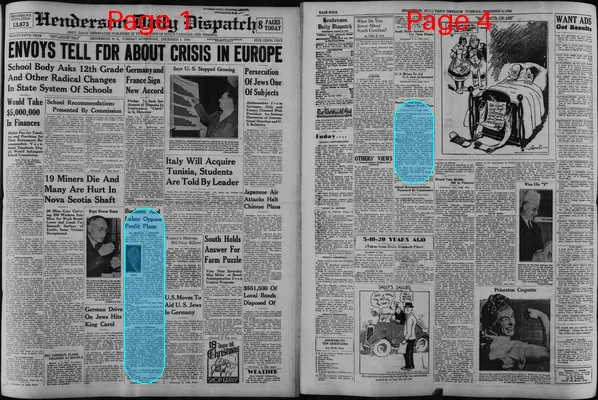
Henderson Daily Dispatch
Henderson, Vance County, North Carolina
What is this article about?
Editorial by Charles P. Stewart critiques a proposal for tax concessions to encourage employer-employee profit sharing. AFL President William Green supports profit sharing in principle but opposes the tax method, fearing wage cuts and profit manipulation. NAM's H. Boardman Spalding agrees, warning of punitive taxation risks, citing Henry T. Rainey's views on taxation's power.
Merged-components note: Business and labor profit sharing editorial continued from page 1 to page 4.
Clippings
1 of 2
OCR Quality
Full Text
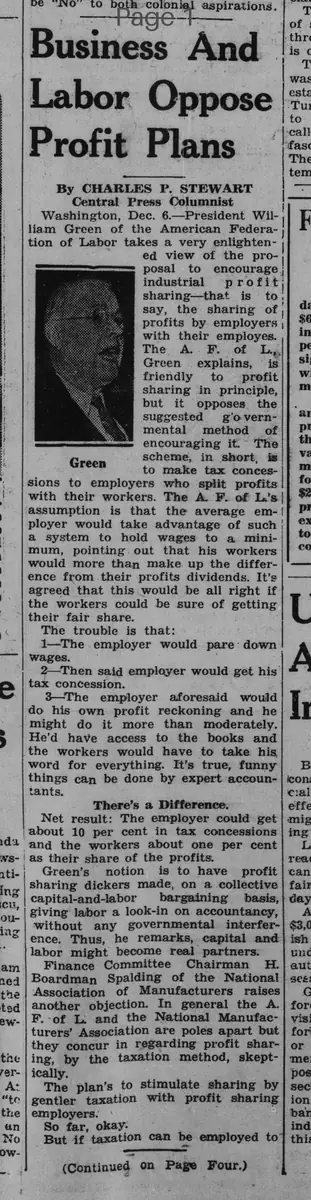
Labor Oppose
Profit Plans
By CHARLES P. STEWART
Central Press Columnist
Washington, Dec. 6.-President William Green of the American Federation of Labor takes a very enlightened view of the proposal to encourage industrial profit sharing-that is to say, the sharing of profits by employers with their employees.
The A. F. of L., Green explains, is friendly to profit sharing in principle, but it opposes the suggested governmental method of encouraging it. The scheme, in short, is Green to make tax concessions to employers who split profits with their workers. The A. F. of L.'s assumption is that the average employer would take advantage of such a system to hold wages to a minimum, pointing out that his workers would more than make up the difference from their profits dividends. It's agreed that this would be all right if the workers could be sure of getting their fair share.
The trouble is that:
1-The employer would pare down wages.
2 Then said employer would get his tax concession.
3 The employer aforesaid would do his own profit reckoning and he might do it more than moderately. He'd have access to the books and the workers would have to take his word for everything. It's true, funny things can be done by expert accountants.
There's a Difference.
Net result: The employer could get about 10 per cent in tax concessions and the workers about one per cent as their share of the profits.
Green's notion is to have profit sharing dickers made on a collective capital-and-labor bargaining basis, giving labor a look-in on accountancy, without any governmental interference. Thus, he remarks, capital and labor might become real partners.
Finance Committee Chairman H. Boardman Spalding of the National Association of Manufacturers raises another objection. In general the A. F. of L. and the National Manufacturers' Association are poles apart but they concur in regarding profit sharing, by the taxation method, skeptically.
The plan's to stimulate sharing by gentler taxation with profit sharing employers.
So far, okay.
But if taxation can be employed to encourage, it logically also can be employed to punish.
The late Henry T. Rainey of Illinois, speaker of the House of Representatives a few years ago, was perhaps the foremost taxation authority we ever had. "You can," he often told me, "legislate anything by taxation, without shooting at it directly."
Medical Taxation.
One day Rainey went on to tell me: "In my day on the House Ways and Means Committee, the question of phosphorous matches came up.
"The workers in phosphorous match factories assimilated the phosphorous into their systems. It resulted in a disease called 'phossy jaw.' The bone rotted. It was terrible. The match-makers said they couldn't help it no 'phossy jaw,' no matches. Well, we slapped an almost prohibitive tax on to phosphorous matches. The makers blamed soon invented a new kind of matches that didn't cause phossy jaw.".
Now, there was a case were punitive taxation was beneficial.
But, broadly speaking, its benefits are doubtful.
Former Speaker Rainey didn't contend that all taxation is good. He only argued that you can do anything with it.
What sub-type of article is it?
What keywords are associated?
What entities or persons were involved?
Editorial Details
Primary Topic
Opposition To Tax Incentivized Profit Sharing
Stance / Tone
Skeptical Of Governmental Tax Method For Profit Sharing
Key Figures
Key Arguments