Thank you for visiting SNEWPapers!
Sign up free
The Daily Union
Washington, District Of Columbia
What is this article about?
The Boston Post praises Hon. David S. Kaufman's speech defending Texas's claim to territory between the Nueces and Rio Grande rivers, arguing Mexico initiated the war by invading Texas land. It cites treaties from 1835-1836, Mexican admissions, and geographers to support Texas's boundary at the Rio Grande, criticizing Whigs for inconsistency on the Mexican War and Gen. Taylor's role.
Clipping
OCR Quality
Full Text
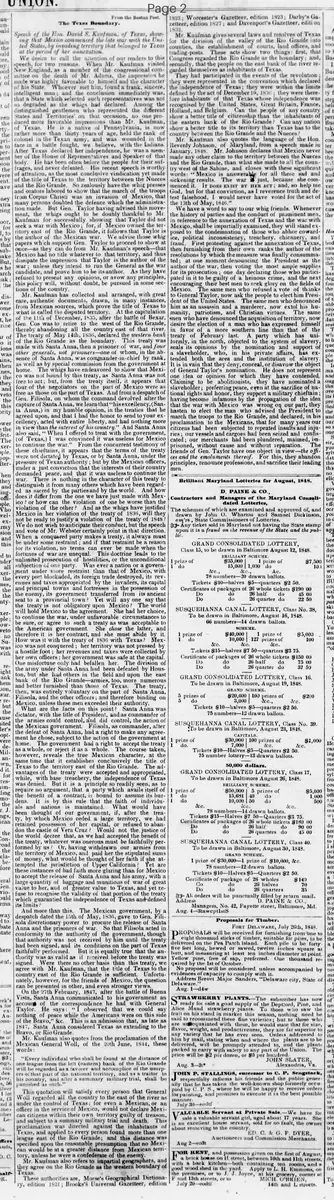
The Texas Boundary.
Speech of the Hon. David S. Kaufman, of Texas, showing that Mexico commenced the late war with the United States, by invading territory that belonged to Texas at the period of her annexation.
We desire to call the attention of our readers to this speech, for two reasons. When Mr. Kaufman visited New England, as a member of the congressional committee on the death of Mr. Adams, the impression he made was highly favorable to himself and the character of his State. Whoever met him, found a frank, sincere intelligent man; and the conclusion immediately was, that a State which selected such representatives was not so degraded as the whigs had declared. Among the distinguished gentlemen who represented the different States and Territories on that occasion, no one produced more favorable impressions than Mr. Kaufman, of Texas. He is a native of Pennsylvania, is now rather more than thirty years of age, held the rank of colonel in the Texan army, and was wounded in the face in a battle fought, we believe, with the Indians. After Texas declared her independence, he was a member of the House of Representatives and Speaker of that body. He has been often before the people for their suffrages, and never defeated. His recent speech is worthy of attention, as the most conclusive vindication yet made of the title of Texas to the territory between the Nueces and the Rio Grande. So zealously have the whig presses and orators labored to show that the march of the troops from Corpus Christi was an invasion of Mexico, that many persons doubted the defence which the administration made. But Gen. Taylor having advised this movement, the whigs ought to be doubly thankful to Mr. Kaufman for successfully showing that Taylor did not seek a war with Mexico; for, if Mexico owned the territory east of the Rio Grande, it follows that Taylor is the author of the Mexican war. We advise those whig papers which support Gen. Taylor to proceed to show as soon as they can do from Mr. Kaufman's speech-that Mexico had no title whatever to that territory, and thus dissipate the impression that Taylor is the author of the war; unless they intend to run the General as the war candidate, and prove him to be its author. As they have refused to present any opinions, or avow any principles, this policy will, without doubt, be pursued in some sections of the country.
Mr. Kaufman has collected and arranged, with great care, authentic documents, drawn, in many instances, from Mexican sources, which prove the title of Texas to what is called the disputed territory. At the capitulation of the 11th of December, 1835, after the battle of Bexar Gen. Cos was to retire to the west of the Rio Grande, thereby abandoning all the country east of that river. The treaty of May 14th, 1836, declared the western bank of the Rio Grande as the boundary. This treaty was made with Santa Anna, then a prisoner of war, and four other generals, not prisoners-one of whom, in the absence of Santa Anna, was commander-in-chief by rank, as well as by special commission from the government at home. The whigs have endeavored to show that Mexico was not bound by this treaty, as Santa Anna was not free to act; but, from the treaty itself, it appears that four of the negotiators on the part of Mexico were as free as those on the part of Texas. And from a despatch of Gen. Filisola, on whom the command devolved after the capture of Santa Anna, we learn that "his excellency. (Santa Anna,) in my humble opinion, in the treaties that he agreed upon, and that I had the honor to send to your excellency, acted with entire liberty, and had nothing more in view than the interest of his country." And Santa Anna also said, "When I offered to treat with the government, (of Texas,) I was convinced it was useless for Mexico to continue the war." From the concurrent testimony of these chieftains, it appears that the terms of the treaty were not dictated by Texas, or by Santa Anna, under the pressure of Texan authority; but by the Mexican officers, under a just conviction that the interests of their country demanded peace, and that it was useless to continue the war. There is nothing in the character of this treaty to distinguish it from many others which have been regarded as sacred by the parties and by the world. And how does it differ from the one we have just made with Mexico? or how can the violation of one be worse than the violation of the other? And as the whigs have justified Mexico in her violation of the treaty of 1836, will they not be ready to justify a violation of the treaty of 1848? We do not wish to anticipate their conduct, but the speech and vote of Mr. Webster certainly point in that direction.
When a conquered party makes a treaty, it always must be under some restraint; and if that restraint be a reason for its violation, no terms can ever be made when the fortunes of war are unequal. This doctrine leads to the unlimited prosecution of hostilities, or the unconditional subjection of one party. Was ever a nation or a government under more restraint than that of Mexico, with every port blockaded, its foreign trade destroyed, its revenues and taxes appropriated by the invaders, its capital and principal towns and fortresses in the possession of the enemy, its government transferred from its ancient seat to a provincial town? Yet will any one say that the treaty is not obligatory upon Mexico? The world will hold Mexico to the agreement. She had her choice, to continue the war, under unfavorable circumstances to be sure, or agree to such a treaty as was acceptable to the American government. She chose the latter, and therefore it is her contract, and she must abide by it.
How was it with the treaty of 1836 with Texas? Mexico was not conquered; her territory was not pressed by a hostile foot; her revenues and taxes were collected by her own officers; her government was safe at the capital. One misfortune only had befallen her. The division of the army under Santa Anna had been defeated by Houston, but she had others in the field and upon the east bank of the Rio Grande-armies, too, more numerous and better furnished than those of Texas. The treaty, then, was entirely voluntary on the part of Santa Anna, Filisola, and the other officers; and therefore binding on Mexico, unless these men exceeded their authority.
What are the facts on this point? Santa Anna was dictator, with the title of President, and as commander of the armies could control, and did control, the action of the Mexican government. Filisola, as commander, after the defeat of Santa Anna, had a right to make any agreement he chose, subject to the action of the government at home. The government had a right to accept the treaty as a whole, or reject it as a whole. The course taken, however, reveals the true Mexican character, at the same time that it establishes conclusively the title of Texas to the territory east of the Rio Grande. The advantages of the treaty were accepted and appropriated, while, with base treachery, the independence of Texas was denied. But it is a principle so readily seen, as to require no argument, that a party which avails itself of the benefit of a contract, is bound to assume its burdens. It is by this rule that the faith of individuals and nations is maintained. What would have been thought of our government, if, after the treaty, by which Mexico ceded a large territory, we had retained possession of her capital, or refused to abandon the castle of Vera Cruz? Would not the justice of the world decree that, as we had accepted the benefit of the treaty, whatever was onerous must be faithfully performed by us? Or, having withdrawn our armies from the territory of Mexico, and paid her the stipulated sums of money, what would be thought of her faith if she attempted the jurisdiction of Upper California? Yet are these instances of bad faith more glaring than for Mexico to accept the release of Santa Anna and his army, with a large quantity of baggage and munitions of war of great value to her, and of greater value to Texas, and yet refuse to recognise the validity of that portion of the treaty which guaranteed the independence of Texas and defined its limits?
And more than this. The Mexican government, by a despatch dated the 15th of May, 1836, gave to Gen. Filisola discretionary power to procure the release of Santa Anna and the prisoners of war. So that Filisola acted in conformity to the authority of the government, though that authority was not received by him until the treaty had been signed, and its conditions on the part of Texas faithfully performed. But it is equally true that the authority was as valid as if received before the treaty was signed. Were there no other basis than this treaty, we agree with Mr. Kaufman, that the title of Texas to the country east of the Rio Grande is sufficient. Unfortunately, however, for the friends of Mexico, the question can be presented in other, and even stronger views.
On the 27th February, 1847, after the battle of Buena Vista, Santa Anna communicated to his government an account of the correspondence he had with General Taylor. He says: "I observed that we could say nothing of peace while the Americans were on this side of the Bravo," &c. This is an admission that, as late as 1847, Santa Anna considered Texas as extending to the Bravo, or Rio Grande
Mr. Kaufman also quotes from the proclamation of the Mexican General Woll, of the 20th June, 1842, these words:
"Every individual who shall be found at the distance of one league from the left (eastern) bank of the Rio Grande will be regarded as a favorer and accomplice of the usurpers of that part of the national territory, and as a traitor to his country, and after a summary military trial, shall be punished as such."
This quotation will satisfy every person that General Woll regarded all the country to the east of the river as under the control of Texas; for even a Mexican, or an officer in the service of Mexico, would not declare Mexican citizens within their own territory guilty of treason, and subject to a summary military trial and death. This proclamation was directed against the inhabitants of Texas, and applied to every person found more than one league east of the Rio Grande; and this distance was specified upon the reasonable presumption that no Mexican would be at a greater distance from Mexican territory, unless he were a confederate of the enemy.
Mr. Kaufman also refers to impartial geographers, and they agree on the Rio Grande as the western boundary of Texas.
These authorities are, Morse's Geographical Dictionary, edition 1821; Brooks's Universal Gazetteer, edition 1823; Worcester's Gazetteer, edition 1823; Darby's Gazetteer, edition 1827; and Davenport's Gazetteer, edition 1832.
Mr. Kaufman gives several laws and resolves of Texas for the division of the valley of the Rio Grande into counties, the establishment of courts, land offices, and trading-posts. These acts show two things: first, that Congress regarded the Rio Grande as the boundary; and, secondly, that the people on the east bank of the river regarded themselves as inhabitants of Texas.
They had participated in the events of the revolution; they were represented in the convention which declared the independence of Texas: they were within the limits defined by the act of December 19, 1836; they were therefore inhabitants of that Texas whose independence was recognised by the United States, Great Britain, France, Holland, and Belgium. Can the people of any country show a better title of citizenship than the inhabitants of the eastern bank of the Rio Grande? Can any nation show a better title to its territory than Texas has to the country between the Rio Grande and the Nueces?
Mr. Kaufman also quotes the language of the Hon. Reverdy Johnson, of Maryland, from a speech made in January, 1848. Mr. Johnson declares that Mexico never made any other claim to the territory between the Nueces and the Rio Grande, than what she made to all the country west of the Sabine, and closes with these significant words: "Mexico is answerable for all these sad and sickening results. The war just, because she commenced it. It does exist by her act; and, so help me God, but for that conviction, as I reverence truth and detest falsehood, I would never have voted for the act of the 13th of May, 1846."
We have a word to say to our whig friends. Whenever the history of parties and the conduct of prominent men, in reference to the annexation of Texas and the war with Mexico, shall be impartially examined, they will stand exposed to the condemnation of those who abhor cowardice, political inconsistency, treachery, chicanery, and fraud. First protesting against the annexation of Texas, then furnishing from their own ranks the author of the resolutions by which the measure was finally consummated; at one moment denouncing the President as the author of the war, then voting the most ample supplies for its prosecution; one day declaring those who participated in it to be guilty of a heinous crime, and the next encouraging their best men to seek glory on the fields of Mexico. The same men who refused a vote of thanks to General Taylor, now ask the people to elect him President of the United States. The same men who denounced him as an assassin and a murderer, now extol his humanity, patriotism, and Christian virtues. The same men who have denounced the acquisition of territory, now desire the election of a man who has expressed himself in favor of a more southern line than that of the treaty of February last. A party which has uniformly, in the north, objected to the system of slavery seals its opinions by the nomination and support of a slaveholder, who, in his private affairs, has extended both the area and the institution of slavery
It is in vain that they deny, conceal, or disavow the object of General Taylor's nomination. He does not represent one idea or opinion for which they have contended. Claiming to be abolitionists, they have nominated a slaveholder; preferring peace, even at the sacrifice of national rights and honor, they support a military chieftain; having become infamous by the propagation of the idea that the war with Mexico was wrong on our part, they hasten to elect the man who advised the President to march the troops to the Rio Grande, and declared, in his proclamation to the Mexicans, that for many years our citizens had been subjected to repeated insults and injuries; our vessels and cargoes had been seized and confiscated; our merchants had been plundered, maimed, imprisoned, without cause and without reparation. The friends of Gen. Taylor have one object in view-the offices and the emoluments thereof. For this, they abandon principles, renounce professions, and sacrifice their leading men.
What sub-type of article is it?
What keywords are associated?
What entities or persons were involved?
Where did it happen?
Domestic News Details
Primary Location
Texas
Key Persons
Outcome
the speech vindicates texas's title to territory east of the rio grande, argues mexico initiated the war, and criticizes whig inconsistencies in supporting gen. taylor despite prior opposition to the war and annexation.
Event Details
Hon. David S. Kaufman's speech in Congress uses historical treaties (1835 capitulation, 1836 treaty), Mexican dispatches, proclamations, geographers, and Texas laws to prove Texas's boundary at the Rio Grande. The Boston Post endorses it, highlighting Kaufman's background and attacking Whig hypocrisy on the Mexican War, annexation, and Taylor's candidacy.