Thank you for visiting SNEWPapers!
Sign up free
Literary
May 6, 1875
The St. Cloud Journal
Saint Cloud, Stearns County, Minnesota
What is this article about?
This biographical narrative describes young Michelangelo, at age 14, impressing Lorenzo de' Medici by sculpting a snow faun's head in the palace gardens, overcoming family opposition to pursue art. It outlines his later masterpieces, including David, Moses, Sistine Chapel frescoes, and St. Peter's dome, affirming his genius from boyhood.
Clipping
OCR Quality
85%
Good
Full Text
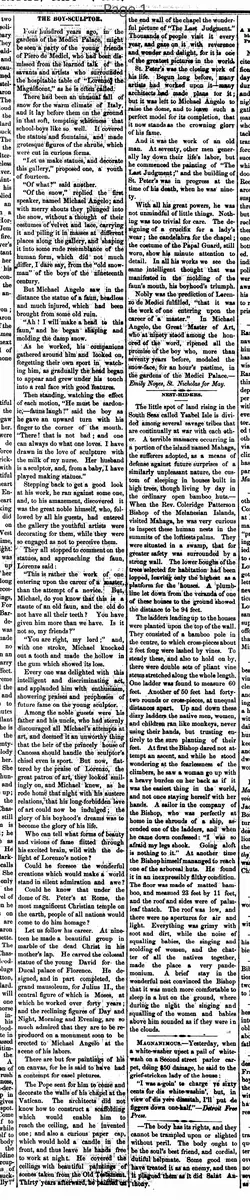
THE BOY-SCULPTOR,
Four hundred years ago, in the gardens of the Medici Palace might say to of Piero de Medici, who had been dismissed from the learned talk of the savants and artists who surrounded the hospitable table of "Lorenzo the Magnificent," as he is often called.
There had been an unusual fall of snow for the warm climate of Italy, and it lay before them on the ground in that soft, tempting whiteness that school-boys like so well. It covered the statues and fountains, and made grotesque figures of the shrubs, which were cut in curious forms.
"Let us make statues, and decorate this gallery," proposed one youth of fourteen.
"Of what?" said another.
"Of the snow," replied the first speaker, named Michael Angelo; and with merry shouts they plunged into the snow, without a thought of their costumes of velvet and lace, carrying it and piling it in masses at different places along the gallery, and shaping it into some rude resemblance of the human form, which did not much differ, I dare say, from the old snow man of the boys of the nineteenth century.
But Michael Angelo saw in the distance the statue of a faun, headless and much injured, which had been brought from some old ruin.
"Ah! I will make a head to this faun," and he began shaping and molding the damp snow.
As he worked his companions gathered around him and looked on forgetting their own sport in watching him, as gradually the head began to appear and grew under his touch into a real face with good features.
Then standing, watching the effect of each motion, "He must be sardonic -fauns laugh!" said the boy as he gave an upward turn with his finger to the corner of the mouth.
"There! that is not bad; and one can always do what one loves. I have drawn in the love of sculpture with the milk of my nurse. Her husband is a sculptor, and, from a baby, I have played making statues."
Stepping back to get a good look at his work, he ran against some one, and, to his amazement, discovered it was the great noble himself, who, followed by all his guests, had entered the gallery the youthful artists were decorating for them, while they were so engaged as not to perceive them.
They all stopped to comment on the statues, and approaching the faun, Lorenzo said:
"This is rather the work of one entering upon the career of master, than the attempt of a novice. But, Michael, do you know that this is a statue of an old faun, and the old do not have all their teeth? You have given him more than we have. Is it not so, my friends?"
"You are right, my lord;" and, with one stroke, Michael knocked out a tooth and made the hollow in the gum which showed its loss.
Every one was delighted with this intelligent and discriminating act, and applauded him with enthusiasm, showering praises and prophesies of future fame on the young sculptor.
Among the noble guests were his father and his uncle, who had sternly discouraged all Michael's attempts at art, and deemed it an unworthy thing that the heir of the princely house of Canossa should handle the "sculptor's chisel even in sport. But now, flattered by the praise of Lorenzo, the great patron of art, they looked smilingly on, and Michael knew, as he rode home that night with his austere relations, that his long-forbidden love of art could now be indulged; the glory of his boyhood's dreams was to become the glory of his life.
Who can tell what forms of beauty and visions of fame flitted through his excited brain, wild with the delight of Lorenzo's notice?
Could he foresee the wonderful creations which would make a world stand in silent admiration and awe?
Could he know that under the dome of St. Peter's at Rome, the most magnificent Christian temple on the earth, people of all nations would come to do him homage?
Let us follow his career. At nineteen he made a beautiful group in marble of the dead Christ in his mother's lap. He carved the colossal statue of the young David for the Ducal palace of Florence. He designed, and in part completed, the grand mausoleum, for Julius II., the central figure of which is Moses, at which he worked over forty years; and the reclining figures of Day and Night, Morning and Evening, are so much admired that they are to be reproduced on a monument soon to be erected to Michael Angelo at the scene of his labors.
There are but few paintings of him on canvas, for he is said to have had a contempt for easel pictures.
The Pope sent for him to come and decorate the walls of his chapel at the Vatican. The architects did not know how to construct a scaffolding which would enable him to reach the ceiling, and he invented one; and also a curious paper cap, which would hold a candle in the front, and thus leave his hand free to work at night. He covered the ceilings with beautiful paintings of scenes taken from the Old Testament.
Thirty years afterward, he painted on the end wall of the chapel the wonderful picture of "The Last Judgment."
Thousands of people visit it every year, and gaze on it with reverence and wonder and delight, for it is one of the greatest pictures in the world.
St. Peter's was the closing work of his life. Begun long before, many artists had worked upon it; many architects had made plans for it; but it was left to Michael Angelo to raise the dome, and to leave such a perfect model for its completion, that it now stands as the crowning glory of his fame.
And it was the work of an old man. At seventy, other men generally lay down their life's labor, but he commenced the painting of "The Last Judgment;" and the building of St. Peter's was in progress at the time of his death, when he was ninety.
With all his great powers, he was not unmindful of little things. Nothing was too trivial for care. The designing of a crucifix for a lady's wear; the candelabra for the chapel; the costume of the Papal Guard, still worn, show his minute attention to detail. In all his works we see the same intelligent thought that was manifested in the molding of the faun's mouth, his boyhood's triumph.
Nobly was the prediction of Lorenzo de Medici fulfilled that it was the work of one entering upon the career of master." In Michael Angelo, the Great Master of Art, who at ninety stood among the honored of the world, ripened all the promise of the boy who, more than seventy years before, modeled the snow-face, for an hour's pastime, in the gardens of the Medici Palace.
Emily Noyes, St. Nicholas for May.
Four hundred years ago, in the gardens of the Medici Palace might say to of Piero de Medici, who had been dismissed from the learned talk of the savants and artists who surrounded the hospitable table of "Lorenzo the Magnificent," as he is often called.
There had been an unusual fall of snow for the warm climate of Italy, and it lay before them on the ground in that soft, tempting whiteness that school-boys like so well. It covered the statues and fountains, and made grotesque figures of the shrubs, which were cut in curious forms.
"Let us make statues, and decorate this gallery," proposed one youth of fourteen.
"Of what?" said another.
"Of the snow," replied the first speaker, named Michael Angelo; and with merry shouts they plunged into the snow, without a thought of their costumes of velvet and lace, carrying it and piling it in masses at different places along the gallery, and shaping it into some rude resemblance of the human form, which did not much differ, I dare say, from the old snow man of the boys of the nineteenth century.
But Michael Angelo saw in the distance the statue of a faun, headless and much injured, which had been brought from some old ruin.
"Ah! I will make a head to this faun," and he began shaping and molding the damp snow.
As he worked his companions gathered around him and looked on forgetting their own sport in watching him, as gradually the head began to appear and grew under his touch into a real face with good features.
Then standing, watching the effect of each motion, "He must be sardonic -fauns laugh!" said the boy as he gave an upward turn with his finger to the corner of the mouth.
"There! that is not bad; and one can always do what one loves. I have drawn in the love of sculpture with the milk of my nurse. Her husband is a sculptor, and, from a baby, I have played making statues."
Stepping back to get a good look at his work, he ran against some one, and, to his amazement, discovered it was the great noble himself, who, followed by all his guests, had entered the gallery the youthful artists were decorating for them, while they were so engaged as not to perceive them.
They all stopped to comment on the statues, and approaching the faun, Lorenzo said:
"This is rather the work of one entering upon the career of master, than the attempt of a novice. But, Michael, do you know that this is a statue of an old faun, and the old do not have all their teeth? You have given him more than we have. Is it not so, my friends?"
"You are right, my lord;" and, with one stroke, Michael knocked out a tooth and made the hollow in the gum which showed its loss.
Every one was delighted with this intelligent and discriminating act, and applauded him with enthusiasm, showering praises and prophesies of future fame on the young sculptor.
Among the noble guests were his father and his uncle, who had sternly discouraged all Michael's attempts at art, and deemed it an unworthy thing that the heir of the princely house of Canossa should handle the "sculptor's chisel even in sport. But now, flattered by the praise of Lorenzo, the great patron of art, they looked smilingly on, and Michael knew, as he rode home that night with his austere relations, that his long-forbidden love of art could now be indulged; the glory of his boyhood's dreams was to become the glory of his life.
Who can tell what forms of beauty and visions of fame flitted through his excited brain, wild with the delight of Lorenzo's notice?
Could he foresee the wonderful creations which would make a world stand in silent admiration and awe?
Could he know that under the dome of St. Peter's at Rome, the most magnificent Christian temple on the earth, people of all nations would come to do him homage?
Let us follow his career. At nineteen he made a beautiful group in marble of the dead Christ in his mother's lap. He carved the colossal statue of the young David for the Ducal palace of Florence. He designed, and in part completed, the grand mausoleum, for Julius II., the central figure of which is Moses, at which he worked over forty years; and the reclining figures of Day and Night, Morning and Evening, are so much admired that they are to be reproduced on a monument soon to be erected to Michael Angelo at the scene of his labors.
There are but few paintings of him on canvas, for he is said to have had a contempt for easel pictures.
The Pope sent for him to come and decorate the walls of his chapel at the Vatican. The architects did not know how to construct a scaffolding which would enable him to reach the ceiling, and he invented one; and also a curious paper cap, which would hold a candle in the front, and thus leave his hand free to work at night. He covered the ceilings with beautiful paintings of scenes taken from the Old Testament.
Thirty years afterward, he painted on the end wall of the chapel the wonderful picture of "The Last Judgment."
Thousands of people visit it every year, and gaze on it with reverence and wonder and delight, for it is one of the greatest pictures in the world.
St. Peter's was the closing work of his life. Begun long before, many artists had worked upon it; many architects had made plans for it; but it was left to Michael Angelo to raise the dome, and to leave such a perfect model for its completion, that it now stands as the crowning glory of his fame.
And it was the work of an old man. At seventy, other men generally lay down their life's labor, but he commenced the painting of "The Last Judgment;" and the building of St. Peter's was in progress at the time of his death, when he was ninety.
With all his great powers, he was not unmindful of little things. Nothing was too trivial for care. The designing of a crucifix for a lady's wear; the candelabra for the chapel; the costume of the Papal Guard, still worn, show his minute attention to detail. In all his works we see the same intelligent thought that was manifested in the molding of the faun's mouth, his boyhood's triumph.
Nobly was the prediction of Lorenzo de Medici fulfilled that it was the work of one entering upon the career of master." In Michael Angelo, the Great Master of Art, who at ninety stood among the honored of the world, ripened all the promise of the boy who, more than seventy years before, modeled the snow-face, for an hour's pastime, in the gardens of the Medici Palace.
Emily Noyes, St. Nicholas for May.
What sub-type of article is it?
Prose Fiction
What themes does it cover?
Moral Virtue
Political
What keywords are associated?
Michelangelo
Boy Sculptor
Snow Faun
Medici Palace
Art Patronage
Lorenzo Magnificent
Sistine Chapel
St Peters Dome
What entities or persons were involved?
Emily Noyes
Literary Details
Title
The Boy Sculptor
Author
Emily Noyes
Subject
The Boyhood Of Michelangelo Buonarroti
Key Lines
"Let Us Make Statues, And Decorate This Gallery," Proposed One Youth Of Fourteen.
"Of The Snow," Replied The First Speaker, Named Michael Angelo;
"He Must Be Sardonic Fauns Laugh!" Said The Boy As He Gave An Upward Turn With His Finger To The Corner Of The Mouth
"You Are Right, My Lord;" And, With One Stroke, Michael Knocked Out A Tooth And Made The Hollow In The Gum Which Showed Its Loss.
Nobly Was The Prediction Of Lorenzo De Medici Fulfilled That It Was The Work Of One Entering Upon The Career Of Master.