Thank you for visiting SNEWPapers!
Sign up free
Story
February 24, 1832
Wilmington Expositor
Wilmington, New Castle County, Delaware
What is this article about?
Article lists 12 preventable causes of disease: insufficient exercise, late hours, impure air, poor bathing, unclean clothing/dwellings, adulterated food/excess, intoxicating drinks, improper clothing, cold exposure, mental overwork, unchecked passions, and misuse of medicine.
Clipping
OCR Quality
90%
Excellent
Full Text
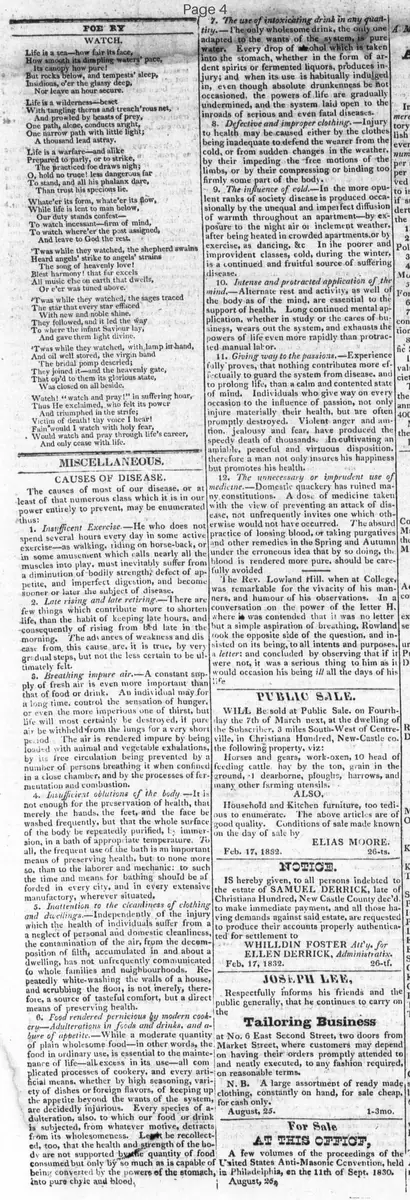
CAUSES OF DISEASE.
The causes of most of our disease, or at least of that numerous class which it is in our power entirely to prevent, may be enumerated thus:
1. Insufficient Exercise.—He who does not spend several hours every day in some active exercise—as walking, riding on horse-back, or in some amusement which calls nearly all the muscles into play, must inevitably suffer from a diminution of bodily strength, defect of appetite, and imperfect digestion, and become sooner or later the subject of disease.
2. Late rising and late retiring.—There are few things which contribute more to shorten life, than the habit of keeping late hours, and consequently of rising from bed late in the morning. The advances of weakness and disease from this cause are, it is true, by very gradual steps, but not the less certain to be ultimately felt.
3. Breathing impure air.—A constant supply of fresh air is even more important than that of food or drink. An individual may for a long time control the sensation of hunger, or even the more imperious one of thirst, but life will most certainly be destroyed, if pure air be withheld from the lungs for a very short period. The air is rendered impure by being loaded with animal and vegetable exhalations, by its free circulation being prevented by a number of persons breathing it when confined in a close chamber, and by the processes of fermentation and combustion.
4. Insufficient oblutions of the body.—It is not enough for the preservation of health, that merely the hands, the feet, and the face be washed frequently, but that the whole surface of the body be repeatedly purified, by immersion, in a bath of appropriate temperature. To all, the frequent use of the bath is an important means of preserving health, but to none more so, than to the laborer and mechanic: to such the time and means for bathing should be afforded in every city, and in every extensive manufactory, wherever situated.
5. Inattention to the cleanliness of clothing and dwellings.—Independently of the injury which the health of individuals suffer from a neglect of personal and domestic cleanliness, the contamination of the air, from the decomposition of filth, accumulated in and about a dwelling, has not unfrequently communicated disease. Repeatedly white-washing the walls of a house, and scrubbing the floor, is not merely, therefore, a source of tasteful comfort, but a direct means of preserving health.
6. Food rendered pernicious by modern cookery—Adulterations in foods and drinks, and abuse of appetite. While a moderate quantity of plain wholesome food—in other words, the food in ordinary use, is essential to the maintenance of life—all excess in its use—all complicated processes of cookery, and every artificial means, whether by high seasoning, variety of dishes or foreign flavors, of keeping up the appetite beyond the wants of the system, are decidedly injurious. Every species of adulteration, also, to which our food or drink is subjected, from whatever motive, detracts from its wholesomeness. Let be recollected, too, that the health and strength of the body are not supported by the quantity of food consumed but only by so much as is capable of being converted by the powers of the stomach into pure chyle and blood.
7. The use of intoxicating drink in any quantity.—The only wholesome drink, the only one adapted to the wants of the system, is pure water. Every drop of alcohol which is taken into the stomach, whether in the form of ardent spirits or fermented liquors, produces injury; and when its use is habitually indulged in, even though absolute drunkenness be not occasioned, the powers of life are gradually undermined, and the system laid open to the inroads of serious and even fatal diseases.
8. Defective and improper clothing.—Injury to health may be caused either by the clothes being inadequate to defend the wearer from the cold, or from sudden changes in the weather, by their impeding the free motions of the limbs, or by their compressing or binding too firmly some part of the body.
9. The influence of cold. In the more opulent ranks of society disease is produced occasionally by the unequal and imperfect diffusion of warmth throughout an apartment—by exposure to the night air or inclement weather, after being heated in crowded apartments, or by exercise, as dancing, &c. In the poorer and improvident classes, cold, during the winter, is a continued and fruitful source of suffering disease.
10. Intense and protracted application of the mind.—Alternate rest and activity, as well of the body as of the mind, are essential to the support of health. Long continued mental application, whether in study or the cares of business, wears out the system, and exhausts the powers of life even more rapidly than protracted manual labor.
11. Giving way to the passions.—Experience fully proves, that nothing contributes more effectually to guard the system from disease, and to prolong life, than a calm and contented state of mind. Individuals who give way on every occasion to the influence of passion, not only injure materially their health, but are often promptly destroyed. Violent anger and ambition, jealousy and fear, have produced the speedy death of thousands. In cultivating an amiable, peaceful and virtuous disposition, therefore a man not only insures his happiness but promotes his health.
12. The unnecessary or imprudent use of medicine.—Domestic quackery has ruined many constitutions. A dose of medicine taken with the view of preventing an attack of disease, not unfrequently invites one which otherwise would not have occurred. The absurd practice of loosing blood, or taking purgatives and other remedies in the Spring and Autumn under the erroneous idea that by so doing, the blood is rendered more pure, should be carefully avoided.
The causes of most of our disease, or at least of that numerous class which it is in our power entirely to prevent, may be enumerated thus:
1. Insufficient Exercise.—He who does not spend several hours every day in some active exercise—as walking, riding on horse-back, or in some amusement which calls nearly all the muscles into play, must inevitably suffer from a diminution of bodily strength, defect of appetite, and imperfect digestion, and become sooner or later the subject of disease.
2. Late rising and late retiring.—There are few things which contribute more to shorten life, than the habit of keeping late hours, and consequently of rising from bed late in the morning. The advances of weakness and disease from this cause are, it is true, by very gradual steps, but not the less certain to be ultimately felt.
3. Breathing impure air.—A constant supply of fresh air is even more important than that of food or drink. An individual may for a long time control the sensation of hunger, or even the more imperious one of thirst, but life will most certainly be destroyed, if pure air be withheld from the lungs for a very short period. The air is rendered impure by being loaded with animal and vegetable exhalations, by its free circulation being prevented by a number of persons breathing it when confined in a close chamber, and by the processes of fermentation and combustion.
4. Insufficient oblutions of the body.—It is not enough for the preservation of health, that merely the hands, the feet, and the face be washed frequently, but that the whole surface of the body be repeatedly purified, by immersion, in a bath of appropriate temperature. To all, the frequent use of the bath is an important means of preserving health, but to none more so, than to the laborer and mechanic: to such the time and means for bathing should be afforded in every city, and in every extensive manufactory, wherever situated.
5. Inattention to the cleanliness of clothing and dwellings.—Independently of the injury which the health of individuals suffer from a neglect of personal and domestic cleanliness, the contamination of the air, from the decomposition of filth, accumulated in and about a dwelling, has not unfrequently communicated disease. Repeatedly white-washing the walls of a house, and scrubbing the floor, is not merely, therefore, a source of tasteful comfort, but a direct means of preserving health.
6. Food rendered pernicious by modern cookery—Adulterations in foods and drinks, and abuse of appetite. While a moderate quantity of plain wholesome food—in other words, the food in ordinary use, is essential to the maintenance of life—all excess in its use—all complicated processes of cookery, and every artificial means, whether by high seasoning, variety of dishes or foreign flavors, of keeping up the appetite beyond the wants of the system, are decidedly injurious. Every species of adulteration, also, to which our food or drink is subjected, from whatever motive, detracts from its wholesomeness. Let be recollected, too, that the health and strength of the body are not supported by the quantity of food consumed but only by so much as is capable of being converted by the powers of the stomach into pure chyle and blood.
7. The use of intoxicating drink in any quantity.—The only wholesome drink, the only one adapted to the wants of the system, is pure water. Every drop of alcohol which is taken into the stomach, whether in the form of ardent spirits or fermented liquors, produces injury; and when its use is habitually indulged in, even though absolute drunkenness be not occasioned, the powers of life are gradually undermined, and the system laid open to the inroads of serious and even fatal diseases.
8. Defective and improper clothing.—Injury to health may be caused either by the clothes being inadequate to defend the wearer from the cold, or from sudden changes in the weather, by their impeding the free motions of the limbs, or by their compressing or binding too firmly some part of the body.
9. The influence of cold. In the more opulent ranks of society disease is produced occasionally by the unequal and imperfect diffusion of warmth throughout an apartment—by exposure to the night air or inclement weather, after being heated in crowded apartments, or by exercise, as dancing, &c. In the poorer and improvident classes, cold, during the winter, is a continued and fruitful source of suffering disease.
10. Intense and protracted application of the mind.—Alternate rest and activity, as well of the body as of the mind, are essential to the support of health. Long continued mental application, whether in study or the cares of business, wears out the system, and exhausts the powers of life even more rapidly than protracted manual labor.
11. Giving way to the passions.—Experience fully proves, that nothing contributes more effectually to guard the system from disease, and to prolong life, than a calm and contented state of mind. Individuals who give way on every occasion to the influence of passion, not only injure materially their health, but are often promptly destroyed. Violent anger and ambition, jealousy and fear, have produced the speedy death of thousands. In cultivating an amiable, peaceful and virtuous disposition, therefore a man not only insures his happiness but promotes his health.
12. The unnecessary or imprudent use of medicine.—Domestic quackery has ruined many constitutions. A dose of medicine taken with the view of preventing an attack of disease, not unfrequently invites one which otherwise would not have occurred. The absurd practice of loosing blood, or taking purgatives and other remedies in the Spring and Autumn under the erroneous idea that by so doing, the blood is rendered more pure, should be carefully avoided.
What sub-type of article is it?
Curiosity
Medical Curiosity
What themes does it cover?
Moral Virtue
What keywords are associated?
Disease Causes
Preventive Health
Exercise
Hygiene
Diet
Alcohol
Mental Health
Story Details
Story Details
Enumeration of 12 preventable causes of disease through lifestyle choices, emphasizing exercise, hygiene, diet, and moderation to maintain health.