Thank you for visiting SNEWPapers!
Sign up free
Editorial
March 28, 1888
The Clifton Clarion
Clifton, Greenlee County, Graham County, Arizona
What is this article about?
Editorial defends mining as a reliable and profitable business, countering perceptions of it as speculative by comparing it favorably to merchandising, professions, trades, and agriculture, which face high failures and debts; highlights Comstock mines' success in creating millionaires.
Clipping
OCR Quality
95%
Excellent
Full Text
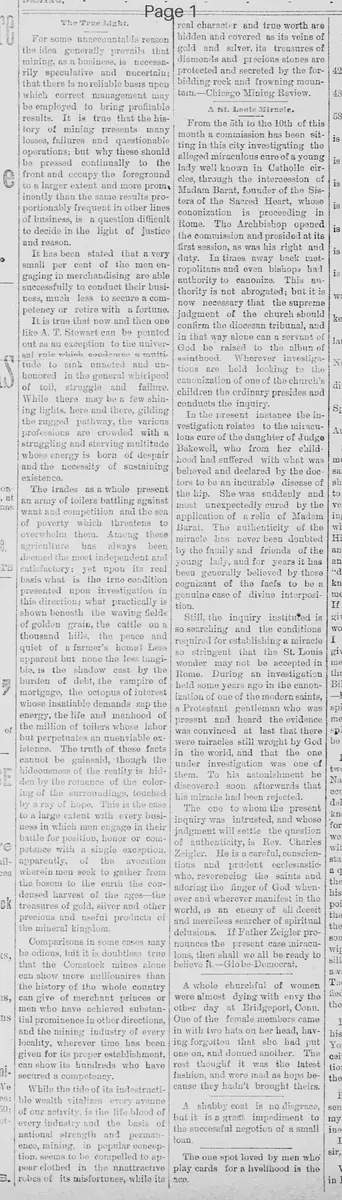
The True Light.
For some unaccountable reason the idea generally prevails that mining, as a business, is necessarily speculative and uncertain; that there is no reliable basis upon which correct management may be employed to bring profitable results. It is true that the history of mining presents many losses, failures and questionable operations; but why these should be pressed continually to the front and occupy the foreground to a larger extent and more prominently than the same results proportionably frequent in other lines of business, is a question difficult to decide in the light of justice and reason.
It has been stated that a very small per cent of the men engaging in merchandising are able successfully to conduct their business, much less to secure a competency or retire with a fortune. It is true that now and then one like A. T. Stewart can be pointed out as an exception to the universal rule which condemns a multitude to sink unnoted and unhonored in the general whirlpool of toil, struggle and failure.
While there may be a few shining lights, here and there, gilding the rugged pathway, the various professions are crowded with a struggling and starving multitude whose energy is born of despair and the necessity of sustaining existence.
The trades as a whole present an army of toilers battling against want and competition and the sea of poverty which threatens to overwhelm them. Among these agriculture has always been deemed the most independent and satisfactory; yet upon its real basis what is the true condition presented upon investigation in this direction: what practically is shown beneath the waving fields of golden grain, the cattle on a thousand hills, the peace and quiet of a farmer's home? Less apparent but none the less tangible, is the shadow cast by the burden of debt, the vampire of mortgage, the octopus of interest whose insatiable demands sap the energy, the life and manhood of the million of toilers whose labor but perpetuates an unenviable existence. The truth of these facts cannot be gainsaid, though the hideousness of the reality is hidden by the romance of the coloring of the surroundings, touched by a ray of hope. This is the case to a large extent with every business in which men engage in their battle for position, honor or competence with a single exception, apparently, of the avocation wherein men seek to gather from the bosom of the earth the condensed harvest of the ages—the treasures of gold, silver and other precious and useful products of the mineral kingdom.
Comparisons in some cases may be odious, but it is doubtless true that the Comstock mines alone can show more millionaires than the history of the whole country can give of merchant princes or men who have achieved substantial prominence in other directions, and the mining industry of every locality, wherever time has been given for its proper establishment, can show its hundreds who have secured a competency.
While the tide of its indestructible wealth vitalizes every avenue of our activity, is the life blood of every industry and the basis of national strength and permanence, mining, in popular conception, seems to be compelled to appear clothed in the unattractive robes of its misfortunes, while its
For some unaccountable reason the idea generally prevails that mining, as a business, is necessarily speculative and uncertain; that there is no reliable basis upon which correct management may be employed to bring profitable results. It is true that the history of mining presents many losses, failures and questionable operations; but why these should be pressed continually to the front and occupy the foreground to a larger extent and more prominently than the same results proportionably frequent in other lines of business, is a question difficult to decide in the light of justice and reason.
It has been stated that a very small per cent of the men engaging in merchandising are able successfully to conduct their business, much less to secure a competency or retire with a fortune. It is true that now and then one like A. T. Stewart can be pointed out as an exception to the universal rule which condemns a multitude to sink unnoted and unhonored in the general whirlpool of toil, struggle and failure.
While there may be a few shining lights, here and there, gilding the rugged pathway, the various professions are crowded with a struggling and starving multitude whose energy is born of despair and the necessity of sustaining existence.
The trades as a whole present an army of toilers battling against want and competition and the sea of poverty which threatens to overwhelm them. Among these agriculture has always been deemed the most independent and satisfactory; yet upon its real basis what is the true condition presented upon investigation in this direction: what practically is shown beneath the waving fields of golden grain, the cattle on a thousand hills, the peace and quiet of a farmer's home? Less apparent but none the less tangible, is the shadow cast by the burden of debt, the vampire of mortgage, the octopus of interest whose insatiable demands sap the energy, the life and manhood of the million of toilers whose labor but perpetuates an unenviable existence. The truth of these facts cannot be gainsaid, though the hideousness of the reality is hidden by the romance of the coloring of the surroundings, touched by a ray of hope. This is the case to a large extent with every business in which men engage in their battle for position, honor or competence with a single exception, apparently, of the avocation wherein men seek to gather from the bosom of the earth the condensed harvest of the ages—the treasures of gold, silver and other precious and useful products of the mineral kingdom.
Comparisons in some cases may be odious, but it is doubtless true that the Comstock mines alone can show more millionaires than the history of the whole country can give of merchant princes or men who have achieved substantial prominence in other directions, and the mining industry of every locality, wherever time has been given for its proper establishment, can show its hundreds who have secured a competency.
While the tide of its indestructible wealth vitalizes every avenue of our activity, is the life blood of every industry and the basis of national strength and permanence, mining, in popular conception, seems to be compelled to appear clothed in the unattractive robes of its misfortunes, while its
What sub-type of article is it?
Economic Policy
Trade Or Commerce
What keywords are associated?
Mining Industry
Business Reliability
Economic Comparison
Comstock Mines
Agriculture Burdens
Merchandising Failures
What entities or persons were involved?
Comstock Mines
A. T. Stewart
Editorial Details
Primary Topic
Defense Of Mining As A Reliable Business
Stance / Tone
Positive Advocacy For Mining Industry
Key Figures
Comstock Mines
A. T. Stewart
Key Arguments
Mining Is Not Inherently Speculative; Correct Management Yields Profits
History Of Mining Shows Losses, But Similar To Other Businesses
Merchandising Has Low Success Rate, Few Fortunes Like A. T. Stewart
Professions Filled With Struggling Multitude
Trades Battle Poverty And Competition
Agriculture Burdened By Debt, Mortgages, And Interest Despite Appearances
Mining Exception: Produces Wealth From Earth's Treasures
Comstock Mines Created More Millionaires Than Other Sectors
Mining Wealth Vitalizes All Industries And National Strength
Mining Unfairly Portrayed By Its Misfortunes