Thank you for visiting SNEWPapers!
Sign up free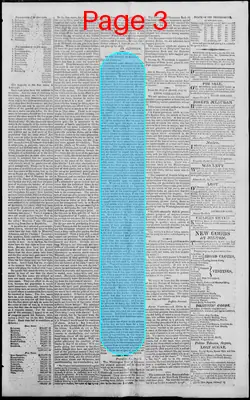
Letter to Editor
August 28, 1819
Edwardsville Spectator
Edwardsville, Madison County, Illinois
What is this article about?
A letter to Illinois citizens argues against instructing representatives on restricting slavery in Missouri's admission to the Union, asserting that anti-slavery sentiment is already clear from past actions like the Northwest Ordinance, conventions, and elections, and representatives should act on conviction alone.
Clipping

OCR Quality
98%
Excellent
Full Text
FOR THE SPECTATOR.
TO THE PEOPLE OF ILLINOIS
FELLOW-CITIZENS,
I have heard some amongst you talk of instructing our representatives in the next congress on the subject of the restriction contemplated to be imposed on the admission of the territory of Missouri into the union. Where is the difficulty, and where is the doubt and uncertainty which render a resort to this measure necessary? Is it demanded for our sake, or is required on their account? Do they distrust their judgment, or are we yet to learn whether we are the friends of slavery, or the friends of freedom? Can it be, that after all we have done, another and yet another expression of public sentiment is asked for? If our interests and our feelings are to be made the pivot of their decision, they knew them long ago, and stronger evidences are not now in our power to give. As the north-west ordinance; is the last year's convention; is the late election of a representative, all, all so ambiguous that we must be called upon again and again to make the solemn declaration, and disavow the conduct of our agents in the halls of congress? Beware, then, fellow-citizens, of every attempt to convene you together. Your good sense will not suffer you to be misled by the ignorant; but it is to counteract the crafty arts of the wily politician, that our caution must ever be on the alert. The dignity of our nature, and our independence as citizens, forbid that we should be duped into the support of a tottering popularity, or sanction by our support an artful expedient. We will never consent to act but for the public good. Individuals must rise by their merits; their prop must be their virtue. If our representatives have erred, they can see through their error without our instructions, and will not wait for our mandate to profit by their conviction. Honorable men, in their situation, must frown indignantly upon the author of them. What can render a representative more abject, than to be supposed incapable of acting uprightly except under the lash of his constituents? I am ready to ascribe their error, if any they have committed, to their judgment, and I ask of you, can we give them new ideas or supply their intellect? And yet, without that power, what is there to be gained? Men are tenacious of their opinions; they are only to be combatted by argument, or supplanted by better information. Can a tumultuous assemblage of people reason with an individual, and refute his opinions? On the contrary, are not their acts only the results or conclusions of their previously conceived notions? They are always anticipated, and if the representative would not yield in the first instance from principle, he will not in the second from advisement. Our representatives must now be convinced from the instance alone of the result of the late congressional election, that the vote they gave on the Missouri question is disapproved by a large majority of the people, and if they wish to explain that vote, or would be guided by the public sentiment different from their own, they ought to unmask and openly avow that our will shall be their future guide. That will is already well known; it is certain, fixed, unequivocal, and immutable: to ask for it again, and in another shape than it has appeared, speaks more than is meant to be understood.
We will not proffer it otherwise than as it is, or in lowly homage—ask it of them as a boon that it may sway their minds. There is a limit beyond which it will not be disobeyed. Whilst, fellow citizens, I lament that a salutary check has not been given to the further extension of slavery, and that our state has been amongst the foremost to prevent the first step to so desirable an end; yet I am not the advocate of force, and will be the last man to coerce our reluctant senators against their wills. We have done better—we have reiterated the most cogent arguments. Individuals may accommodate them to suit their fastidious tastes; a people cannot.
It has been my object in this address to show that we have been for a long time decidedly averse to slavery, and that our representatives in the late congress knowing this, and yet not answering our wishes or expectations, in this respect, on the Missouri question, it is useless to instruct them on the vote they will give hereafter, as their determination must have proceeded from other and weightier reasons, beyond our influence or control.
This will be the subject of another address.
PUBLIUS.
TO THE PEOPLE OF ILLINOIS
FELLOW-CITIZENS,
I have heard some amongst you talk of instructing our representatives in the next congress on the subject of the restriction contemplated to be imposed on the admission of the territory of Missouri into the union. Where is the difficulty, and where is the doubt and uncertainty which render a resort to this measure necessary? Is it demanded for our sake, or is required on their account? Do they distrust their judgment, or are we yet to learn whether we are the friends of slavery, or the friends of freedom? Can it be, that after all we have done, another and yet another expression of public sentiment is asked for? If our interests and our feelings are to be made the pivot of their decision, they knew them long ago, and stronger evidences are not now in our power to give. As the north-west ordinance; is the last year's convention; is the late election of a representative, all, all so ambiguous that we must be called upon again and again to make the solemn declaration, and disavow the conduct of our agents in the halls of congress? Beware, then, fellow-citizens, of every attempt to convene you together. Your good sense will not suffer you to be misled by the ignorant; but it is to counteract the crafty arts of the wily politician, that our caution must ever be on the alert. The dignity of our nature, and our independence as citizens, forbid that we should be duped into the support of a tottering popularity, or sanction by our support an artful expedient. We will never consent to act but for the public good. Individuals must rise by their merits; their prop must be their virtue. If our representatives have erred, they can see through their error without our instructions, and will not wait for our mandate to profit by their conviction. Honorable men, in their situation, must frown indignantly upon the author of them. What can render a representative more abject, than to be supposed incapable of acting uprightly except under the lash of his constituents? I am ready to ascribe their error, if any they have committed, to their judgment, and I ask of you, can we give them new ideas or supply their intellect? And yet, without that power, what is there to be gained? Men are tenacious of their opinions; they are only to be combatted by argument, or supplanted by better information. Can a tumultuous assemblage of people reason with an individual, and refute his opinions? On the contrary, are not their acts only the results or conclusions of their previously conceived notions? They are always anticipated, and if the representative would not yield in the first instance from principle, he will not in the second from advisement. Our representatives must now be convinced from the instance alone of the result of the late congressional election, that the vote they gave on the Missouri question is disapproved by a large majority of the people, and if they wish to explain that vote, or would be guided by the public sentiment different from their own, they ought to unmask and openly avow that our will shall be their future guide. That will is already well known; it is certain, fixed, unequivocal, and immutable: to ask for it again, and in another shape than it has appeared, speaks more than is meant to be understood.
We will not proffer it otherwise than as it is, or in lowly homage—ask it of them as a boon that it may sway their minds. There is a limit beyond which it will not be disobeyed. Whilst, fellow citizens, I lament that a salutary check has not been given to the further extension of slavery, and that our state has been amongst the foremost to prevent the first step to so desirable an end; yet I am not the advocate of force, and will be the last man to coerce our reluctant senators against their wills. We have done better—we have reiterated the most cogent arguments. Individuals may accommodate them to suit their fastidious tastes; a people cannot.
It has been my object in this address to show that we have been for a long time decidedly averse to slavery, and that our representatives in the late congress knowing this, and yet not answering our wishes or expectations, in this respect, on the Missouri question, it is useless to instruct them on the vote they will give hereafter, as their determination must have proceeded from other and weightier reasons, beyond our influence or control.
This will be the subject of another address.
PUBLIUS.
What sub-type of article is it?
Persuasive
Political
Reflective
What themes does it cover?
Slavery Abolition
Politics
What keywords are associated?
Missouri Territory
Slavery Restriction
Illinois Representatives
Public Sentiment
Congressional Election
Anti Slavery
Northwest Ordinance
What entities or persons were involved?
Publius
The People Of Illinois
Letter to Editor Details
Author
Publius
Recipient
The People Of Illinois
Main Argument
illinois citizens should not instruct representatives to oppose slavery in missouri's admission, as anti-slavery sentiment is already evident from historical actions and elections, and representatives must act on their own judgment and conviction.
Notable Details
References Northwest Ordinance
Mentions Last Year's Convention
Cites Late Congressional Election
Discusses Missouri Question