Thank you for visiting SNEWPapers!
Sign up free
Literary
April 30, 1828
Literary Cadet And Rhode Island Statesman
Providence, Providence County, Rhode Island
What is this article about?
An essay advocating true piety as a calm, steady heart-felt devotion that enhances female happiness and moral duties, contrasting it with asceticism. It argues piety regulates affections, provides solace amid life's trials, and leads to lasting felicity, especially for women with their intense sensibilities. Concludes with a poetic excerpt on blessedness.
Clipping
OCR Quality
98%
Excellent
Full Text
MISCELLANY
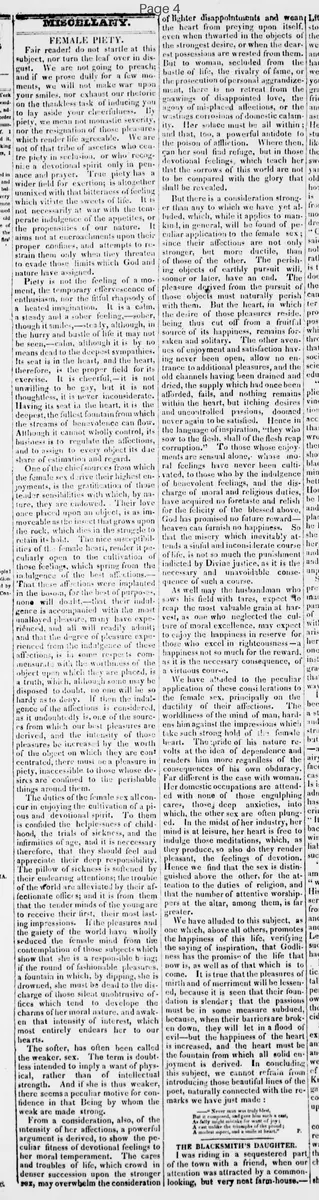
FEMALE PIETY.
Fair reader! do not startle at this subject, nor turn the leaf over in disgust. We are not going to preach: and if we prosed dully for a few moments, we will not make war upon your smiles, nor exhaust our rhetoric on the thankless task of inducing you to lay aside your cheerfulness. By piety, we mean not monastic severity, nor the resignation of those pleasures which render life agreeable. "We are not of that tribe of ascetics who centre piety in seclusion. or who recognize a devotional spirit only in penance and prayer. True piety has a wider field for exertion; is altogether unmingled with that bitterness of feeling which vitiates the sweets of life. It is not necessarily at war with the temperate indulgence of the appetites, or the propensities of our nature. It aims not at encroachments upon their proper confines, and attempts to restrain them only when they threaten to evade those limits which God and nature have assigned.
Piety is not the feeling of a moment, the temporary effervescence of enthusiasm, nor the fitful rhapsody of a heated imagination. It is a calm, a steady and a sober feeling,-sober, though it smiles,-steady, although, in the hurry and bustle of life it may not be seen,--calm, although it is by no means dead to the deepest sympathies. Its seat is in the heart, and the heart, therefore, is the proper field for its exercise. It is cheerful,-it is not unwilling to be gay, but it is not thoughtless, it is never inconsiderate. Having its seat in the heart, it is the deepest, the fullest fountain from which the streams of benevolence can flow. Although it cannot wholly control, its business is to regulate the affections, and to assign to every object its due share of estimation and regard.
One of the chief sources from which the female sex derive their highest enjoyments, is the gratification of those tender sensibilities with which, by nature, they are endowed. Their love once placed upon an object, is as immovable as the insect that grows upon the rock, which dies in the struggle to retain its hold. The nice susceptibilities of the female heart, render it peculiarly open to the cultivation of those feelings, which spring from the indulgence of the best affections.-- That these affections were implanted in the bosom, for the best of purposes, none will doubt,-that their indulgence is accompanied with the most unalloyed pleasure, many have experienced., and all will readily admit; and that the degree of pleasure experienced from the indulgence of these affections, is in some respects commensurate with the worthiness of the object upon which they are placed, is a truth, which, although some may be disposed to doubt. no one will be so hardy as to deny. If then the indulgence of the affections is considered, as it undoubtedly is, one of the sources from which our best pleasures are derived, and the intensity of those pleasures be increased by the worth of the object on which they are concentrated, there must be a pleasure in piety, inaccessible to those whose desires are confined to the perishable things around them.
The duties of the female sex all concur in enjoying the cultivation of a pious and devotional spirit. To them is confided the helplessness of childhood, the trials of sickness, and the infirmities of age, and it is necessary therefore, that they should feel and appreciate their deep responsibility. The pillow of sickness is softened by their endearing attentions; the troubles of the world are alleviated by their affectionate offices; and it is from them that the tender minds of the young are to receive their first, their most lasting impressions. If the pleasures and the gaiety of the world have wholly seduced the female mind from the contemplation of those subjects which show that she is a responsible being; if the round of fashionable pleasures, a fountain in which, by dipping, she is drowned, she must be dead to the discharge of those silent unobtrusive offices which tend to develope the charms of her moral nature, and awaken that intensity of interest, which most entirely endears her to our hearts.
The softer, has often been called the weaker sex. The term is doubtless intended to imply a want of physical, rather than of intellectual strength. And if she is thus weaker, there seems a peculiar motive for confidence in that Being by whom the weak are made strong.
From a consideration, also, of the intensity of her affections, a powerful argument is derived, to show the peculiar fitness of devotional feelings to her moral temperament. The cares and troubles of life, which crowd in denser succession upon the stronger sex, may overwhelm the consideration of lighter disappointments and wean the heart from preying upon itself. even when thwarted in the objects of the strongest desire, or when the dearest possessions are wrested from them. But to woman, secluded from the bustle of life, the rivalry of fame, or the prosecution of personal aggrandizement, there is no retreat from the gnawings of disappointed love, the agony of mis-placed affections, or the wasting corrosions of domestic calamity. Her solace must be all within: and that, too, a powerful antidote to the poison of affliction. Where then, can her soul find refuge, but in those devotional feelings, which teach her that the sorrows of this world are not to be compared with the glory that shall be revealed.
But there is a consideration stronger than any to which we have yet alluded, which, while it applies to mankind, in general, will be found of peculiar application to the female sex; since their affections are not only stronger, but more ductile, than of those of the other. The perishing objects of earthly pursuit will, sooner or later, have an end. The pleasure derived from the pursuit of those objects must naturally perish with them. But the heart, in which the desire of those pleasures reside, being thus cut off from a fruitful source of its happiness, remains forsaken and solitary. The other avenues of enjoyment and satisfaction having never been open, allow no entrance to additional pleasures, and the old channels having been drained and dried, the supply which had once been afforded, fails, and nothing remains within the heart, but itching desires and uncontrolled passions, doomed never again to be satisfied. Hence in the language of inspiration, "they who sow to the flesh, shall of the flesh reap corruption." To those whose enjoyments are sensual alone: whose moral feelings have never been cultivated, to those who by the indulgence of benevolent feelings, and the discharge of moral and religious duties, have acquired no foretaste and relish for the felicity of the blessed above, God has promised no future reward- heaven can furnish no happiness. So that the misery which inevitably attends a sinful and inconsiderate course of life, is not so much the punishment inflicted by Divine justice, as it is the necessary and unavoidable consequence of such a course.
As well may the husbandman who sows his field with tares, expect to reap the most valuable grain at harvest, as one who neglected the culture of moral excellence, may expect to enjoy the happiness in reserve for those who excel in righteousness-a happiness not so much for the reward, as it is the necessary consequence, of a virtuous course.
We have alluded to the peculiar application of these considerations to the female sex, principally on the ductility of their affections. The worldliness of the mind of man, hardens him against the impressions which take such strong hold of the female heart. The pride of his nature revolts at the idea of dependence and renders him more regardless of the consequences of his own obduracy. Far different is the case with woman. Her domestic occupations are attended with none of those engulfing cares, those deep anxieties, into which, the other sex are often plunged. In the midst of her industry, her mind is at leisure, her heart is free to indulge those meditations, which, as they produce, so also do they render pleasant, the feelings of devotion. Hence we find that the sex is distinguished above the other, for the attention to the duties of religion, and that the number of attentive worshippers at the altar, among them, is far greater.
We have alluded to this subject, as one which, above all others, promotes the happiness of this life, verifying the saying of inspiration, that Godliness has the promise of the life that now is, as well as of that which is to come. It is true that the pleasures of mirth and of merriment will be lessened, because it is seen that their foundation is slender; that the passions must be in some measure subdued, because, when their barriers are broken down, they will let in a flood of evil-but the happiness of the heart is increased, and the heart must be the fountain from which all solid enjoyment is derived. In concluding this subject, we cannot refrain from introducing those beautiful lines of the poet, naturally connected with the remarks we have just made :
"Never man was truly blest,
But it composed, and gave him such a cast,
As folly might mistake for want of joy;
A cast unlike the triumphs of the proud;
A modest aspect, and a smile at heart."
P.
FEMALE PIETY.
Fair reader! do not startle at this subject, nor turn the leaf over in disgust. We are not going to preach: and if we prosed dully for a few moments, we will not make war upon your smiles, nor exhaust our rhetoric on the thankless task of inducing you to lay aside your cheerfulness. By piety, we mean not monastic severity, nor the resignation of those pleasures which render life agreeable. "We are not of that tribe of ascetics who centre piety in seclusion. or who recognize a devotional spirit only in penance and prayer. True piety has a wider field for exertion; is altogether unmingled with that bitterness of feeling which vitiates the sweets of life. It is not necessarily at war with the temperate indulgence of the appetites, or the propensities of our nature. It aims not at encroachments upon their proper confines, and attempts to restrain them only when they threaten to evade those limits which God and nature have assigned.
Piety is not the feeling of a moment, the temporary effervescence of enthusiasm, nor the fitful rhapsody of a heated imagination. It is a calm, a steady and a sober feeling,-sober, though it smiles,-steady, although, in the hurry and bustle of life it may not be seen,--calm, although it is by no means dead to the deepest sympathies. Its seat is in the heart, and the heart, therefore, is the proper field for its exercise. It is cheerful,-it is not unwilling to be gay, but it is not thoughtless, it is never inconsiderate. Having its seat in the heart, it is the deepest, the fullest fountain from which the streams of benevolence can flow. Although it cannot wholly control, its business is to regulate the affections, and to assign to every object its due share of estimation and regard.
One of the chief sources from which the female sex derive their highest enjoyments, is the gratification of those tender sensibilities with which, by nature, they are endowed. Their love once placed upon an object, is as immovable as the insect that grows upon the rock, which dies in the struggle to retain its hold. The nice susceptibilities of the female heart, render it peculiarly open to the cultivation of those feelings, which spring from the indulgence of the best affections.-- That these affections were implanted in the bosom, for the best of purposes, none will doubt,-that their indulgence is accompanied with the most unalloyed pleasure, many have experienced., and all will readily admit; and that the degree of pleasure experienced from the indulgence of these affections, is in some respects commensurate with the worthiness of the object upon which they are placed, is a truth, which, although some may be disposed to doubt. no one will be so hardy as to deny. If then the indulgence of the affections is considered, as it undoubtedly is, one of the sources from which our best pleasures are derived, and the intensity of those pleasures be increased by the worth of the object on which they are concentrated, there must be a pleasure in piety, inaccessible to those whose desires are confined to the perishable things around them.
The duties of the female sex all concur in enjoying the cultivation of a pious and devotional spirit. To them is confided the helplessness of childhood, the trials of sickness, and the infirmities of age, and it is necessary therefore, that they should feel and appreciate their deep responsibility. The pillow of sickness is softened by their endearing attentions; the troubles of the world are alleviated by their affectionate offices; and it is from them that the tender minds of the young are to receive their first, their most lasting impressions. If the pleasures and the gaiety of the world have wholly seduced the female mind from the contemplation of those subjects which show that she is a responsible being; if the round of fashionable pleasures, a fountain in which, by dipping, she is drowned, she must be dead to the discharge of those silent unobtrusive offices which tend to develope the charms of her moral nature, and awaken that intensity of interest, which most entirely endears her to our hearts.
The softer, has often been called the weaker sex. The term is doubtless intended to imply a want of physical, rather than of intellectual strength. And if she is thus weaker, there seems a peculiar motive for confidence in that Being by whom the weak are made strong.
From a consideration, also, of the intensity of her affections, a powerful argument is derived, to show the peculiar fitness of devotional feelings to her moral temperament. The cares and troubles of life, which crowd in denser succession upon the stronger sex, may overwhelm the consideration of lighter disappointments and wean the heart from preying upon itself. even when thwarted in the objects of the strongest desire, or when the dearest possessions are wrested from them. But to woman, secluded from the bustle of life, the rivalry of fame, or the prosecution of personal aggrandizement, there is no retreat from the gnawings of disappointed love, the agony of mis-placed affections, or the wasting corrosions of domestic calamity. Her solace must be all within: and that, too, a powerful antidote to the poison of affliction. Where then, can her soul find refuge, but in those devotional feelings, which teach her that the sorrows of this world are not to be compared with the glory that shall be revealed.
But there is a consideration stronger than any to which we have yet alluded, which, while it applies to mankind, in general, will be found of peculiar application to the female sex; since their affections are not only stronger, but more ductile, than of those of the other. The perishing objects of earthly pursuit will, sooner or later, have an end. The pleasure derived from the pursuit of those objects must naturally perish with them. But the heart, in which the desire of those pleasures reside, being thus cut off from a fruitful source of its happiness, remains forsaken and solitary. The other avenues of enjoyment and satisfaction having never been open, allow no entrance to additional pleasures, and the old channels having been drained and dried, the supply which had once been afforded, fails, and nothing remains within the heart, but itching desires and uncontrolled passions, doomed never again to be satisfied. Hence in the language of inspiration, "they who sow to the flesh, shall of the flesh reap corruption." To those whose enjoyments are sensual alone: whose moral feelings have never been cultivated, to those who by the indulgence of benevolent feelings, and the discharge of moral and religious duties, have acquired no foretaste and relish for the felicity of the blessed above, God has promised no future reward- heaven can furnish no happiness. So that the misery which inevitably attends a sinful and inconsiderate course of life, is not so much the punishment inflicted by Divine justice, as it is the necessary and unavoidable consequence of such a course.
As well may the husbandman who sows his field with tares, expect to reap the most valuable grain at harvest, as one who neglected the culture of moral excellence, may expect to enjoy the happiness in reserve for those who excel in righteousness-a happiness not so much for the reward, as it is the necessary consequence, of a virtuous course.
We have alluded to the peculiar application of these considerations to the female sex, principally on the ductility of their affections. The worldliness of the mind of man, hardens him against the impressions which take such strong hold of the female heart. The pride of his nature revolts at the idea of dependence and renders him more regardless of the consequences of his own obduracy. Far different is the case with woman. Her domestic occupations are attended with none of those engulfing cares, those deep anxieties, into which, the other sex are often plunged. In the midst of her industry, her mind is at leisure, her heart is free to indulge those meditations, which, as they produce, so also do they render pleasant, the feelings of devotion. Hence we find that the sex is distinguished above the other, for the attention to the duties of religion, and that the number of attentive worshippers at the altar, among them, is far greater.
We have alluded to this subject, as one which, above all others, promotes the happiness of this life, verifying the saying of inspiration, that Godliness has the promise of the life that now is, as well as of that which is to come. It is true that the pleasures of mirth and of merriment will be lessened, because it is seen that their foundation is slender; that the passions must be in some measure subdued, because, when their barriers are broken down, they will let in a flood of evil-but the happiness of the heart is increased, and the heart must be the fountain from which all solid enjoyment is derived. In concluding this subject, we cannot refrain from introducing those beautiful lines of the poet, naturally connected with the remarks we have just made :
"Never man was truly blest,
But it composed, and gave him such a cast,
As folly might mistake for want of joy;
A cast unlike the triumphs of the proud;
A modest aspect, and a smile at heart."
P.
What sub-type of article is it?
Essay
What themes does it cover?
Moral Virtue
Religious
What keywords are associated?
Female Piety
Devotion
Moral Affections
Religious Duties
Heartfelt Benevolence
Gender Roles
Spiritual Solace
What entities or persons were involved?
P.
Literary Details
Title
Female Piety
Author
P.
Key Lines
"Never Man Was Truly Blest,
But It Composed, And Gave Him Such A Cast,
As Folly Might Mistake For Want Of Joy;
A Cast Unlike The Triumphs Of The Proud;
A Modest Aspect, And A Smile At Heart."