Thank you for visiting SNEWPapers!
Sign up free
Virginia Argus
Richmond, Virginia
What is this article about?
Account of the Grand Sanhedrim's opening in Paris on February 9, under Napoleon's initiative, including religious ceremonies, discourses on Jewish duties, and adoption of a plan for synagogues, consistories, and rabbinical functions to align with French civil and military obligations.
Clipping
OCR Quality
Full Text
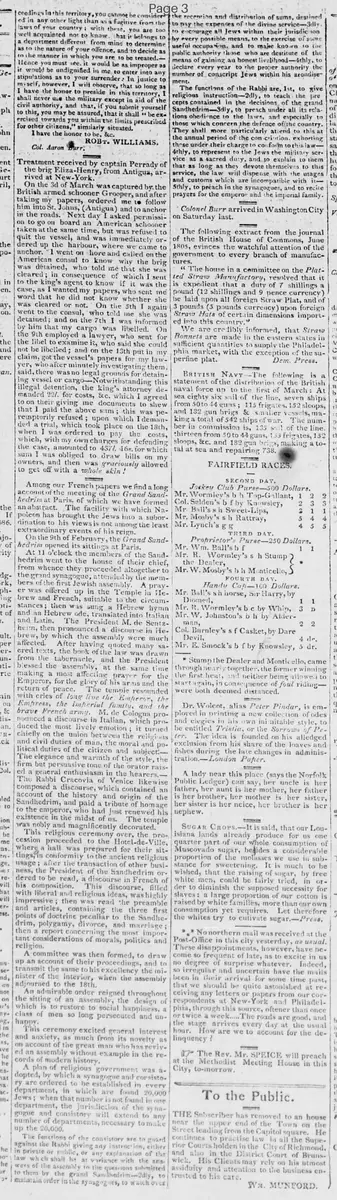
On the 9th of February, the Grand Sanhedrim opened its sittings at Paris. At 11 o'clock the members of the Sanhedrim went to the house of their chief, from whence they proceeded altogether to the grand synagogue, attended by the members of the first Jewish assembly. A prayer was offered up in the Temple in Hebrew and French, suitable to the circumstances; then was sung a Hebrew hymn and an Hebrew ode, translated into Italian and Latin. The President M. de Sentzheim, then pronounced a discourse in Hebrew, by which the assembly were much affected. After having quoted many sacred texts, the book of the law was drawn from the tabernacle, and the President blessed the assembly, "at the same time making a most affecting prayer for the Emperor, for the glory of his arms and the return of peace. The temple resounded with cries of long live the Emperor, the Empress, the imperial family, and the brave French army. M. de Cologna pronounced a discourse in Italian, which produced the most lively emotion; it turned chiefly on the union between the religious and civil duties of man, the moral and political duties of the citizen and subject:— The elegance and warmth of the style, the firm but persuasive tone of the orator raised a general enthusiasm in the hearers.— The Rabbi Cracovia of Venice likewise composed a discourse, which contained an account of the history and origin of the Sanhedrim, and paid a tribute of homage to the emperor, who had just renewed his existence in the midst of us. The temple was nobly and magnificently decorated.
This religious ceremony over, the procession proceeded to the Hotel-de-Ville, where a hall was prepared for their sittings, in conformity to the ancient religious usage; after the transaction of other business, the President of the Sanhedrim ordered to be read, a discourse in French of his composition. This discourse, filled with liberal and religious ideas, was highly impressive; then was read the preamble and articles, containing the three first points of doctrine peculiar to the Sanhedrim, polygamy, divorce, and marriage; then a report concerning the most important considerations of morals, politics and religion.
A committee was then formed, to draw up an account of their proceedings, and to transmit the same to his excellency the minister of the interior, when the assembly adjourned to the 18th.
An admirable order reigned throughout the sitting of an assembly, the design of which is to restore to social happiness, a class of men so long persecuted and unhappy.
This ceremony excited general interest and anxiety, as much from its novelty as on account of the great man who has revived an assembly without example in the records of modern history.
A plan of religious government was adopted, by which a synagogue and consistory are ordered to be established in every department, in which are found 20,000 Jews : when that number is not found in one department, the jurisdiction of the synagogue and consistory will extend to any number of departments, necessary to make up the 20,000.
The functions of the consistory are to guard against the Rabbi giving any instruction, either in private or public, or any explanation of the law which shall be at variance with the answers of the assembly to the questions submitted to them by the grand Sanhedrim—2dly, to maintain order in the synagogues, to watch over the reception and distribution of sums destined to pay the expenses of the divine service—3dly. to encourage all Jews within their jurisdiction by every possible means, to the exercise of some useful occupation, and to make known to the public authority those who are destitute of the means of gaining an honest livelihood—4thly. to declare every year to the proper authority the number of conscript Jews within his arrondissement.
The functions of the Rabbi are, 1st, to give religious instruction—2dly, to teach the precepts contained in the decisions. of the grand Sanhedrim—3dly, to preach under all its relations obedience to the laws, and especially to those which concern the defence of the country. They shall more particularly attend to this at the annual period of the conscription. exhorting those under their charge to conform to this law—4thly, to represent to the Jews the military service as a sacred duty. and to explain to them that as long as they devote themselves to this service, the law will dispense with the usages and customs which are incompatible with it—5thly, to preach in the synagogues, and to recite prayers for the emperor and the imperial family.
What sub-type of article is it?
What keywords are associated?
What entities or persons were involved?
Where did it happen?
Foreign News Details
Primary Location
Paris
Event Date
9th Of February
Key Persons
Outcome
adoption of a plan of religious government establishing synagogues and consistories in departments with 20,000 jews, defining functions for consistories and rabbis to align jewish practices with french civil, moral, and military duties.
Event Details
The Grand Sanhedrim opened its sittings in Paris with a religious ceremony at the grand synagogue, including prayers, hymns, and discourses in Hebrew, Italian, and French by President M. de Sentzheim, M. de Cologna, and Rabbi Cracovia, expressing loyalty to Napoleon. The assembly then proceeded to the Hotel-de-Ville for business, reading discourses and reports on doctrine points like polygamy, divorce, and marriage, and considerations of morals, politics, and religion. A committee was formed to report to the minister of the interior, adjourning to the 18th. The ceremony and assembly aimed to integrate persecuted Jews into social happiness under Napoleon's revival of the ancient Sanhedrim.