Thank you for visiting SNEWPapers!
Sign up free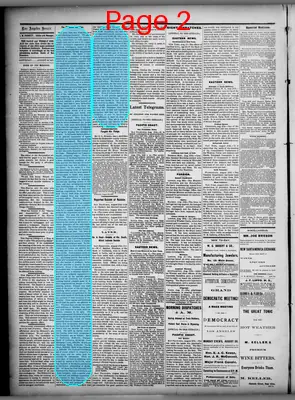
Commercial
August 28, 1875
Los Angeles Daily Herald
Los Angeles, Los Angeles County, California
What is this article about?
Report on the alarming closure of the Bank of California in San Francisco, triggering a money panic and temporary bank suspensions. Critiques California's lax banking regulations, lack of reserves and oversight, and calls for legislative reforms. Details capital of major banks and savings institutions as of July 1, 1875. Local Los Angeles banks remain stable.
Merged-components note: Merged continuation of the financial situation article across columns on page 2.
Clipping
OCR Quality
98%
Excellent
Full Text
The Financial Situation.
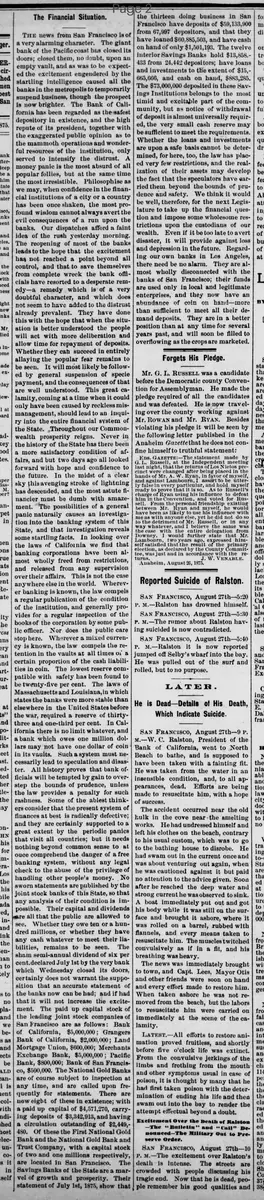
The news from San Francisco is of a very alarming character. The giant bank of the Pacific coast has closed its doors; closed them, no doubt, upon an empty vault, and as was to be expected the excitement engendered by the startling intelligence caused all the banks in the metropolis to temporarily suspend business, though the prospect is now brighter. The Bank of California has been regarded as the safest depository in existence, and the high repute of its president, together with the exaggerated public opinion as to the mammoth operations and wonderful resources of the institution, only served to intensify the distrust. A money panic is the most absurd of all popular follies, but at the same time the most irresistible. Philosophise as we may, when confidence in the financial institutions of a city or a country has been once shaken, the most profound wisdom cannot always avert the evil consequences of a run upon the banks. Our dispatches afford a faint idea of the rush yesterday morning. The reopening of most of the banks leads to the hope that the excitement has not reached a point beyond all control, and that to save themselves from complete wreck the bank officials have resorted to a desperate remedy-a remedy which is of a very doubtful character, and which does not seem to have added to the distrust already prevalent. They have done this with the hope that when the situation is better understood the people will act with more deliberation and allow time for repayment of deposits. Whether they can succeed in entirely allaying the popular fear remains to be seen. It will most likely be followed by general suspension of specie payment, and the consequences of that are well understood. This great calamity, coming at a time when it could only have been caused by reckless mismanagement, should lead to an inquiry into the entire financial system of the State. Throughout our Commonwealth prosperity reigns. Never in the history of the State has there been a more satisfactory condition of affairs, and but two days ago all looked forward with hope and confidence to the future. In the midst of a clear sky this avenging stroke of lightning has descended, and the most astute financier must be dumb with amazement. "The possibilities of a general panic naturally causes an investigation into the banking system of this State, and that investigation reveals some startling facts. In looking over the laws of California we find that banking corporations have been almost wholly freed from restrictions, and released from any supervision over their affairs. This is not the case anywhere else in the world. Wherever banking is known, the law compels a regular publication of the condition of the institution, and generally provides for a regular inspection of the books of the corporation by some public officer. Nor does the public care stop here. Wherever a mixed currency is known, the law compels the retention in the vaults at all times of a certain proportion of the cash liabilities in coin. The lowest reserve compatible with safety has been found to be twenty-five per cent. The laws of Massachusetts and Louisiana, in which states the banks were more stable than elsewhere in the United States before the war, required a reserve of thirty-three and one-third per cent. In California there is no limit whatever, and a bank which owes one million dollars may not have one dollar of coin in its vaults. Such a system must necessarily lead to speculation and disaster. All history proves that bank officials will be tempted by gain to overstep the bounds of prudence, unless the law provides a penalty for such rashness. Some of the ablest thinkers consider that the present system of finances at best is radically defective; and they are certainly supported to a great extent by the periodic panics that visit all countries; but it needs nothing beyond common sense to at once comprehend the danger of a free banking system, without any legal check to the abuse of the privilege of handling other people's money. No sworn statements are published by the joint stock banks of this State, so that any analysis of their condition is impossible. Their capital and dividends are all that the public are allowed to see. Whether they owe ten or a hundred millions, or whether they have any cash whatever to meet their liabilities, remains to be seen. The sham semi-annual dividend of six per cent. declared July 1st by the very bank which Wednesday closed its doors, certainly does not warrant the supposition that an accurate statement of the banks now can be had: and if had that it will not increase the excitement. The paid up capital stock of the leading joint stock companies of San Francisco are as follows: Bank of California, $5,000,000; Grangers Bank of California, $2,000,000; Land Mortgage Union, $600,000; Merchants Exchange Bank, $5,000,000; Pacific Bank, $800,000; Bank of San Francisco, $500,000. The National Gold Banks are of course subject to inspection at any time, and are called upon frequently for statements. There are now eight of these in existence; with a paid up capital of $4,571,270, carrying deposits of $3,342,913, and having a circulation outstanding of $2,449,480. Of these the First National Gold Bank and the National Gold Bank and Trust Company, with a capital stock of two and one millions respectively, are located in San Francisco. The Savings Banks of the State are a marvel of growth and prosperity. Their statement of July 1st, 1875, show that
the thirteen doing business in San Francisco have deposits of $59,133,900 from 67,997 depositors, and that they have loaned $60,885,503, and have cash on hand of only $1,501,193. The twelve interior Savings Banks hold $13,858,433 from 24,442 depositors; have loans and investments to the extent of $15,665,666, and cash on hand, $883,285.
The $73,000,000 deposited in these Savings Institutions belongs to the most timid and excitable part of the community, but as notice of withdrawal of deposit is almost universally required, the very small cash reserve may be sufficient to meet the requirements. Whether the loans and investments are upon a safe basis cannot be determined, for here, too, the law has placed very few restrictions, and the realization of their assets may develop the fact that the speculators have carried them beyond the bounds of prudence and safety. We think it would be well, therefore, for the next Legislature to take up the financial question and impose some wholesome restrictions upon the custodians of our wealth. Even if it be too late to avert disaster, it will provide against loss and depression in the future. Regarding our own banks in Los Angeles there need be no alarm. They are almost wholly disconnected with the banks of San Francisco; their funds are used only in local and legitimate enterprises, and they now have an abundance of coin on hand-more than sufficient to meet all their demand deposits. They are in a better position than at any time for several years past, and will soon be filled to overflowing as the crops are marketed.
The news from San Francisco is of a very alarming character. The giant bank of the Pacific coast has closed its doors; closed them, no doubt, upon an empty vault, and as was to be expected the excitement engendered by the startling intelligence caused all the banks in the metropolis to temporarily suspend business, though the prospect is now brighter. The Bank of California has been regarded as the safest depository in existence, and the high repute of its president, together with the exaggerated public opinion as to the mammoth operations and wonderful resources of the institution, only served to intensify the distrust. A money panic is the most absurd of all popular follies, but at the same time the most irresistible. Philosophise as we may, when confidence in the financial institutions of a city or a country has been once shaken, the most profound wisdom cannot always avert the evil consequences of a run upon the banks. Our dispatches afford a faint idea of the rush yesterday morning. The reopening of most of the banks leads to the hope that the excitement has not reached a point beyond all control, and that to save themselves from complete wreck the bank officials have resorted to a desperate remedy-a remedy which is of a very doubtful character, and which does not seem to have added to the distrust already prevalent. They have done this with the hope that when the situation is better understood the people will act with more deliberation and allow time for repayment of deposits. Whether they can succeed in entirely allaying the popular fear remains to be seen. It will most likely be followed by general suspension of specie payment, and the consequences of that are well understood. This great calamity, coming at a time when it could only have been caused by reckless mismanagement, should lead to an inquiry into the entire financial system of the State. Throughout our Commonwealth prosperity reigns. Never in the history of the State has there been a more satisfactory condition of affairs, and but two days ago all looked forward with hope and confidence to the future. In the midst of a clear sky this avenging stroke of lightning has descended, and the most astute financier must be dumb with amazement. "The possibilities of a general panic naturally causes an investigation into the banking system of this State, and that investigation reveals some startling facts. In looking over the laws of California we find that banking corporations have been almost wholly freed from restrictions, and released from any supervision over their affairs. This is not the case anywhere else in the world. Wherever banking is known, the law compels a regular publication of the condition of the institution, and generally provides for a regular inspection of the books of the corporation by some public officer. Nor does the public care stop here. Wherever a mixed currency is known, the law compels the retention in the vaults at all times of a certain proportion of the cash liabilities in coin. The lowest reserve compatible with safety has been found to be twenty-five per cent. The laws of Massachusetts and Louisiana, in which states the banks were more stable than elsewhere in the United States before the war, required a reserve of thirty-three and one-third per cent. In California there is no limit whatever, and a bank which owes one million dollars may not have one dollar of coin in its vaults. Such a system must necessarily lead to speculation and disaster. All history proves that bank officials will be tempted by gain to overstep the bounds of prudence, unless the law provides a penalty for such rashness. Some of the ablest thinkers consider that the present system of finances at best is radically defective; and they are certainly supported to a great extent by the periodic panics that visit all countries; but it needs nothing beyond common sense to at once comprehend the danger of a free banking system, without any legal check to the abuse of the privilege of handling other people's money. No sworn statements are published by the joint stock banks of this State, so that any analysis of their condition is impossible. Their capital and dividends are all that the public are allowed to see. Whether they owe ten or a hundred millions, or whether they have any cash whatever to meet their liabilities, remains to be seen. The sham semi-annual dividend of six per cent. declared July 1st by the very bank which Wednesday closed its doors, certainly does not warrant the supposition that an accurate statement of the banks now can be had: and if had that it will not increase the excitement. The paid up capital stock of the leading joint stock companies of San Francisco are as follows: Bank of California, $5,000,000; Grangers Bank of California, $2,000,000; Land Mortgage Union, $600,000; Merchants Exchange Bank, $5,000,000; Pacific Bank, $800,000; Bank of San Francisco, $500,000. The National Gold Banks are of course subject to inspection at any time, and are called upon frequently for statements. There are now eight of these in existence; with a paid up capital of $4,571,270, carrying deposits of $3,342,913, and having a circulation outstanding of $2,449,480. Of these the First National Gold Bank and the National Gold Bank and Trust Company, with a capital stock of two and one millions respectively, are located in San Francisco. The Savings Banks of the State are a marvel of growth and prosperity. Their statement of July 1st, 1875, show that
the thirteen doing business in San Francisco have deposits of $59,133,900 from 67,997 depositors, and that they have loaned $60,885,503, and have cash on hand of only $1,501,193. The twelve interior Savings Banks hold $13,858,433 from 24,442 depositors; have loans and investments to the extent of $15,665,666, and cash on hand, $883,285.
The $73,000,000 deposited in these Savings Institutions belongs to the most timid and excitable part of the community, but as notice of withdrawal of deposit is almost universally required, the very small cash reserve may be sufficient to meet the requirements. Whether the loans and investments are upon a safe basis cannot be determined, for here, too, the law has placed very few restrictions, and the realization of their assets may develop the fact that the speculators have carried them beyond the bounds of prudence and safety. We think it would be well, therefore, for the next Legislature to take up the financial question and impose some wholesome restrictions upon the custodians of our wealth. Even if it be too late to avert disaster, it will provide against loss and depression in the future. Regarding our own banks in Los Angeles there need be no alarm. They are almost wholly disconnected with the banks of San Francisco; their funds are used only in local and legitimate enterprises, and they now have an abundance of coin on hand-more than sufficient to meet all their demand deposits. They are in a better position than at any time for several years past, and will soon be filled to overflowing as the crops are marketed.
What sub-type of article is it?
Banking
Economic
Policy
What keywords are associated?
Bank Failure
Financial Panic
San Francisco Banks
Banking Regulations
California Finance
Savings Banks
Money Panic
What entities or persons were involved?
Bank Of California
Grangers Bank Of California
Land Mortgage Union
Merchants Exchange Bank
Pacific Bank
Bank Of San Francisco
First National Gold Bank
National Gold Bank And Trust Company
Where did it happen?
San Francisco, California
Commercial Details
Location
San Francisco, California
Event Date
July 1875
Key Figures
Bank Of California
Grangers Bank Of California
Land Mortgage Union
Merchants Exchange Bank
Pacific Bank
Bank Of San Francisco
First National Gold Bank
National Gold Bank And Trust Company
Notable Details
Bank Closure On Wednesday
Temporary Suspension Of Banks
No Reserve Requirements In California
Savings Banks Deposits $73,000,000 As Of July 1, 1875
Low Cash Reserves In Savings Banks
Call For Legislative Restrictions