Thank you for visiting SNEWPapers!
Sign up free
The New York Journal, And Weekly Register
New York, New York County, New York
What is this article about?
Proceedings of the New York House of Assembly, April 12-16, 1787, covering debates and passage of bills on Vermont independence, copper coinage, insolvent debtors, citation acts repeal, and others; messages from senate and council; resolutions on delegates and claims; list of session acts.
Clipping
OCR Quality
Full Text
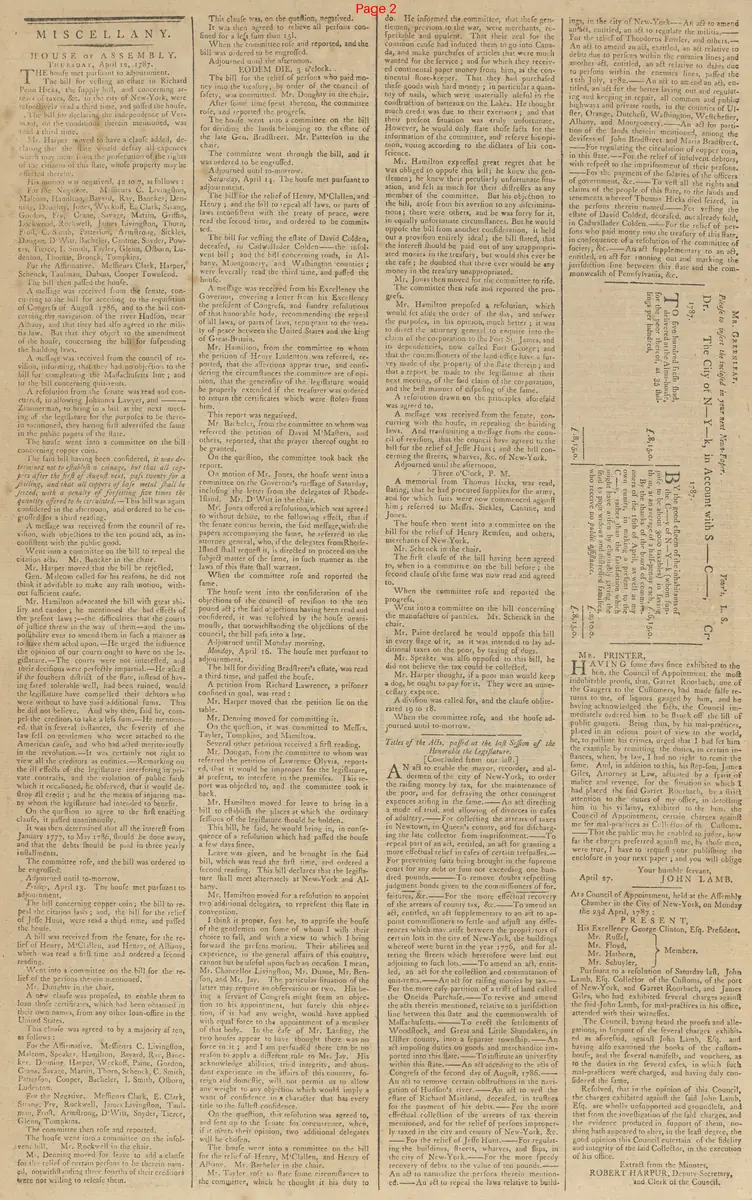
HOUSE OF ASSEMBLY.
THURSDAY, April 12, 1787.
The house met pursuant to adjournment.
The bill for vesting an estate in Richard Penn Hicks, the supply bill, and concerning arrears of taxes, &c. in the city of New-York, were respectively read a third time, and passed the house.
The bill for declaring the independence of Vermont, on the conditions therein mentioned, was read a third time.
Mr. Harper moved to have a clause added, declaring that the state would defray all expenses which may incur from the prosecution of the rights of the citizens of this state, whose property may be affected thereby.
His motion was negatived, 42 to 7, as follows:
For the Negative. Messieurs C. Livingston, Malcom, Hamilton, Bayard, Ray, Bancker, Denning, Doughty, Jones, Wyckoff, E. Clark, Strang, Gordon, Fry, Crane, Savage, Martin, Griffin, Lockwood, Rockwell, James Livingston, Thorn, Frost, C. Smith, Patterson, Armstrong, Sickles, Dongan, DeWitt, Bacheler, Cantine, Snyder, Powers, Tierce, I. Smith, Tayler, Glenn, Osborn, Livingston, Thomas, Bronck, Tompkins.
For the Affirmative. Messieurs Clark, Harper, Schenck, Tallman, Dubois, Cooper, Townsend.
The bill then passed the house.
A message was received from the senate, concurring to the bill for acceding to the requisition of Congress of August 1786, and to the bill concerning the navigation of the river Hudson, near Albany, and that they had also agreed to the militia law. But that they object to the amendment of the house, concerning the bill for suspending the building laws.
A message was received from the council of revision, informing, that they had no objection to the bill for completing the Massachusetts line; and to the bill concerning quit-rents.
A resolution from the senate was read and concurred, in allowing Johannes Lawyer, and Zimmerman, to bring in a bill at the next meeting of the legislature for the purposes to be therein mentioned, they having first advertised the same in the public papers of the state.
The house went into a committee on the bill concerning copper coin.
The said bill having been considered, it was determined not to establish a coinage, but that all coppers after the first of August next, pass twenty for a shilling, and that all coppers of base metal shall be seized, with a penalty of forfeiting five times the quantity offered to be circulated.—This bill was again considered in the afternoon, and ordered to be engrossed for a third reading.
A message was received from the council of revision, with objections to the ten pound act, as inconsistent with the public good.
Went into a committee on the bill to repeal the citation acts. Mr. Bancker in the chair.
Mr. Harper moved that the bill be rejected.
Gen. Malcom called for his reasons, he did not think it advisable to make any rash motion, without sufficient cause.
Mr. Hamilton advocated the bill with great ability and candor: he mentioned the bad effects of the present laws;—the difficulties that the courts of justice threw in the way of them—and the impossibility ever to amend them in such a manner as to have them acted upon.—He urged the influence the opinion of our courts ought to have on the legislature.—The courts were not interested, and their decisions were perfectly impartial.—He asked if the southern district of the state, instead of having fared tolerably well, had been ruined, would the legislature have compelled their debtors who were without to have paid additional sums. This he did not believe. And why then, said he, compel the creditors to take a less sum.—He mentioned, that in several instances, the severity of the law fell on gentlemen who were attached to the American cause, and who had acted meritoriously in the revolution.—It was certainly not right to view all the creditors as enemies.—Remarking on the ill effects of the legislature interfering in private contracts, and the violation of public faith which it occasioned, he observed, that it would destroy all credit; and be the means of injuring many whom the legislature had intended to benefit.
On the question to agree to the first enacting clause, it passed unanimously.
It was then determined that all the interest from January 1777, to May 1786, should be done away, and that the debts should be paid in three yearly installments.
The committee rose, and the bill was ordered to be engrossed.
Adjourned until to-morrow.
FRIDAY, April 13. The house met pursuant to adjournment.
The bill concerning copper coin; the bill to repeal the citation laws; and, the bill for the relief of Jesse Hunt, were read a third time, and passed the house.
A bill was received from the senate, for the relief of Henry McClallen, and Henry, of Albany, which was read a first time and ordered a second reading.
Went into a committee on the bill for the relief of the persons therein mentioned.
Mr. Doughty in the chair.
A new clause was proposed, to enable them to loan those certificates, which had been obtained in their own names, from any other loan-office in the United States.
This clause was agreed to by a majority of ten, as follows:
For the Affirmative. Messieurs C. Livingston, Malcom, Speaker, Hamilton, Bayard, Ray, Bancker, Denning, Harper, Wyckoff, Paine, Gordon, Crane, Savage, Martin, Thorn, Schenck, C. Smith, Patterson, Cooper, Bacheler, I. Smith, Osborn, Livingston.
For the Negative. Messieurs Clark, E. Clark, Strang, Fry, Rockwell, James Livingston, Tallman, Frost, Armstrong, DeWitt, Snyder, Tierce, Glenn, Tompkins.
The committee then rose and reported.
The house went into a committee on the insolvent bill. Mr. Rockwell in the chair.
Mr. Denning moved for leave to add a clause for the relief of certain persons to be therein named, notwithstanding three fourths of their creditors were not willing to release them.
This clause was, on the question, negatived.
It was then agreed to relieve all persons confined for a less sum than 15l.
When the committee rose and reported, and the bill was ordered to be engrossed.
Adjourned until the afternoon.
EODEM DIE, 3 o'clock.
The bill for the relief of persons who paid money into the treasury, by order of the council of safety, was committed. Mr. Doughty in the chair.
After some time spent thereon, the committee rose, and reported the progress.
The house went into a committee on the bill for dividing the lands belonging to the estate of the late Gen. Bradstreet. Mr. Patterson in the chair.
The committee went through the bill, and it was ordered to be engrossed.
Adjourned until to-morrow.
SATURDAY, April 14. The house met pursuant to adjournment.
The bill for the relief of Henry, McClallen, and Henry; and the bill to repeal all laws, or parts of laws inconsistent with the treaty of peace, were read the second time, and ordered to be committed.
The bill for vesting the estate of David Colden, deceased, in Cadwallader Colden—the insolvent bill; and the bill concerning roads, in Albany, Montgomery, and Washington counties; were severally read the third time, and passed the house.
A message was received from his Excellency the Governor, covering a letter from his Excellency the president of Congress, and sundry resolutions of that honorable body, recommending the repeal of all laws, or parts of laws, repugnant to the treaty of peace between the United States and the king of Great-Britain.
Mr. Hamilton, from the committee to whom the petition of Henry Livingston was referred, reported, that the assertions appear true, and considering the circumstances the committee are of opinion, that the generosity of the legislature would be properly extended if the treasurer was ordered to return the certificates which were stolen from him.
This report was negatived.
Mr. Bacheler, from the committee to whom was referred the petition of David McMasters, and others, reported, that the prayer thereof ought to be granted.
On the question, the committee took back the report.
On motion of Mr. Jones, the house went into a committee on the Governor's message of Saturday, enclosing the letter from the delegates of Rhode-Island. Mr. DeWitt in the chair.
Mr. Jones offered a resolution, which was agreed to without debate, to the following effect, that if the senate concur herein, the said message, with the papers accompanying the same, be referred to the attorney general, who, if the delegates from Rhode-Island shall request it, is directed to proceed on the subject matter of the same, in such manner as the laws of this state shall warrant.
When the committee rose and reported the same.
The house went into the consideration of the objections of the council of revision to the ten pound act; the said objections having been read and considered, it was resolved by the house unanimously, that notwithstanding the objections of the council, the bill pass into a law.
Adjourned until Monday morning.
MONDAY, April 16. The house met pursuant to adjournment.
The bill for dividing Bradstreet's estate, was read a third time, and passed the house.
A petition from Richard Lawrence, a prisoner confined in goal, was read:
Mr. Harper moved that the petition lie on the table.
Mr. Denning moved for committing it.
On the question, it was committed to Mess. Tayler, Tompkins, and Hamilton.
Several other petitions received a first reading.
Mr. Dongan, from the committee to whom was referred the petition of Lawrence Olyvia, reported, that it would be improper for the legislature, at present, to interfere in the premises. This report was objected to, and the committee took it back.
Mr. Hamilton moved for leave to bring in a bill to establish the places at which the ordinary sessions of the legislature should be holden.
This bill, he said, he would bring in, in consequence of a resolution which had passed the house a few days since.
Leave was given, and he brought in the said bill, which was read the first time, and ordered a second reading. This bill declares that the legislature shall meet alternately at New-York and Albany.
Mr. Hamilton moved for a resolution to appoint two additional delegates, to represent this state in convention.
I think it proper, says he, to apprise the house of the gentlemen on some of whom I wish their choice to fall, and with a view to which I bring forward the present motion. Their abilities and experience, in the general affairs of this country, cannot but be useful upon such an occasion. I mean, Mr. Chancellor Livingston, Mr. Duane, Mr. Benson, and Mr. Jay. The particular situation of the latter may require an observation or two. His being a servant of Congress might seem an objection to his appointment, but surely this objection, if it had any weight, would have applied with equal force to the appointment of a member of that body. In the case of Mr. Lansing, the two houses appear to have thought there was no force in it; and I am persuaded there can be no reason to apply a different rule to Mr. Jay. His acknowledged abilities, tried integrity, and abundant experience in the affairs of this country, foreign and domestic, will not permit us to allow any weight to any objection which would imply a want of confidence in a character that has every title to the fullest confidence.
On the question, this resolution was agreed to, and sent up to the senate for concurrence, when, if it meets their opinion, two additional delegates will be chosen.
The house went into a committee on the bill for the relief of Henry, McClallen, and Henry of Albany. Mr. Bacheler in the chair.
Mr. Tayler rose to state some circumstances to the committee, which he thought it his duty to do. He informed the committee, that these gentlemen, previous to the war, were merchants, respectable and opulent. That their zeal for the common cause had induced them to go into Canada, and make purchases of articles that were much wanted for the service; and for which they received continental paper money from him, as the continental store-keeper. That they had purchased these goods with hard money; in particular a quantity of nails, which were materially useful in the construction of batteaux on the Lakes. He thought much credit was due to their exertions; and that their present situation was truly unfortunate. However, he would only state those facts for the information of the committee, and reserve his opinion, voting according to the dictates of his conscience.
Mr. Hamilton expressed great regret that he was obliged to oppose this bill; he knew the gentlemen; he knew their peculiarly unfortunate situation, and felt as much for their distresses as any member of the committee. But his objection to the bill, arose from his aversion to any discriminations; there were others, and he was sorry for it, in equally unfortunate circumstances. But he would oppose the bill from another consideration, it held out a provision entirely ideal; the bill stated, that the interest should be paid out of any unappropriated monies in the treasury, but would this ever be the case; he doubted that there ever would be any money in the treasury unappropriated.
Mr. Jones then moved for the committee to rise.
The committee then rose and reported the progress.
Mr. Hamilton proposed a resolution, which would set aside the order of the day, and answer the purposes, in his opinion, much better; it was to direct the attorney general to enquire into the claim of the corporation to the Fort St. James, and its dependencies, now called Fort George; and that the commissioners of the land-office have a survey made of the property of the state therein; and that a report be made to the legislature at their next meeting, of the said claim of the corporation, and the best manner of disposing of the same.
A resolution drawn on the principles aforesaid was agreed to.
A message was received from the senate, concurring with the house, in repealing the building laws. And transmitting a message from the council of revision, that the council have agreed to the bill for the relief of Jesse Hunt; and the bill concerning the streets, wharves, &c. of New-York.
Adjourned until the afternoon.
Three o'Clock, P. M.
A memorial from Thomas Hicks, was read, stating, that he had procured supplies for the army, and for which suits were now commenced against him: referred to Mess. Sickles, Cantine, and Jones.
The house then went into a committee on the bill for the relief of Henry Remsen, and others, merchants of New-York.
Mr. Schenck in the chair.
The first clause of the bill having been agreed to, when in a committee on the bill before; the second clause of the same was now read and agreed to.
When the committee rose and reported the progress.
Went into a committee on the bill concerning the manufacture of pantiles. Mr. Schenck in the chair.
Mr. Paine declared he would oppose this bill in every stage of it, as it was intended to lay additional taxes on the poor, by taxing of dogs.
Mr. Speaker was also opposed to this bill, he did not believe the tax could be collected.
Mr. Harper thought, if a poor man would keep a dog, he ought to pay for it. They were an unnecessary expense.
A division was called for, and the clause obliterated 19 to 18.
When the committee rose, and the house adjourned until to-morrow.
Titles of the Acts, passed at the last Session of the Honorable the Legislature.
Concluded from our last.
An act to enable the mayor, recorder, and aldermen of the city of New-York, to order the raising money by tax, for the maintenance of the poor, and for defraying the other contingent expenses arising in the same.—An act directing a mode of trial, and allowing of divorces in cases of adultery.—For collecting the arrears of taxes in Newtown, in Queen's county, and for discharging the late collector from imprisonment.—To repeal part of an act, entitled, an act for granting a more effectual relief in cases of certain trespasses.—For preventing suits being brought in the supreme court for any debt or sum not exceeding one hundred pounds.
To remove doubts respecting judgment bonds given to the commissioners of forfeitures, &c.—For the more effectual recovery of the arrears of county tax, &c.—To amend an act, entitled, an act supplementary to an act to appoint commissioners to settle and adjust any differences which may arise between the proprietors of certain lots in the city of New-York, the buildings whereof were burnt in the year 1776, and for altering the streets which heretofore were laid out adjoining to such lots.—To amend an act, entitled, an act for the collection and commutation of quit-rents.—An act for raising monies by tax.—For the more easy partition of a tract of land called the Oneida Purchase.—To revive and amend the acts therein mentioned, relative to a jurisdiction line between this state and the commonwealth of Massachusetts.—
To erect the settlements of Woodstock, and Great and Little Shandaken, in Ulster county, into a separate township.—An act imposing duties on goods and merchandize imported into this state.—To institute an university within this state.—An act acceding to the acts of Congress of the second day of August, 1786.—An act to remove certain obstructions in the navigation of Hudson's river.—An act to vest the estate of Richard Maitland, deceased, in trustees for the payment of his debts.—For the more effectual collection of the arrears of tax therein mentioned, and for the relief of persons improperly taxed in the city and county of New-York. &c. -For the relief of Jesse Hunt.—For regulating the buildings, streets, wharves, and slips, in the city of New-York.—For the more speedy recovery of debts to the value of ten pounds.—An act to naturalize the persons therein mentioned.—An act to repeal the laws relative to buildings in the city of New-York—An act to amend an act, entitled, an act to regulate the militia.—For the relief of Theodorus Fowler, and others.—An act to amend an act, entitled, an act relative to debts due to persons within the enemies lines; and another act, entitled, an act relative to debts due to persons within the enemies lines, passed the 12th July, 1782.—An act to amend an act, entitled, an act for the better laying out and regulating and keeping in repair, all common and public highways and private roads, in the counties of Ulster, Orange, Dutchess, Washington, Westchester, Albany, and Montgomery.—An act for partition of the lands therein mentioned, among the devisees of John Bradstreet and Maria Bradstreet.
For regulating the circulation of copper coin, in this state.—For the relief of insolvent debtors, with respect to the imprisonment of their persons. -For the payment of the salaries of the officers of government, &c.—To vest all the rights and claims of the people of this state, to the lands and tenements whereof Thomas Hicks died seised, in the persons therein named.—For vesting the estate of David Colden, deceased, not already sold, in Cadwallader Colden.—For the relief of persons who paid money into the treasury of this state, in consequence of a resolution of the committee of safety, &c.—An act supplementary to an act, entitled, an act for running out and marking the jurisdiction line between this state and the commonwealth of Pennsylvania, &c.
What sub-type of article is it?
What keywords are associated?
What entities or persons were involved?
Where did it happen?
Domestic News Details
Primary Location
New York
Event Date
April 12 To 16, 1787
Key Persons
Outcome
multiple bills passed including vermont independence (with negatived amendment), copper coin regulation, repeal of citation acts, insolvent debtors relief, estate vestings, road improvements, and treaty compliance; resolutions on delegates to convention, rhode-island message referral, and fort george claim inquiry; list of session acts provided.
Event Details
The New York House of Assembly met over several days, debating and passing bills on various matters such as Vermont's independence (amendment to defray citizen expenses defeated 42-7), copper coin circulation (no coinage established, base metal penalty), repeal of citation acts (interest waived 1777-1786, three-year payments), insolvent debtors (relief for under 15l debts), relief for specific persons like Jesse Hunt, Henry McClallen, and Henry of Albany; messages from senate and council of revision concurred or objected; committees on petitions and Governor's messages; motion for alternating sessions in New-York and Albany; proposal for additional convention delegates including Mr. Chancellor Livingston, Mr. Duane, Mr. Benson, and Mr. Jay; list of acts from the session including taxes, divorces, imports, university institution, and more.