Thank you for visiting SNEWPapers!
Sign up free
The Hawaiian Gazette
Honolulu, Honolulu County, Hawaii
What is this article about?
In 1837, traveler Scott is falsely accused of murdering a peddler at a Doncaster inn after grabbing the victim's valise in panic. Trial evidence from a blacksmith's hammer exposes real killers—John Steele and son Richard—who confess to the robbery plot and are executed at York.
Clipping
OCR Quality
Full Text
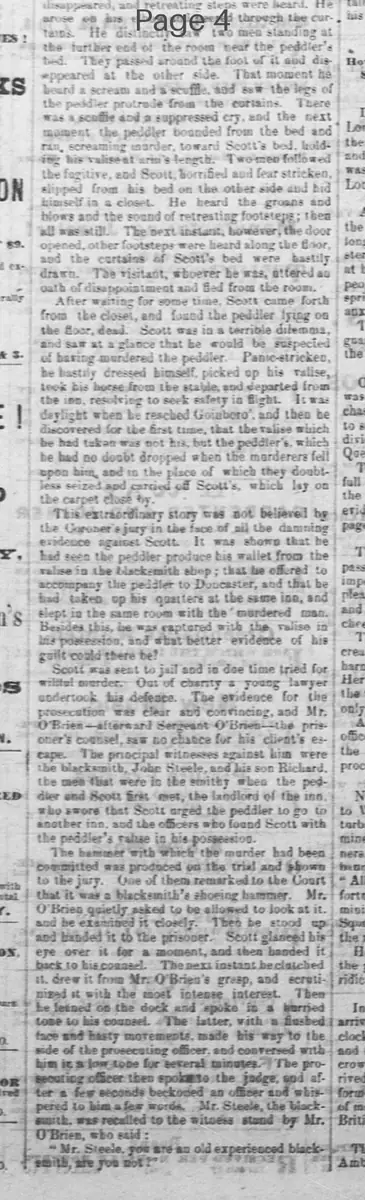
Scott had retired to rest, but the torments of the day still preyed upon his mind. He tossed and turned in uneasy slumber. Suddenly he heard a rustle and a footfall on the floor. Proceeding to the other side, this woman—he heard a tread and a groan, and Mr. somebody on the pillow turning in the curtain. There was a scuffle and a suppressed cry, and the next moment, the peddler turned from the bed and ran, screaming murder, toward Scott's bed. 'Help! Murder!' Scott awoke in terror. He followed the fugitive, and Scott, roused and fear-stricken, hastily left his bed on the other side and hid himself in a closet. He heard the groans and blows and the push of murdering footsteps; then, 'We are still.' The party imagining, however, the door opened, other footsteps were heard in the room, and the curtains of Scott's bed were largely drawn. Two figures, however, in a short time disappeared from the room.
After waiting for some time, Scott came forth from the closet, and found the peddler lying on the floor, dead. Scott was in a terrible dilemma, and saw at a glance that he could be suspected of having murdered the peddler. Panic-stricken, he hastily dressed himself, picked up his valise, took his horse from the stable, and departed from the inn, resolving to seek safety in flight. It was daylight when he reached Gainsborough, and then he discovered for the first time that the valise which he had taken was not his, but the peddler's, which he had no doubt dropped when the murderers fell upon him, and in the place of which they doubtless seized and carried off Scott's, which lay on the carpet close by.
This extraordinary story was not believed by the Coroner's jury in the face of all the damning evidence against Scott. It was shown that he had seen the peddler produce his wallet from the valise in the blacksmith shop; that he offered to accompany the peddler to Doncaster, and that he had taken up his quarters at the same inn, and slept in the same room with the murdered man. Besides this, he was captured with the valise in his possession, and what better evidence of his guilt could there be?
Scott was sent to jail and in due time tried for willful murder. Out of charity a young lawyer undertook his defense. The evidence for the prosecution was clear and convincing, and Mr. O'Brien—afterward Sergeant O'Brien—the prisoner's counsel, saw no chance for his client's escape. The principal witnesses against him were the blacksmith, John Steele, and his son Richard, the men that were in the smithy when the peddler and Scott first met, the landlord of the inn, who swore that Scott urged the peddler to go to another inn, and the officers who found Scott with the peddler's valise in his possession.
The hammer with which the murder had been committed was produced on the trial and shown to the jury. One of them remarked to the Court that it was a blacksmith's shoeing hammer. Mr. O'Brien quietly asked to be allowed to look at it, and he examined it closely. Then he stood up and handed it to the prisoner. Scott glanced his eye over it for a moment, and then handed it back to his counsel. The next instant he clutched it, drew it from Mr. O'Brien's grasp, and scrutinized it with the most intense interest. Then he leaned on the dock and spoke in a hurried tone to his counsel. The latter, with a flushed face and hasty movements, made his way to the end of the prosecuting officer, and conversed with him in a low tone for several minutes. The prosecuting officer then spoke to the judge, and after a few seconds beckoned an officer and whispered to him a few words. Mr. Steele, the blacksmith, was recalled to the witness stand by Mr. O'Brien, who said:
"Mr. Steele, you are an old experienced blacksmith, are you not?"
"Anything peculiar in the manufacture of horseshoe nails in that district, Mr. Steele?"
"I think there is, sir."
"Pray tell us what that peculiarity is, Mr. Steele."
"The head is divided in the middle."
"A mark like the head of that nail used as a gauge in the handle of that hammer, Mr. Steele," the counsel asked, handing the witness the weapon found near the body of the murdered peddler.
The witness's hand shook like a leaf as he reached it out for the hammer; his cheeks grew deadly pale, his lips became parched, and though he held the hammer in his hand his starting eyes were fixed on his questioner.
"Anything like that nail?" Mr. O'Brien repeated calmly, looking at the witness.
"Yes, sir," Steele replied at length, with difficulty.
"Should you say that nail had been made in Holderness, Mr. Steele?"
"It looks like it, sir," was Steele's reply.
"Now, Steele," the counsel said, moving almost close up to him, and standing so that judge and jury could see both witness and interrogator distinctly; "did you ever see this hammer before you saw it in this Court?"
The witness gave a gasp, and then, recovering himself, said:
"Yes, sir. I saw it in the hand of the Coroner."
At this juncture there was a disturbance in the Court, and the bailiff was seen striving to prevent a young man from quitting the room. The young man was Richard Steele, the blacksmith's son.
"Let me go," he said, "that's the old scoundrel that did it. He knows that hammer is his well enough. He knows he planned the whole thing and led me into it. I'll turn King's evidence; I'll blab the whole story. Let me go and I'll hang the old villain, though he is my father."
The scene that followed cannot be described. Suffice it to say that a nolle prosequi was entered and Scott was transferred into an important witness, Steele and his son being duly indicted and tried for the murder of the peddler. Scott swore to the blacksmith having taken the nail from an old horse shoe, remarked that it had been made in Holderness, and had driven it into the hammer head as a gauge. The hammer was furthermore identified as having belonged to Steele and testimony was given which showed that the blacksmith and his son were absent from home the night of the murder, a market man swearing he passed them near Doncaster, going in the direction of York hill, at 3 o'clock in the morning on the 21st of June. But the evidence that settled their fate was furnished by Scott's valise, which they had taken at the time of the murder of the peddler. It was discovered in the ash heap at the back of the smithy. Steele and his son were convicted and sentenced to be hanged and both made a full confession to the following effect:
Steele Sr. resolved on the robbery and the murder, if need be, of the peddler immediately after he discovered that the man was possessed of a large sum of money. After the peddler and his companion had quitted the smithy Steele closed it, and communicated to his son his design respecting the peddler. The son, who was a profligate man, assented to the scheme. Both were ready to start after the two men and get ahead of them by a bridle-path, but the smith changed his plan. If they did that they would have to attack them both in the open road and on horseback. The smith knew the inn to which they were going, and was well acquainted with the outbuildings in which they were to sleep. He proposed, therefore, that they should rob the peddler in his sleep, and only use violence in case it was necessary to secure their safety.
When they entered the outbuilding the smith went toward Scott's bed, while Richard remained near the door. Finding the man who was wanted was not there, Steele and his son approached the other bed and found the peddler, knowing it was he from his heavy breathing. They tried to remove the valise on which he slept from under his head, but he evidently had his hand in the strap, and the tug awoke him.
The reader knows the rest from the story told by Scott. After the smith and his son had quitted the room, with what they supposed was the peddler's valise, Steele's mind misgave him, and a dread that Scott had been an observer of the bloody deed, and would recognize the perpetrators, seized him.
He hurried back to the room resolved to brain Scott if he found him awake. On discovering the bed empty, the smith dropped his hammer in fright, the only explanation to his mind of Scott's absence being that he had witnessed the crime and quitted the place secretly to give the alarm. The smith and his son departed panic-stricken, and on reaching home discovered to their intense mortification and disappointment that the valise for which they had murdered a man and exposed themselves to the gallows contained a few old clothes and a Bible. Steele and his son were hanged at York, December 8, 1837.
What sub-type of article is it?
What themes does it cover?
What keywords are associated?
What entities or persons were involved?
Where did it happen?
Story Details
Key Persons
Location
Doncaster Inn, Holderness District, York
Event Date
21st Of June; Execution December 8, 1837
Story Details
Scott shares a room with a peddler at a Doncaster inn. Murderers attack the peddler at night; Scott hides, then flees with the wrong valise and is accused. At trial, lawyer O'Brien identifies a unique nail in the murder hammer linking it to blacksmith John Steele. Steele's son confesses; father and son are convicted and hanged for the robbery-murder.