Thank you for visiting SNEWPapers!
Sign up free
The Virginia Gazette
Richmond, Williamsburg, Richmond County, Virginia
What is this article about?
Lord George Gordon delivers a critical speech in the House of Commons on February 6, denouncing the King's speech, highlighting Irish grievances demanding free trade, Scottish unrest over Papist indulgences and defenseless coasts, and announcing intent to request arms for Scotland.
Clipping
OCR Quality
Full Text
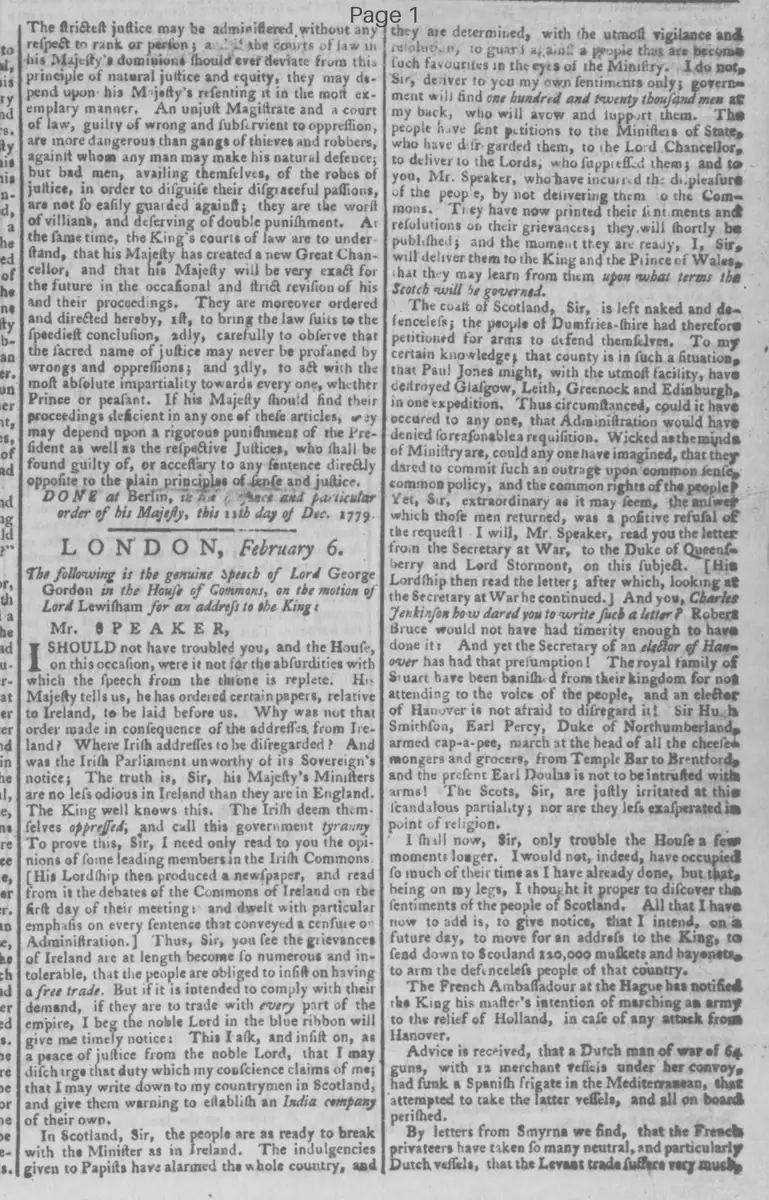
The following is the genuine Speech of Lord George Gordon in the House of Commons, on the motion of Lord Lewisham for an address to the King:
Mr. SPEAKER,
I should not have troubled you, and the House, on this occasion, were it not for the absurdities with which the speech from the throne is replete. His Majesty tells us, he has ordered certain papers, relative to Ireland, to be laid before us. Why was not that order made in consequence of the address from Ireland? Where Irish addresses to be disregarded? And was the Irish Parliament unworthy of its Sovereign's notice; The truth is, Sir, his Majesty's Ministers are no less odious in Ireland than they are in England. The King well knows this. The Irish deem themselves oppressed; and call this government tyranny. To prove this, Sir, I need only read to you the opinions of some leading members in the Irish Commons.
His Lordship then produced a newspaper, and read from it the debates of the Commons of Ireland on the first day of their meeting: and dwelt with particular emphasis on every sentence that conveyed a censure on Administration. Thus, Sir, you see the grievances of Ireland are at length become so numerous and intolerable, that the people are obliged to insist on having a free trade. But if it is intended to comply with their demand, if they are to trade with every part of the empire, I beg the noble Lord in the blue ribbon will give me timely notice: This I ask, and insist on, as a piece of justice from the noble Lord, that I may discharge that duty which my conscience claims of me; that I may write down to my countrymen in Scotland, and give them warning to establish an India company of their own.
In Scotland, Sir, the people are as ready to break with the Minister as in Ireland. The indulgencies given to Papists have alarmed the whole country, and they are determined, with the utmost vigilance and resolution, to guard against a property that are become such favourites in the eyes of the Ministry. I do not, Sir, deliver to you my own sentiments only; government will find one hundred and twenty thousand men as my back, who will avow and support them. The people have sent petitions to the Ministers of State who have disregarded them, to the Lord Chancellor, to deliver to the Lords, who suppressed them; and to you, Mr. Speaker, who have incurred the displeasure of the people, by not delivering them to the Commons. They have now printed their sentiments and resolutions on their grievances; they will shortly be published; and the moment they are ready, I, Sir, will deliver them to the King and the Prince of Wales that they may learn from them upon what terms the Scotch will be governed.
The coast of Scotland, Sir, is left naked and defenceless; the people of Dumfries-shire had therefore petitioned for arms to defend themselves. To my certain knowledge; that county is in such a situation, that Paul Jones might, with the utmost facility, have destroyed Glasgow, Leith, Greenock and Edinburgh, in one expedition. Thus circumstanced, could it have occurred to any one, that Administration would have denied so reasonable a requisition. Wicked as the minds of Ministry are, could any one have imagined, that they dared to commit such an outrage upon common sense, common policy, and the common rights of the people? Yet, Sir, extraordinary as it may seem, the answer which those men returned, was a positive refusal of the request! I will, Mr. Speaker, read you the letter from the Secretary at War, to the Duke of Queensberry and Lord Stormont, on this subject. [His Lordship then read the letter; after which, looking at the Secretary at War he continued.] And you, Charles Jenkinson how dared you to write such a letter? Robert Bruce would not have had temerity enough to have done it: And yet the Secretary of an elector of Hanover has had that presumption! The royal family of Stuart have been banished from their kingdom for not attending to the voice of the people, and an elector of Hanover is not afraid to disregard it! Sir Hugh Smithson, Earl Percy, Duke of Northumberland armed cap-a-pee, march at the head of all the cheesemongers and grocers, from Temple Bar to Brentford, and the present Earl Douglas is not to be entrusted with arms! The Scots, Sir, are justly irritated at this scandalous partiality; nor are they less exasperated in point of religion.
I shall now, Sir, only trouble the House a few moments longer. I would not, indeed, have occupied so much of their time as I have already done, but that, being on my legs, I thought it proper to discover the sentiments of the people of Scotland. All that I have now to add is, to give notice, that I intend, on a future day, to move for an address to the King, to send down to Scotland 120,000 muskets and bayonets to arm the defenceless people of that country.
What sub-type of article is it?
What keywords are associated?
What entities or persons were involved?
Where did it happen?
Foreign News Details
Primary Location
Ireland And Scotland
Event Date
February 6
Key Persons
Event Details
Lord George Gordon criticizes the King's speech, reads Irish Commons debates censuring administration, highlights Irish demands for free trade and oppression, warns of Scottish reaction including establishing an India company, discusses Scottish alarm over Papist indulgences supported by 120,000 men, notes suppressed petitions, describes defenseless Scottish coast especially Dumfries-shire vulnerable to Paul Jones, reads and condemns letter from Secretary at War refusing arms, references historical figures and partiality, and announces intent to move for 120,000 muskets for Scotland.