Thank you for visiting SNEWPapers!
Sign up free
Literary
July 17, 1787
The New York Packet
New York, New York County, New York
What is this article about?
This essay explores the instructional and entertaining value of observing minute creations like insects and birds, arguing they reveal divine wisdom and power as profoundly as celestial bodies. It discusses animal structures, perceptions, pain, nests, instincts, and God's benevolence, quoting Shakespeare and Cowley.
Clipping
OCR Quality
95%
Excellent
Full Text
MISCELLANY.
An ESSAY on the instruction and entertainment to be derived from a view of the minutest objects of creation.
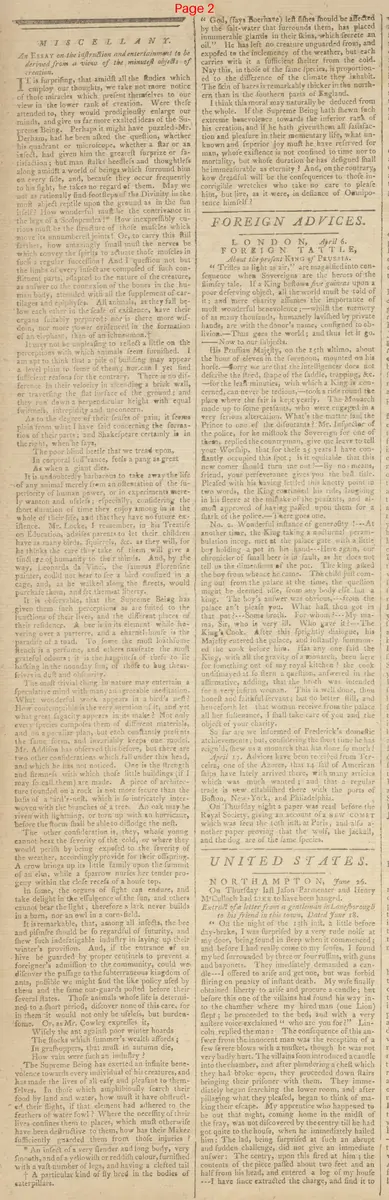
'Tis surprising, that amidst all the studies which employ our thoughts, we take not more notice of those miracles which present themselves to our view in the lower rank of creation. Were these attended to, they would prodigiously enlarge our minds, and give us far more exalted ideas of the Supreme Being. Perhaps it might have puzzled Mr. Derham, had he been asked the question, whether his quadrant or microscope, whether a star or an insect, had given him the greatest surprise or satisfaction; but man talks heedless and thoughtless along amidst a world of beings which surround him on every side, and, because they occur frequently to his sight, he takes no regard of them. May we not as rationally find footsteps of the Divinity in the most abject reptile upon the ground as in the sun itself? How wonderful must be the contrivance in the legs of a Scolopendra!* How inexpressibly curious must be the structure of those muscles which move its unnumbered joints! Or, to carry this still farther, how amazingly small must the nerves be which convey the spirits to actuate those muscles in such a regular succession! And I question not but the limbs of every insect are composed of such constituent parts, adapted to the nature of the creature, as answer to the connexion of the bones in the human body, attended with all the supplement of cartilages and epiphyses. All animals, as they fall below each other in the scale of existence, have their organs suitably prepared: nor is there more wisdom, nor more power evidenced in the formation of an elephant, than of an ichneumon.†
It may not be unpleasing to reflect a little on the perceptions with which animals themselves are furnished. I am apt to think that a pile of building may appear a level plain to some of them; nor can I yet find sufficient reasons for the contrary. There is no difference in their velocity in ascending a brick wall, or traversing the flat surface of the ground; and they run down a perpendicular height with equal swiftness, intrepidity and unconcern.
As to the degree of their senses of pain; it seems plain from what I have said concerning the formation of their parts; and Shakespeare certainly is in the right, when he says,
The poor blind beetle that we tread upon,
In corporal sufferance, feels a pang as great
As when a giant dies.
It is undoubtedly barbarous to take away the life of any animal merely from an ostentation of the superiority of human power, or in experiments merely wanton and useless; especially, considering the short duration of time they enjoy among us in the whole of their life, and that they have no future existence. Mr. Locke, I remember, in his Treatise on Education, advises parents to let their children have as many birds, squirrels, &c. as they will, for he thinks the care they take of them will give a tincture of humanity to their minds. And, by the way, Leonardo da Vinci, the famous Florentine painter, could not bear to see a bird confined in a cage, and, as he walked along the streets, would purchase them, and set them at liberty.
It is observable, that the Supreme Being has given them such perceptions as are suited to the functions of their lives, and the different places of their residence. A bee is in its element while hovering over a parterre, and a charnel-house is the paradise of a toad. To some the most loathsome stench is a perfume, and others nauseate the most grateful odours; it is the happiness of these to lie basking in the noonday sun, of those to hug themselves in dust and obscurity.
The most trivial thing in nature may entertain a speculative mind with many an agreeable meditation. What wonderful work appears in a bird's nest? How contemptible is the very mention of it, and yet what great sagacity appears in its make? Not only every species composes them of different materials, and on a peculiar plan, but each constantly presents the same form, and invariably keeps one model.
Mr. Addison has observed this before, but there are two other considerations which fall under this head, and which he has not noticed. One is the strength and firmness with which those little buildings (if I may so call them) are made. A piece of architecture founded on a rock is not more secure than the basis of a bird's-nest, which is so intricately interwoven with the branches of a tree. An oak may be riven with lightning, or torn up with an hurricane, before the storm shall be able to dislodge the nest.
The other consideration is, they, whose young cannot bear the severity of the cold, or where they would perish by being exposed to the severity of the weather, accordingly provide for their offspring. A crow brings up its little family upon the summit of an elm, while a sparrow nurses her tender progeny within the close recesses of a house top.
In some, the organs of sight can endure, and take delight in the effulgence of the sun, and others cannot bear the light, therefore a lark never builds in a barn, nor an owl in a corn-field.
It is remarkable, that, among all insects, the bee and pismire should be so regardful of futurity, and shew such indefatigable industry in laying up their winter's provision. And, if the entrance of a hive be guarded by proper sentinels to prevent a foreigner's admission to the community, could we discover the passage to the subterranean kingdom of ants, possibly we might find the like policy used by them and the same out-guards posted before their several states. Those animals whose life is determined to a short period, discover none of this care, for in them it would not only be useless, but burdensome. Or, as Mr. Cowley expresses it,
Wisely the ant against poor winter hoards
The stocks which summer's wealth affords;
In grasshoppers, that must in autumn die,
How vain were such an industry?
The Supreme Being has exerted an infinite benevolence towards every individual of his creatures, and has made the lives of all easy and pleasant to themselves. In those which amphibiously search their food by land and water, how must it have obstructed their flight, if that element had adhered to the feathers of water fowl? Where the necessity of their lives confines them to places, which must otherwise have been destructive to them, how has their Maker sufficiently guarded them from those injuries?
* An insect of a very slender and long body, very smooth, and of a yellowish or reddish colour, furnished with a vast number of legs, and having a clefted tail.
† A particular kind of fly bred in the bodies of caterpillars.
An ESSAY on the instruction and entertainment to be derived from a view of the minutest objects of creation.
'Tis surprising, that amidst all the studies which employ our thoughts, we take not more notice of those miracles which present themselves to our view in the lower rank of creation. Were these attended to, they would prodigiously enlarge our minds, and give us far more exalted ideas of the Supreme Being. Perhaps it might have puzzled Mr. Derham, had he been asked the question, whether his quadrant or microscope, whether a star or an insect, had given him the greatest surprise or satisfaction; but man talks heedless and thoughtless along amidst a world of beings which surround him on every side, and, because they occur frequently to his sight, he takes no regard of them. May we not as rationally find footsteps of the Divinity in the most abject reptile upon the ground as in the sun itself? How wonderful must be the contrivance in the legs of a Scolopendra!* How inexpressibly curious must be the structure of those muscles which move its unnumbered joints! Or, to carry this still farther, how amazingly small must the nerves be which convey the spirits to actuate those muscles in such a regular succession! And I question not but the limbs of every insect are composed of such constituent parts, adapted to the nature of the creature, as answer to the connexion of the bones in the human body, attended with all the supplement of cartilages and epiphyses. All animals, as they fall below each other in the scale of existence, have their organs suitably prepared: nor is there more wisdom, nor more power evidenced in the formation of an elephant, than of an ichneumon.†
It may not be unpleasing to reflect a little on the perceptions with which animals themselves are furnished. I am apt to think that a pile of building may appear a level plain to some of them; nor can I yet find sufficient reasons for the contrary. There is no difference in their velocity in ascending a brick wall, or traversing the flat surface of the ground; and they run down a perpendicular height with equal swiftness, intrepidity and unconcern.
As to the degree of their senses of pain; it seems plain from what I have said concerning the formation of their parts; and Shakespeare certainly is in the right, when he says,
The poor blind beetle that we tread upon,
In corporal sufferance, feels a pang as great
As when a giant dies.
It is undoubtedly barbarous to take away the life of any animal merely from an ostentation of the superiority of human power, or in experiments merely wanton and useless; especially, considering the short duration of time they enjoy among us in the whole of their life, and that they have no future existence. Mr. Locke, I remember, in his Treatise on Education, advises parents to let their children have as many birds, squirrels, &c. as they will, for he thinks the care they take of them will give a tincture of humanity to their minds. And, by the way, Leonardo da Vinci, the famous Florentine painter, could not bear to see a bird confined in a cage, and, as he walked along the streets, would purchase them, and set them at liberty.
It is observable, that the Supreme Being has given them such perceptions as are suited to the functions of their lives, and the different places of their residence. A bee is in its element while hovering over a parterre, and a charnel-house is the paradise of a toad. To some the most loathsome stench is a perfume, and others nauseate the most grateful odours; it is the happiness of these to lie basking in the noonday sun, of those to hug themselves in dust and obscurity.
The most trivial thing in nature may entertain a speculative mind with many an agreeable meditation. What wonderful work appears in a bird's nest? How contemptible is the very mention of it, and yet what great sagacity appears in its make? Not only every species composes them of different materials, and on a peculiar plan, but each constantly presents the same form, and invariably keeps one model.
Mr. Addison has observed this before, but there are two other considerations which fall under this head, and which he has not noticed. One is the strength and firmness with which those little buildings (if I may so call them) are made. A piece of architecture founded on a rock is not more secure than the basis of a bird's-nest, which is so intricately interwoven with the branches of a tree. An oak may be riven with lightning, or torn up with an hurricane, before the storm shall be able to dislodge the nest.
The other consideration is, they, whose young cannot bear the severity of the cold, or where they would perish by being exposed to the severity of the weather, accordingly provide for their offspring. A crow brings up its little family upon the summit of an elm, while a sparrow nurses her tender progeny within the close recesses of a house top.
In some, the organs of sight can endure, and take delight in the effulgence of the sun, and others cannot bear the light, therefore a lark never builds in a barn, nor an owl in a corn-field.
It is remarkable, that, among all insects, the bee and pismire should be so regardful of futurity, and shew such indefatigable industry in laying up their winter's provision. And, if the entrance of a hive be guarded by proper sentinels to prevent a foreigner's admission to the community, could we discover the passage to the subterranean kingdom of ants, possibly we might find the like policy used by them and the same out-guards posted before their several states. Those animals whose life is determined to a short period, discover none of this care, for in them it would not only be useless, but burdensome. Or, as Mr. Cowley expresses it,
Wisely the ant against poor winter hoards
The stocks which summer's wealth affords;
In grasshoppers, that must in autumn die,
How vain were such an industry?
The Supreme Being has exerted an infinite benevolence towards every individual of his creatures, and has made the lives of all easy and pleasant to themselves. In those which amphibiously search their food by land and water, how must it have obstructed their flight, if that element had adhered to the feathers of water fowl? Where the necessity of their lives confines them to places, which must otherwise have been destructive to them, how has their Maker sufficiently guarded them from those injuries?
* An insect of a very slender and long body, very smooth, and of a yellowish or reddish colour, furnished with a vast number of legs, and having a clefted tail.
† A particular kind of fly bred in the bodies of caterpillars.
What sub-type of article is it?
Essay
What themes does it cover?
Nature
Religious
Moral Virtue
What keywords are associated?
Minute Creation
Divine Wisdom
Animal Structures
Bird Nests
Insect Instincts
Natural Theology
Benevolence God
Animal Perceptions
Literary Details
Title
An Essay On The Instruction And Entertainment To Be Derived From A View Of The Minutest Objects Of Creation.
Key Lines
May We Not As Rationally Find Footsteps Of The Divinity In The Most Abject Reptile Upon The Ground As In The Sun Itself?
The Poor Blind Beetle That We Tread Upon,
In Corporal Sufferance, Feels A Pang As Great
As When A Giant Dies.
What Wonderful Work Appears In A Bird's Nest? How Contemptible Is The Very Mention Of It, And Yet What Great Sagacity Appears In Its Make?
Wisely The Ant Against Poor Winter Hoards
The Stocks Which Summer's Wealth Affords;
In Grasshoppers, That Must In Autumn Die,
How Vain Were Such An Industry?
The Supreme Being Has Exerted An Infinite Benevolence Towards Every Individual Of His Creatures, And Has Made The Lives Of All Easy And Pleasant To Themselves.