Thank you for visiting SNEWPapers!
Sign up free
Daily Republican
Wilmington, New Castle County, Delaware
What is this article about?
Morris Carberry, a watchman, fatally shot Samuel Adams at the Old Ferry Rolling Mill without provocation. Coroner's jury unanimously deemed the act willful, committing Carberry to trial without bail in New Castle jail. Editorial criticizes lack of intervention by foreman McCafferty.
Merged-components note: These components form a complete logical unit on the Carberry murder trial, inquest, and analysis; the second continues directly from the first on the same subject matter.
Clippings
1 of 2
OCR Quality
Full Text
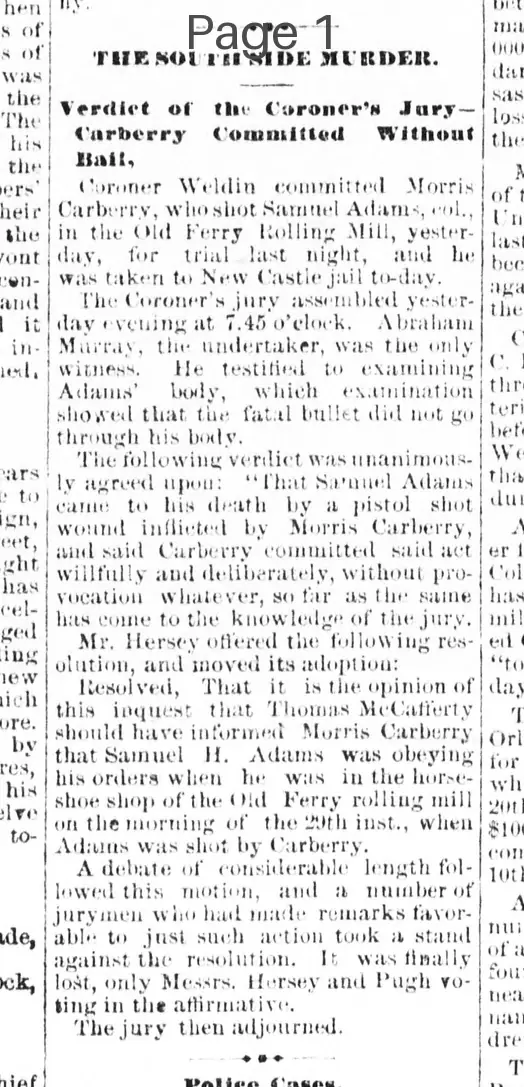
Verdict of the Coroner's Jury-
Carberry Committed without
Bail,
Coroner Weldin committed Morris Carberry, who shot Samuel Adams, col., in the Old Ferry Rolling Mill, yesterday, for trial last night, and he was taken to New Castle jail to-day. The Coroner's jury assembled yesterday evening at 7.45 o'clock. Abraham Murry, the undertaker, was the only witness. He testified to examining Adams' body, which examination showed that the fatal bullet did not go through his body.
The following verdict was unanimously agreed upon: "That Samuel Adams came to his death by a pistol shot wound inflicted by Morris Carberry, and said Carberry committed said act willfully and deliberately, without provocation whatever, so far as the same has come to the knowledge of the jury."
Mr. Hersey offered the following resolution, and moved its adoption:
Resolved, That it is the opinion of this inquest that Thomas McCafferty should have informed Morris Carberry that Samuel H. Adams was obeying his orders when he was in the horseshoe shop of the Old Ferry rolling mill on the morning of the 30th inst., when Adams was shot by Carberry.
A debate of considerable length followed this motion, and a number of jurymen who had made remarks favorable to just such action took a stand against the resolution. It was finally lost, only Messrs. Hersey and Pugh voting in the affirmative.
The jury then adjourned.
Yesterday's Murder.
With the full evidence of the coroner's inquest and the facts of yesterday's murder fully reported the public can see and judge for themselves of the enormity of the crime. Viewed all in all there was no provocation whatever for the commission of the bloody deed. Watchmen are necessarily clothed with considerable authority, and for that reason should be cool, dispassionate, brave men, who will never resort to deeds of violence except as a last resort. That Carberry had courage could not be disputed, and those who know him best know that he was unusually intelligent and a well informed man, but there his qualifications for the important position which he held, ceased. He lacked self-control, that element of character so important in every man who to the least extent has power entrusted to his hands. The fact that Carberry was a watchman in the employ of a large manufacturing company and entrusted with the protection of property and certain special interests involved which he was to guard with jealous care, will of course be used to mitigate his crime, but at the same time as was stated by Mr. Davis in his evidence such extreme action was entirely uncalled for and inexcusable, and stamped Carberry as totally unfit for the position he held. Though we do not specially desire to censure the foreman of the particular department of the works where the murder took place, yet it does seem remarkably strange that he could not during the whole time in which the deed of violence was transacted have presence of mind enough to even speak a word to Carberry, and tell him that Adams was in that mill under his direction at that time. It is natural for some people under such circumstances to lose presence of mind and to be riveted to the spot without the power of remonstrance or even speech, and the case of McCafferty is a remarkable instance of it. He testified himself that from five to ten minutes elapsed from the commencement of the attack of Carberry on Adams, until the fatal shot was fired which almost instantly killed the latter. We know how easy it is for persons to be mistaken in regard to time during such an exciting period, but even if only two minutes had elapsed, there was sufficient time for Mr. McCafferty to have said "Hold on Mr. Carberry, I ordered Adams in here to do some work." This much would have been sufficient to have checked such a reckless and impulsive man as Carberry. Of course full allowance must be made for Mr. McCafferty. He nor any other person who witnessed the deed of violence which terminated in murder, had any thought we presume that Carberry would shoot, even though he several times flourished his pistol which was heavily loaded, in Adams' face. Still most of men, especially bosses of shops, would have interfered to protect a workman acting under his orders. It may be that flourishing pistols in the face of a workman was a frequent occurrence and created no surprise, but we are inclined to think that a discriminating public will say that after a man has deliberately cocked his pistol using both hands in doing so, as Mr. McCafferty testified Carberry did, and then flourish it in the face of another man with such expressions as, "by Jesus Christ you will go out of this," it was high time that somebody should interfere, either to put the objectionable man out without allowing him to be shot, or induce the unfortunate man with the pistol to give up his weapon. It is very unfortunate for the poor man that was murdered, for Carberry, and for Mr. McCafferty, that the latter did not speak the word in time that would have saved the life of a human being, saved Carberry from the crime of murder and himself from the unpleasant reflection that he lacked presence of mind just at a time when a single word would have averted the crime which followed.
What sub-type of article is it?
What themes does it cover?
What keywords are associated?
What entities or persons were involved?
Where did it happen?
Story Details
Key Persons
Location
Old Ferry Rolling Mill, New Castle Jail
Event Date
Morning Of The 30th Inst.
Story Details
Watchman Morris Carberry shot and killed Samuel Adams in the Old Ferry Rolling Mill without provocation. Coroner's jury, after examining the body, found the act willful and deliberate, committing Carberry for trial without bail. A resolution criticizing foreman Thomas McCafferty for not intervening was rejected.