Thank you for visiting SNEWPapers!
Sign up free
The Evening Telegraph
Philadelphia, Philadelphia County, Pennsylvania
What is this article about?
Editorial from N.Y. Tribune on workingwomen's distress: capable women earn fair wages but shun domestic jobs due to pride; overcrowding in some fields; need for appealing, non-charitable affordable homes to address misery among the incapable and burdened.
Clipping
OCR Quality
Full Text
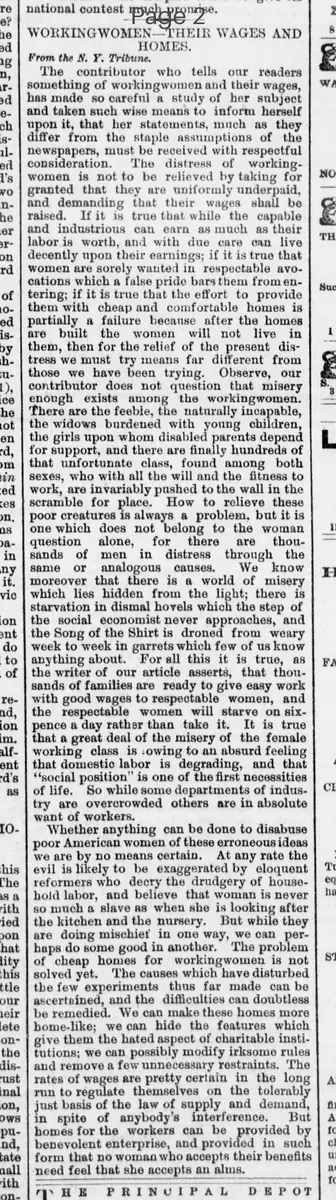
From the N. Y. Tribune.
The contributor who tells our readers something of workingwomen and their wages, has made so careful a study of her subject and taken such wise means to inform herself upon it, that her statements, much as they differ from the staple assumptions of the newspapers, must be received with respectful consideration. The distress of working women is not to be relieved by taking for granted that they are uniformly underpaid, and demanding that their wages shall be raised. If it is true that while the capable and industrious can earn as much as their labor is worth, and with due care can live decently upon their earnings; if it is true that women are sorely wanted in respectable avocations which a false pride bars them from entering: if it is true that the effort to provide them with cheap and comfortable homes is partially a failure because after the homes are built the women will not live in them, then for the relief of the present distress we must try means far different from those we have been trying. Observe, our contributor does not question that misery enough exists among the workingwomen. There are the feeble, the naturally incapable, the widows burdened with young children, the girls upon whom disabled parents depend for support, and there are finally hundreds of that unfortunate class, found among both sexes, who with all the will and the fitness to work, are invariably pushed to the wall in the scramble for place. How to relieve these poor creatures is always a problem, but it is one which does not belong to the woman question alone, for there are thousands of men in distress through the same or analogous causes.
We know moreover that there is a world of misery which lies hidden from the light; there is starvation in dismal hovels which the step of the social economist never approaches, and the Song of the Shirt is droned from weary week to week in garrets which few of us know anything about. For all this it is true, as the writer of our article asserts, that thousands of families are ready to give easy work with good wages to respectable women, and the respectable women will starve on sixpence a day rather than take it. It is true that a great deal of the misery of the female working class is owing to an absurd feeling that domestic labor is degrading, and that 'social position' is one of the first necessities of life. So while some departments of industry are overcrowded others are in absolute want of workers.
Whether anything can be done to disabuse poor American women of these erroneous ideas we are by no means certain. At any rate the evil is likely to be exaggerated by eloquent reformers who decry the drudgery of household labor, and believe that woman is never so much a slave as when she is looking after the kitchen and the nursery. But while they are doing mischief in one way, we can perhaps do some good in another. 'The problem of cheap homes for workingwomen is not solved yet. The causes which have disturbed the few experiments thus far made can be ascertained, and the difficulties can doubtless be remedied. We can make these homes more home-like: we can hide the features which give them the hated aspect of charitable institutions; we can possibly modify irksome rules and remove a few unnecessary restraints. The rates of wages are pretty certain in the long run to regulate themselves on the tolerably just basis of the law of supply and demand, in spite of anybody's interference. But homes for the workers can be provided by benevolent enterprise, and provided in such form that no woman who accepts their benefits need feel that she accepts an alms.'
What sub-type of article is it?
What themes does it cover?
What keywords are associated?
Where did it happen?
Story Details
Location
New York
Story Details
The article discusses the wages and living conditions of workingwomen, arguing that while some are underpaid or incapable, many capable women refuse decent-paying domestic jobs due to false pride and aversion to 'degrading' labor. It critiques overcrowding in certain industries and suggests improving affordable homes to make them more appealing without the stigma of charity.