Thank you for visiting SNEWPapers!
Sign up free
The New Hampshire Gazette And General Advertiser
Portsmouth, Rockingham County, New Hampshire
What is this article about?
Detailed proceedings of the U.S. House of Representatives from May 7-12, 1789, covering address to President Washington, debates on tonnage duties and impost bill (including reductions on spirits and molasses), appointment of Sergeant at Arms Joseph Wheaton, and committee on presidential titles.
Merged-components note: Continuation of congressional proceedings report across pages 1 and 2; relabeled to domestic_news as it fits local/national non-story news.
Clippings
1 of 2
OCR Quality
Full Text
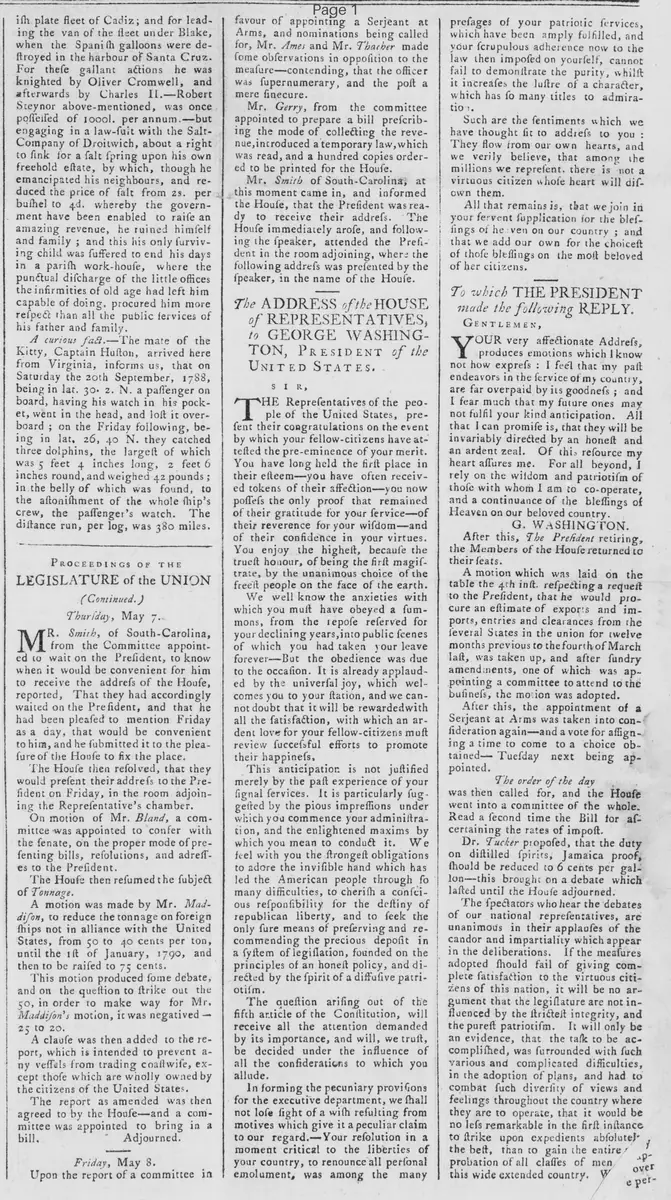
Thursday, May 7.
R. Smith, of South-Carolina, from the Committee appointed to wait on the President, to know when it would be convenient for him to receive the address of the House, reported, That they had accordingly waited on the President, and that he had been pleased to mention Friday as a day, that would be convenient to him, and he submitted it to the pleasure of the House to fix the place.
The House then resolved, that they would present their address to the President on Friday, in the room adjoining the Representative's chamber.
On motion of Mr. Bland, a committee was appointed to confer with the senate, on the proper mode of presenting bills, resolutions, and addresses to the President.
The House then resumed the subject of Tonnage.
A motion was made by Mr. Madison, to reduce the tonnage on foreign ships not in alliance with the United States, from 50 to 40 cents per ton, until the 1st of January, 1790, and then to be raised to 75 cents.
This motion produced some debate, and on the question to strike out the 50, in order to make way for Mr. Madison's motion, it was negatived - 25 to 20.
A clause was then added to the report, which is intended to prevent any vessels from trading coastwise, except those which are wholly owned by the citizens of the United States.
The report as amended was then agreed to by the House-and a committee was appointed to bring in a bill.
Adjourned.
Friday, May 8.
Upon the report of a committee in favour of appointing a Serjeant at Arms, and nominations being called for, Mr. Ames and Mr. Thacher made some observations in opposition to the measure-contending, that the officer was supernumerary, and the post a mere sinecure.
Mr. Gerry, from the committee appointed to prepare a bill prescribing the mode of collecting the revenue, introduced a temporary law, which was read, and a hundred copies ordered to be printed for the House.
Mr. Smith of South-Carolina, at this moment came in, and informed the House, that the President was ready to receive their address. The House immediately arose, and following the speaker, attended the President in the room adjoining, where the following address was presented by the speaker, in the name of the House.
The ADDRESS of the HOUSE of REPRESENTATIVES, to GEORGE WASHINGTON, PRESIDENT of the UNITED STATES.
SIR,
The Representatives of the people of the United States, present their congratulations on the event by which your fellow-citizens have attested the pre-eminence of your merit. You have long held the first place in their esteem--you have often received tokens of their affection---you now possess the only proof that remained of their gratitude for your services--of their reverence for your wisdom--and of their confidence in your virtues. You enjoy the highest, because the truest honour, of being the first magistrate, by the unanimous choice of the freest people on the face of the earth.
We well know the anxieties with which you must have obeyed a summons, from the repose reserved for your declining years, into public scenes of which you had taken your leave forever--But the obedience was due to the occasion. It is already applauded by the universal joy, which welcomes you to your station, and we cannot doubt that it will be rewarded with all the satisfaction, with which an ardent love for your fellow-citizens must review successful efforts to promote their happiness.
This anticipation is not justified merely by the past experience of your signal services. It is particularly suggested by the pious impressions under which you commence your administration, and the enlightened maxims by which you mean to conduct it. We feel with you the strongest obligations to adore the invisible hand which has led the American people through so many difficulties, to cherish a conscientious responsibility for the destiny of republican liberty, and to seek the only sure means of preserving and recommending the precious deposit in a system of legislation, founded on the principles of an honest policy, and directed by the spirit of a diffusive patriotism.
The question arising out of the fifth article of the Constitution, will receive all the attention demanded by its importance, and will, we trust, be decided under the influence of all the considerations to which you allude.
In forming the pecuniary provisions for the executive department, we shall not lose sight of a wish resulting from motives which give it a peculiar claim to our regard.--Your resolution in a moment critical to the liberties of your country, to renounce all personal emolument, was among the many presages of your patriotic services, which have been amply fulfilled, and your scrupulous adherence now to the law then imposed on yourself, cannot fail to demonstrate the purity, whilst it increases the lustre of a character, which has so many titles to admiration.
Such are the sentiments which we have thought fit to address to you: They flow from our own hearts, and we verily believe, that among the millions we represent, there is not a virtuous citizen whose heart will disown them.
All that remains is, that we join in your fervent supplication for the blessings of heaven on our country; and that we add our own for the choicest of those blessings on the most beloved of her citizens.
To which THE PRESIDENT made the following REPLY.
Gentlemen,
YOUR very affectionate Address, produces emotions which I know not how to express: I feel that my past endeavors in the service of my country, are far overpaid by its goodness; and I fear much that my future ones may not fulfil your kind anticipation. All that I can promise is, that they will be invariably directed by an honest and an ardent zeal. Of this resource my heart assures me. For all beyond, I rely on the wisdom and patriotism of those with whom I am to co-operate, and a continuance of the blessings of Heaven on our beloved country.
G. WASHINGTON.
After this, The President retiring, the Members of the House returned to their seats.
A motion which was laid on the table the 4th inst. respecting a request to the President, that he would procure an estimate of exports and imports, entries and clearances from the several States in the union for twelve months previous to the fourth of March last, was taken up, and after sundry amendments, one of which was appointing a committee to attend to the business, the motion was adopted.
After this, the appointment of a Serjeant at Arms was taken into consideration again-and a vote for assigning a time to come to a choice obtained-- Tuesday next being appointed.
The order of the day was then called for, and the House went into a committee of the whole.
Read a second time the Bill for ascertaining the rates of impost.
Dr. Tucker proposed, that the duty on distilled spirits, Jamaica proof, should be reduced to 6 cents per gallon--this brought on a debate which lasted until the House adjourned.
The spectators who hear the debates of our national representatives, are unanimous in their applauses of the candor and impartiality which appear in the deliberations. If the measures adopted should fail of giving complete satisfaction to the virtuous citizens of this nation, it will be no argument that the legislature are not influenced by the strictest integrity, and the purest patriotism. It will only be an evidence, that the task to be accomplished, was surrounded with such various and complicated difficulties, in the adoption of plans, and had to combat such diversity of views and feelings throughout the country where they are to operate, that it would be no less remarkable in the first instance to strike upon expedients absolutely the best, than to gain the entire approbation of all classes of men in this wide extended country.
Persuade ourselves however, that wise measures will be pursued, and a very general acquiescence in them will prevail among our enlightened countrymen. They will no doubt recollect, that future legislatures may amend what is found unintelligible, and correct any unequal operation, that the laws may be supposed to produce in different parts of the Union: For it is no less requisite, that a spirit of accommodation and justice should characterize the bulk of the citizens, than that it should govern those who have the management of public affairs.
Saturday, May 9.
The bill regulating the collection of the impost, was read a second time, and the house went into a committee of the whole.
Mr. Tucker proposed a reduction upon distilled spirits, Jamaica proof, introductory to a general deduction from the sums annexed to the specified articles in the bill—This was supported with great spirit by several speakers—The pernicious tendency of high duties, and the known advantages resulting from moderate ones, were again dilated upon: However, the question being put on the proposition of Mr. Tucker, it was negatived—26 to 19.
Monday, May 11.
A message from the Senate, purporting that they had appointed a committee to join with such committee as the house may appoint, to confer upon the subject of a title which it may be proper to give to the President of the United States, was read—
Upon which Mr. Parker moved, that a resolution should be adopted to this effect—That the house could not concur with the senate, having already decided upon the subject unanimously.
Mr. Page supported the motion, he was fully of opinion, that by the constitution the house had neither a right to suggest or propose any thing upon the subject. The matter was largely debated and a variety of motions were then introduced—and one from Mr. Trumbull, for appointing a committee to confer with a committee of Senate on the subject in debate, was adopted, and Messrs. Madison, Trumbull, Page, Sherman, and Benson were appointed.
In committee of the whole.
Mr. Gerry proposed, that six cents on Molasses should be struck out, and two inserted. This produced a debate, in which Mr. Ames, and Mr. Madison were the principal speakers, but the house adjourned without coming to a vote upon the proposition.
Tuesday, May 12.
Read a petition from Mr. Morse, on the subject of his American Geography: and one from several citizens of New-Jersey on the subject of the election—counter to one read some days since.
Order of the day.
The house proceeded to the choice of a Sergeant at Arms, when on balloting it was found, that Mr. Joseph Wheaton, of Rhode-Island, was chosen.
In committee of the whole.
The impost bill was taken up, and the debate upon the duty of 6 cents on molasses was resumed.
Speeches upon this occasion, were similar to those which had been made upon the previous discussion of the subject: Many of the former ideas in favour of a reduction of the duty, were amplified, and the substitution of an excise on Rum and other spirits distilled in the country, was contended for—on this side of the question the speakers were Mr. Ames, Mr. Gerry and Mr. Goodhue—their observations were closed by a proposition, to strike out six cents and leave a blank for the sum to be annexed The speakers on the other side were Mr. Madison, Mr. Fitzsimons and Mr. Sherman This part of the question had equal justice above proposition being taken, it passed in the affirmative.
It was then moved that the blank should be filled with five cents, this after some further debate passed in the affirmative, by a vote of 25 to 23.
A message from the Senate, was at this stage of the business announced, when the committee arose,—The purport of this message was, that the Senate concurred with the House in the appointment of a committee, to confer upon the subject of titles, &c.
The speaker having again left the chair.—The House in committee of the whole continued the consideration of the impost bill, when the several articles from molasses to teas inclusive, were read and accepted in committee. In the bill Hyson tea was substituted in lieu of superior green tea.
Adjourned.
What sub-type of article is it?
What keywords are associated?
What entities or persons were involved?
Domestic News Details
Event Date
May 7 12, 1789
Key Persons
Outcome
house presents address to president washington; tonnage bill amended and passed; sergeant at arms joseph wheaton appointed; impost bill debated with reductions on molasses to 5 cents per gallon approved (25-23); committee appointed to confer with senate on presidential titles.
Event Details
The House of Representatives conducts sessions from May 7 to 12, 1789, arranging and delivering an address to President Washington, debating and amending tonnage duties on foreign ships, introducing and debating impost and revenue collection bills with proposals to reduce duties on distilled spirits and molasses, appointing a Sergeant at Arms, receiving petitions, and forming a committee on presidential titles in response to Senate message.