Thank you for visiting SNEWPapers!
Sign up free
Norfolk Gazette And Publick Ledger
Norfolk, Virginia
What is this article about?
Petition from the West India Colonies to King George III protesting recent parliamentary measures on the slave trade abolition, warning of economic ruin to colonies and Britain without compensation, emphasizing historical reliance on the trade for prosperity and security.
Clipping
OCR Quality
Full Text
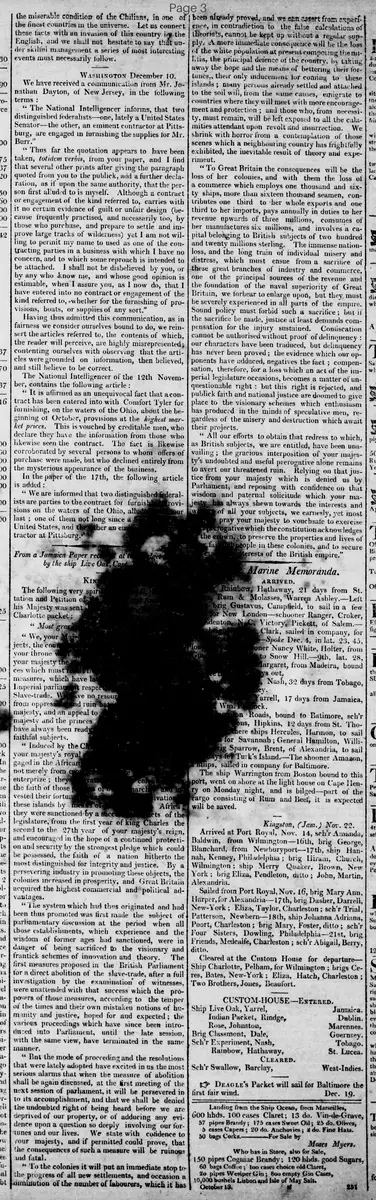
The following very spirited Representation and Petition of his Majesty's West India Colonies was sent by the Charlotte packet :
" Most gracious Sovereign,
" We, your Majesty's most dutiful and loyal subjects, the council, assembly and other inhabitants of [your throne?], humbly approach your majesty the more sensibly affected by the late measures, which have lately taken place in the Imperial parliament respecting the Slave-trade. We have no resource from oppression and ruin—but your majesty, and an appeal to your majesty and the princes [?], have always been ready faithful subjects.
" Induced by the confidence we repose in your majesty's royal favour, we presume to state, that your subjects engaged in the African trade, not merely from motives of interest, but from a reliance on the faith of those laws and institutions, under which they had embarked their fortunes in the cultivation of these islands by means of Africa they were sanctioned by successive acts of the legislature, from the first year of king Charles the second to the 27th year of your majesty's reign, and encouraged in the hope of a continued protection and security by the strongest pledge which could be possessed, the faith of a nation hitherto the most distinguished for integrity and justice. By a persevering industry in promoting these objects, the colonies increased in prosperity, and Great Britain acquired the highest commercial and political advantages.
" The system which had thus originated and had been thus promoted was first made the subject of parliamentary discussion at the period when all those establishments, which experience and the wisdom of former ages had sanctioned, were in danger of being sacrificed to the visionary and frantick schemes of innovation and theory. The first measures proposed in the British Parliament for a direct abolition of the slave-trade, after a full investigation by the examination of witnesses, were unattended with that success which the proposers of those measures, according to the temper of the times and their own mistaken notions of humanity and justice, hoped for and expected; the various proceedings which have since been introduced into Parliament, until the late session, with the same view, have terminated in the same manner.
"But the mode of proceeding and the resolutions that were lately adopted have excited in us the most serious alarms that when the measure of abolition shall be again discussed, at the first meeting of the next session of parliament, it will be persevered in to its accomplishment, and that we shall be denied the undoubted right of being heard before we are deprived of our property, or of adducing any evidence upon a question so deeply involving our fortunes and our lives. We state with confidence to your majesty, and if permitted could prove, that the consequences of such a measure will be ruinous and fatal.
" To the colonies it will put an immediate stop to the progress of all new settlements, and occasion a diminution of the number of labourers, which it has been already proved, and we can assert from experience, in contradiction to the false calculations of theorists, cannot be kept up without a regular supply. A more immediate consequence will be the loss of the white population at present composing the militia, the principal defence of the country, by taking away the hope and the means of bettering their fortunes, their only inducement for coming to these islands ; many persons already settled and attached to the soil will, from the same causes, emigrate to countries where they will meet with more encouragement and protection ; and those who, from necessity, must remain, will be left exposed to all the calamities attendant upon revolt and insurrection. We shrink with horror from a contemplation of those scenes which a neighbouring country has frightfully exhibited, the inevitable result of theory and experiment.
" To Great Britain the consequences will be the loss of her colonies, and with them the loss of a commerce which employs one thousand and sixty ships, more than sixteen thousand seamen, contributes one third to her whole exports and one third to her imports, pays annually in duties to her revenue upwards of three millions, consumes of her manufactures six millions, and involves a capital belonging to British subjects of two hundred and twenty millions sterling. The immense national loss, and the long train of individual misery and distress, which must ensue from a sacrifice of these great branches of industry and commerce, one of the principal sources of the revenue and the foundation of the naval superiority of Great Britain, we forbear to enlarge upon, but they must be severely experienced in all parts of the empire. Sound policy must forbid such a sacrifice; but if the sacrifice be made, justice at least demands compensation for the injury sustained. Confiscation cannot be authorised without proof of delinquency : our characters have been traduced, but delinquency has never been proved; the evidence which our opponents have adduced, negatives the fact ; compensation, therefore, for a loss which an act of the imperial legislature occasions, becomes a matter of unquestionable right : but this right is rejected, and publick faith and national justice are doomed to give place to the visionary schemes which enthusiasm has produced in the minds of speculative men, regardless of the misery and destruction which await their projects.
" All our efforts to obtain that redress to which, as British subjects, we are entitled, have been unavailing ; the gracious interposition of your majesty's undoubted and useful prerogative alone remains to avert our threatened ruin. Relying on that justice from your majesty which is denied us by Parliament, and reposing with confidence on that wisdom and paternal solicitude which, your majesty has always shewn towards the interests and welfare of all your subjects, we earnestly, yet most humbly pray your majesty to vouchsafe to exercise that prerogative which the constitution acknowledges in the crown, to preserve the properties and lives of your people in these colonies, and to secure the interests of the British empire."
What sub-type of article is it?
What keywords are associated?
What entities or persons were involved?
Where did it happen?
Foreign News Details
Primary Location
West India Colonies
Event Date
Late Session Of Parliament
Key Persons
Outcome
potential ruin to colonies and loss of british commerce employing 1060 ships, 16000 seamen, contributing one third to exports and imports, paying three millions in duties, without compensation
Event Details
The council, assembly, and inhabitants of the West India Colonies petition the King against recent parliamentary measures on the slave trade, arguing it was sanctioned by laws from Charles II to the 27th year of his reign, warning of halted settlements, labor shortages, emigration, risk of revolt, and massive economic losses to Britain if abolished without hearing or compensation.