Thank you for visiting SNEWPapers!
Sign up free
Literary
October 10, 1789
The Kentucky Gazette
Lexington, Fayette County, Kentucky
What is this article about?
George Morgan's essay details an improved method for managing bees using stacked wooden box hives to harvest pure honey without harming the insects, critiquing prior techniques by Wildman and White, and emphasizing ease and profitability for American beekeepers.
Clipping
OCR Quality
65%
Fair
Full Text
From the American Museum, for Feb. 1789.
Thoughts on the management of BEES.
Published by order of the Philadelphia agricultural society.
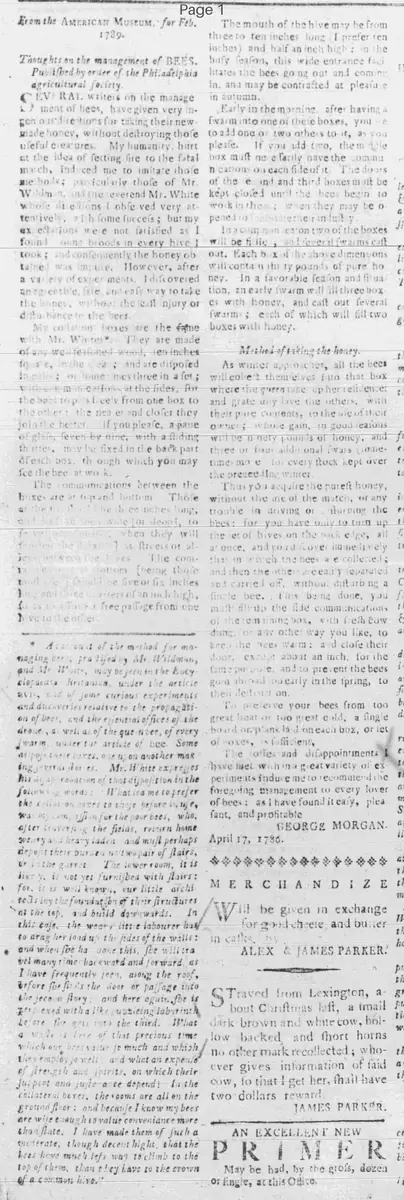
SEVERAL writers on the management of bees, have given very ingenious directions for taking their new made honey, without destroying those useful creatures. My humanity hurt at the idea of offering such to the fatal torch, induced me to imitate those methods; particularly those of Mr. Wildman, and the reverend Mr. White, whose directions I observed very attentively, with some success; but my expectations were not satisfied as I found young broods in every hive I took; and consequently the honey obtained was impure. However, after a variety of experiments, I discovered an easier and better way to take the honey, without the least injury or disturbance to the bees.
My common hives are the same with Mr. Wildman's. They are made of any well seasoned wood, ten inches square, and are disposed in sets; sometimes three in a set; raised two or three inches from the ground. In the hives top slide way from one box to the next: the nearer and closer they join the better (if you please, a pane of glass between by nature, with a sliding door in the back part of each box, through which you may fetch the bee away.
The communications between the boxes are at top and bottom. Those at the top are made long, one inch wide or deep, to when they will force or all.
res The com-
of being those
mll e live or six inches
arrers of an high,
ft deep passage from one
Pvctocor
A. one of the method for ma-
naging bees, practiced by M. Houdman,
and Mr. Wildman, may be seen in the Encyclopedia Britannica, under the article
Bee, and of some curious experiments
and discoveries relative to the propagation
of bees, and the different offices of the
drone, as well as of the queen bee, of every
warm climate, to article of bee Some
at post-their hives, one upon another making five or six. Mr. White expresses
his utter abomination of this disposition in the
following words: Whereas we may prefer
the flat one story to those near ruining,
warm em a misfortune for the poor bees, who,
after traversing the fields, return home
weary and heavily laden and must perhaps
depart her burden two pair of stairs,
dr the parent. The lower room, it is
likely, is not yet furnished with stairs:
for, it is well known, our little architects lay the foundation of their structures
at the top, and build downwards. In
this case, the weary little labourer has
to drag her load up the sides of the walls?
and when she has done this, she will travel
many times backward and forward, as
I have frequently seen, along the roof,
before she finds the door or passage into
the repository, and here again she is
perplexed with a like zig-zag labyrinth
Le one fee acts in the third. What
a waste of that precious time
which our bees value so much and which
they employ so well and what an expense
of strength and spirits, on which their
support and life are dependent -In the
collateral hives, the rooms are all on the
ground floor: and because I know my bees
are wiser on this head than I am, I have made them of such a
moderate, though decent height, that the
bees have much less way to climb to the
top of them, than they have to the crown
of a common hive."
The mouth of the hive may be from
three to ten inches long. I prefer seven
inches) and half an inch high: in the
busy season, this wide entrance facilitates
the bees going out and coming
in. and may be contracted at pleasure
in autumn.
Early in the morning, after having a
swarm into one or these boxes, you
are to add one or two others to it, as you
please. If you add two, then the second
box must necessarily have the communi-
n canons on each file of it. The doors
of the second and third boxes must be
kept closed until the bees begun to
work in them; then they may be o
pened of either the third in July
In a fortnight or so two of the boxes
will be filled, and several swarms cast
out. Each box of the above dimensions
will contain thirty pound of pure ho
ney. In a favorable season and situation,
an early swarm will fill three boxes
with honey, and cast out several
swarms; each of which will fill two
boxes with honey.
Method of taking the honey.
As winter approaches, all the bees
will collect themselves into that box
where the queen takes up her residence,
and great way leave the others, with
their pure contents, to the use of their
owner; whose gain, in good seasons
will be ninety pounds of honey, and
three or four additional swarms one-
time more for every stock kept over
the present winter
Thus you acquire the purest honey,
without the use of the match, or any
trouble in driving or throwing the
bees: for you have only to turn up
the several hives on the thick edge, all
at once, and work off immediately
the in which the bees are collected;
and then the other easily emptied,
and carried off, without disturbing a
single bee. This being done, you
make riddle the side communications
of the remaining box, with fetch cow
dung, or any other way you like, to
keep the bees warm: and close their
door. except about an inch, for the
fame purpose, and to prevent the bees
going abroad too early in the spring, to
the idleness on.
I. n e c. ve your bees from too
great heat or too great cold, a single
board or plank laid on each box, or set
of boxes, is sufficiently,
The o Te, and disappointment: I
have met with in a great variety of ex-
periments induce me to recommend the
foregoing management to every lover
of bees: as I have found it easy, plea
sant, and profitable
GEORGE MORGAN.
April 17, 1786.
Thoughts on the management of BEES.
Published by order of the Philadelphia agricultural society.
SEVERAL writers on the management of bees, have given very ingenious directions for taking their new made honey, without destroying those useful creatures. My humanity hurt at the idea of offering such to the fatal torch, induced me to imitate those methods; particularly those of Mr. Wildman, and the reverend Mr. White, whose directions I observed very attentively, with some success; but my expectations were not satisfied as I found young broods in every hive I took; and consequently the honey obtained was impure. However, after a variety of experiments, I discovered an easier and better way to take the honey, without the least injury or disturbance to the bees.
My common hives are the same with Mr. Wildman's. They are made of any well seasoned wood, ten inches square, and are disposed in sets; sometimes three in a set; raised two or three inches from the ground. In the hives top slide way from one box to the next: the nearer and closer they join the better (if you please, a pane of glass between by nature, with a sliding door in the back part of each box, through which you may fetch the bee away.
The communications between the boxes are at top and bottom. Those at the top are made long, one inch wide or deep, to when they will force or all.
res The com-
of being those
mll e live or six inches
arrers of an high,
ft deep passage from one
Pvctocor
A. one of the method for ma-
naging bees, practiced by M. Houdman,
and Mr. Wildman, may be seen in the Encyclopedia Britannica, under the article
Bee, and of some curious experiments
and discoveries relative to the propagation
of bees, and the different offices of the
drone, as well as of the queen bee, of every
warm climate, to article of bee Some
at post-their hives, one upon another making five or six. Mr. White expresses
his utter abomination of this disposition in the
following words: Whereas we may prefer
the flat one story to those near ruining,
warm em a misfortune for the poor bees, who,
after traversing the fields, return home
weary and heavily laden and must perhaps
depart her burden two pair of stairs,
dr the parent. The lower room, it is
likely, is not yet furnished with stairs:
for, it is well known, our little architects lay the foundation of their structures
at the top, and build downwards. In
this case, the weary little labourer has
to drag her load up the sides of the walls?
and when she has done this, she will travel
many times backward and forward, as
I have frequently seen, along the roof,
before she finds the door or passage into
the repository, and here again she is
perplexed with a like zig-zag labyrinth
Le one fee acts in the third. What
a waste of that precious time
which our bees value so much and which
they employ so well and what an expense
of strength and spirits, on which their
support and life are dependent -In the
collateral hives, the rooms are all on the
ground floor: and because I know my bees
are wiser on this head than I am, I have made them of such a
moderate, though decent height, that the
bees have much less way to climb to the
top of them, than they have to the crown
of a common hive."
The mouth of the hive may be from
three to ten inches long. I prefer seven
inches) and half an inch high: in the
busy season, this wide entrance facilitates
the bees going out and coming
in. and may be contracted at pleasure
in autumn.
Early in the morning, after having a
swarm into one or these boxes, you
are to add one or two others to it, as you
please. If you add two, then the second
box must necessarily have the communi-
n canons on each file of it. The doors
of the second and third boxes must be
kept closed until the bees begun to
work in them; then they may be o
pened of either the third in July
In a fortnight or so two of the boxes
will be filled, and several swarms cast
out. Each box of the above dimensions
will contain thirty pound of pure ho
ney. In a favorable season and situation,
an early swarm will fill three boxes
with honey, and cast out several
swarms; each of which will fill two
boxes with honey.
Method of taking the honey.
As winter approaches, all the bees
will collect themselves into that box
where the queen takes up her residence,
and great way leave the others, with
their pure contents, to the use of their
owner; whose gain, in good seasons
will be ninety pounds of honey, and
three or four additional swarms one-
time more for every stock kept over
the present winter
Thus you acquire the purest honey,
without the use of the match, or any
trouble in driving or throwing the
bees: for you have only to turn up
the several hives on the thick edge, all
at once, and work off immediately
the in which the bees are collected;
and then the other easily emptied,
and carried off, without disturbing a
single bee. This being done, you
make riddle the side communications
of the remaining box, with fetch cow
dung, or any other way you like, to
keep the bees warm: and close their
door. except about an inch, for the
fame purpose, and to prevent the bees
going abroad too early in the spring, to
the idleness on.
I. n e c. ve your bees from too
great heat or too great cold, a single
board or plank laid on each box, or set
of boxes, is sufficiently,
The o Te, and disappointment: I
have met with in a great variety of ex-
periments induce me to recommend the
foregoing management to every lover
of bees: as I have found it easy, plea
sant, and profitable
GEORGE MORGAN.
April 17, 1786.
What sub-type of article is it?
Essay
What themes does it cover?
Agriculture Rural
What keywords are associated?
Beekeeping
Bee Hives
Honey Extraction
Agricultural Management
Philadelphia Society
What entities or persons were involved?
George Morgan.
Literary Details
Title
Thoughts On The Management Of Bees.
Author
George Morgan.
Subject
On The Management Of Bees
Key Lines
My Humanity Hurt At The Idea Of Offering Such To The Fatal Torch, Induced Me To Imitate Those Methods; Particularly Those Of Mr. Wildman, And The Reverend Mr. White...
Thus You Acquire The Purest Honey, Without The Use Of The Match, Or Any Trouble In Driving Or Throwing The Bees...
I Have Found It Easy, Pleasant, And Profitable