Thank you for visiting SNEWPapers!
Sign up free
Letter to Editor
March 16, 1798
Gazette Of The United States, & Philadelphia Daily Advertiser
Philadelphia, Philadelphia County, Pennsylvania
What is this article about?
A letter urging the U.S. government to honor endorsements on Revolutionary War emission bills by paying interest, arguing they are binding contracts essential for national honor and credit amid potential crises.
Clipping
OCR Quality
95%
Excellent
Full Text
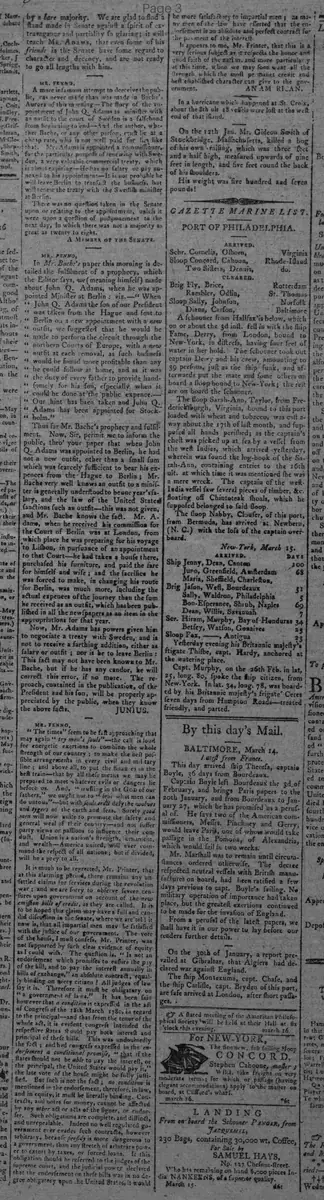
MR. FENNO,
"The times" seem to be fast approaching that may again "try men's souls"—the call is loud for energetic exertions to combine the whole strength of our country; to make the best possible arrangements in every civil and military line; and above all, to put the finances in the best train—that by all these means we may be prepared to meet whatever evils or dangers lie before us. And, "trusting in the God of our fathers," we ought not to fear what men can do unto us" but with souls armed defy the wolves and tygers of the earth and sea. Surely good men will now unite to promote the safety and general weal of their country and not suffer party views or passions to influence their conduct. Union is a nation's strength, ornament, and wealth—America united, will ever command the respect of all nations; but if divided, will be a prey to all.
It is much to be regretted, Mr. Printer, that at this alarming period, there remains any unsettled claims for services during the revolution war; and we are sorry to observe severe censures upon government on account of the new emission bills of credit, as they are called. It is to be hoped this claim may have a full and candid discussion in the senate, where we are told it now is, that all impartial men may be satisfied with the justice of our government.—The vote of the house, I must confess, Mr. Printer, was not supported by such clear evidence of equity as I could wish. The question is, "Is not an endorsement which promises to ensure the pay of the bill, and to pay the interest annually in bills of exchange," an absolute contract, equally binding on every citizen? All judges of law say it is. Therefore it must be obligatory on "a government of laws." It has been said however that a condition is expressed in the act of Congress of the 18th March 1780, in regard to the principal—and that from the tenor of the whole act, it is evident congress intended the respective states should pay both interest and principal of these bills. This was undoubtedly the sense; and had congress expressed in the endorsement a conditional promise, "that if the states should not be able to pay the interest, or the principal, the United States would pay it," the late vote of the house might be fully justified. But such is not the fact; no condition is mentioned in the endorsement, therefore, in law, and in equity, it must be literally binding. Contracts, and notes for money, cannot be affected by any other act or acts of the signer, or endorser. Such obligations are complete, and distinct, and unrepealable. Indeed no well regulated government ever evades such contracts, however arbitrary, because perfidy is more dangerous to a government, than any stretch of arbitrary power to extort by taxes, or forced loans. If this obligation should be referred to the judges of the supreme court, and the judicial power declared that the endorsement on these bills was in no degree obligatory upon the United States, it would be more satisfactory to impartial men if many men of the law have asserted that the endorsement is an absolute and perfect contract for the payment of the interest.
It appears to me, Mr. Printer, that this is a very serious subject as it regards the honor and good faith of the nation, and more particularly at this time, when we may soon want all the strength which the most permanent credit and best established character can give to the government.
AN AMERICAN.
"The times" seem to be fast approaching that may again "try men's souls"—the call is loud for energetic exertions to combine the whole strength of our country; to make the best possible arrangements in every civil and military line; and above all, to put the finances in the best train—that by all these means we may be prepared to meet whatever evils or dangers lie before us. And, "trusting in the God of our fathers," we ought not to fear what men can do unto us" but with souls armed defy the wolves and tygers of the earth and sea. Surely good men will now unite to promote the safety and general weal of their country and not suffer party views or passions to influence their conduct. Union is a nation's strength, ornament, and wealth—America united, will ever command the respect of all nations; but if divided, will be a prey to all.
It is much to be regretted, Mr. Printer, that at this alarming period, there remains any unsettled claims for services during the revolution war; and we are sorry to observe severe censures upon government on account of the new emission bills of credit, as they are called. It is to be hoped this claim may have a full and candid discussion in the senate, where we are told it now is, that all impartial men may be satisfied with the justice of our government.—The vote of the house, I must confess, Mr. Printer, was not supported by such clear evidence of equity as I could wish. The question is, "Is not an endorsement which promises to ensure the pay of the bill, and to pay the interest annually in bills of exchange," an absolute contract, equally binding on every citizen? All judges of law say it is. Therefore it must be obligatory on "a government of laws." It has been said however that a condition is expressed in the act of Congress of the 18th March 1780, in regard to the principal—and that from the tenor of the whole act, it is evident congress intended the respective states should pay both interest and principal of these bills. This was undoubtedly the sense; and had congress expressed in the endorsement a conditional promise, "that if the states should not be able to pay the interest, or the principal, the United States would pay it," the late vote of the house might be fully justified. But such is not the fact; no condition is mentioned in the endorsement, therefore, in law, and in equity, it must be literally binding. Contracts, and notes for money, cannot be affected by any other act or acts of the signer, or endorser. Such obligations are complete, and distinct, and unrepealable. Indeed no well regulated government ever evades such contracts, however arbitrary, because perfidy is more dangerous to a government, than any stretch of arbitrary power to extort by taxes, or forced loans. If this obligation should be referred to the judges of the supreme court, and the judicial power declared that the endorsement on these bills was in no degree obligatory upon the United States, it would be more satisfactory to impartial men if many men of the law have asserted that the endorsement is an absolute and perfect contract for the payment of the interest.
It appears to me, Mr. Printer, that this is a very serious subject as it regards the honor and good faith of the nation, and more particularly at this time, when we may soon want all the strength which the most permanent credit and best established character can give to the government.
AN AMERICAN.
What sub-type of article is it?
Persuasive
Political
Ethical Moral
What themes does it cover?
Economic Policy
Military War
Politics
What keywords are associated?
Revolutionary War Claims
Emission Bills
Government Contracts
National Honor
Congress Act 1780
Supreme Court
Fiscal Obligation
What entities or persons were involved?
An American.
Mr. Fenno,
Letter to Editor Details
Author
An American.
Recipient
Mr. Fenno,
Main Argument
the u.s. government is absolutely bound by endorsements on revolutionary war emission bills to pay annual interest, as they constitute unconditional contracts; failing to honor them would damage national honor and credit, especially in times of potential danger.
Notable Details
References Act Of Congress 18th March 1780
Critiques Vote Of The House
Suggests Referral To Supreme Court Judges
Emphasizes Perfidy More Dangerous Than Arbitrary Power