Thank you for visiting SNEWPapers!
Sign up free
The Daily Union
Washington, District Of Columbia
What is this article about?
On May 29, 1853, in a criminal trial, the court debates discharging a hung jury after over a day of deliberation. Defense counsel Bradley and Carlisle argue against it, citing the defendant's financial ruin and potential oppression by the government, but the judge exercises discretion to discharge the jury, as agreement seems impossible.
Clipping
OCR Quality
Full Text
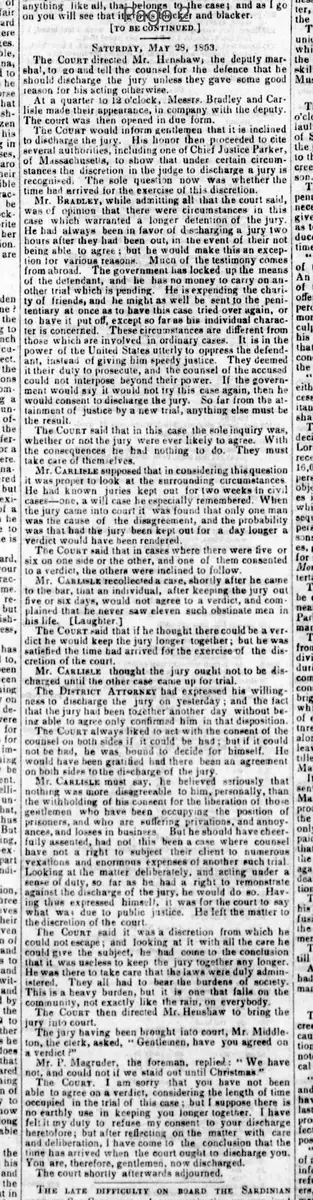
The Court directed Mr. Henshaw, the deputy marshal, to go and tell the counsel for the defence that he should discharge the jury unless they gave some good reason for his acting otherwise.
At a quarter to 12 o'clock, Messrs. Bradley and Carlisle made their appearance, in company with the deputy. The court was then opened in due form.
The Court would inform gentlemen that it is inclined to discharge the jury. His Honor then proceeded to cite several authorities, including one of Chief Justice Parker, of Massachusetts, to show that under certain circumstances the discretion in the judge to discharge a jury is recognized. The sole question now was whether the time had arrived for the exercise of this discretion.
Mr. Bradley, while admitting all that the court said, was of opinion that there were circumstances in this case which warranted a longer detention of the jury. He had always been in favor of discharging a jury two hours after they had been out, in the event of their not being able to agree; but he would make this an exception for various reasons. Such of the testimony comes from abroad. The government has locked up the means of the defendant, and he has no money to carry on any other trial which is pending. He is expending the charity of friends, and he might as well be sent to the penitentiary at once as to have this case tried over again, or to have it put off execution so far as his individual character is concerned. "These circumstances are different from those which are involved in ordinary cases. It is in the power of the United States utterly to oppress the defendant, instead of giving him speedy justice. They deemed it their duty to prosecute, and the counsel of the accused could not interpose beyond their power. If the government would say it would not try this case again, then he would consent to discharge the jury. So far from the attainment of justice by a new trial, anything else must be the result."
The Court said that in this case the sole inquiry was, whether or not the jury were ever likely to agree. With the consequences he had nothing to do. They must take care of themselves.
Mr. Carlisle supposed that in considering this question it was proper to look at the surrounding circumstances. He had known juries kept out for two weeks in civil cases—one, a will case he especially remembered. When the jury came into court it was found that only one man was the cause of the disagreement, and the probability was that had the jury been kept out for a day longer a verdict would have been rendered.
The Court said that in cases where there were five or six on one side or the other, and one of them consented to a verdict, the others were inclined to follow.
Mr. Carlisle recollected a case, shortly after he came to the bar, that an individual, after keeping the jury out five or six days, would not agree to a verdict, and complained that he never saw eleven such obstinate men in his life. [Laughter.]
The Court said that if he thought there could be a verdict he would keep the jury longer together; but he was satisfied the time had arrived for the exercise of the discretion of the court.
Mr. Carlisle thought the jury ought not to be discharged until the other case came up for trial.
The District Attorney had expressed his willingness to discharge the jury on yesterday; and the fact that the jury had been together another day without being able to agree only confirmed him in that disposition.
The Court always liked to act with the consent of the counsel on both sides if it could be had; but if it could not be had, he was bound to decide for himself. He would have been gratified had there been an agreement on both sides to the discharge of the jury.
Mr. Carlisle must say, he believed seriously that nothing was more disagreeable to him, personally, than the withholding of his consent for the liberation of those gentlemen who have been occupying the position of prisoners, and who are suffering privations, and annoyances, and losses in business. But he should have cheerfully assented, had not this been a case where counsel have not a right to subject their client to numerous vexations and enormous expenses of another such trial. Looking at the matter deliberately, and acting under a sense of duty, so far as he had a right to remonstrate against the discharge of the jury, he would do so. Having thus expressed himself, it was for the court to say what was due to public justice. He left the matter to the discretion of the court.
The Court said it was a discretion from which he could not escape; and looking at it with all the care he could give the subject, he had come to the conclusion that it was useless to keep the jury together any longer. He was there to take care that the laws were duly administered. They all had to bear the burdens of society. This is a heavy burden, but it is one that falls on the community, not exactly like the rain, on everybody.
The Court then directed Mr. Henshaw to bring the jury into court.
The jury having been brought into court, Mr. Middleton, the clerk, asked, "Gentlemen, have you agreed on a verdict?"
Mr. P. Magruder, the foreman, replied: "We have not, and could not if we staid out until Christmas."
The Court: I am sorry that you have not been able to agree on a verdict, considering the length of time occupied in the trial of this case; but I suppose there is no earthly use in keeping you longer together. I have felt it my duty to refuse my consent to your discharge heretofore: but after reflecting on the matter with care and deliberation, I have come to the conclusion that the time has arrived when the court ought to discharge you. You are, therefore, gentlemen, now discharged.
What sub-type of article is it?
What themes does it cover?
What keywords are associated?
What entities or persons were involved?
Story Details
Key Persons
Event Date
1853 05 29
Story Details
In a criminal trial, after the jury deliberates over a day without agreement, defense counsel argues against discharge due to the defendant's impoverished state and potential government oppression from retrial, but the judge, citing judicial discretion, discharges the hung jury upon confirming their inability to agree.