Thank you for visiting SNEWPapers!
Sign up free
Norfolk Gazette And Publick Ledger
Norfolk, Virginia
What is this article about?
The Boston Centinel republishes 1814 official documents on Napoleon Bonaparte's abdication, the treaty with Allied Powers granting him Elba and family provisions, and Allies' declaration against treating with him, amid his recent return to France causing a European crisis and debate on treaty violations.
Merged-components note: Sequential components continuing the article on the European crisis, including official documents on Napoleon's abdication, treaty, and allied declaration.
Clipping
OCR Quality
Full Text
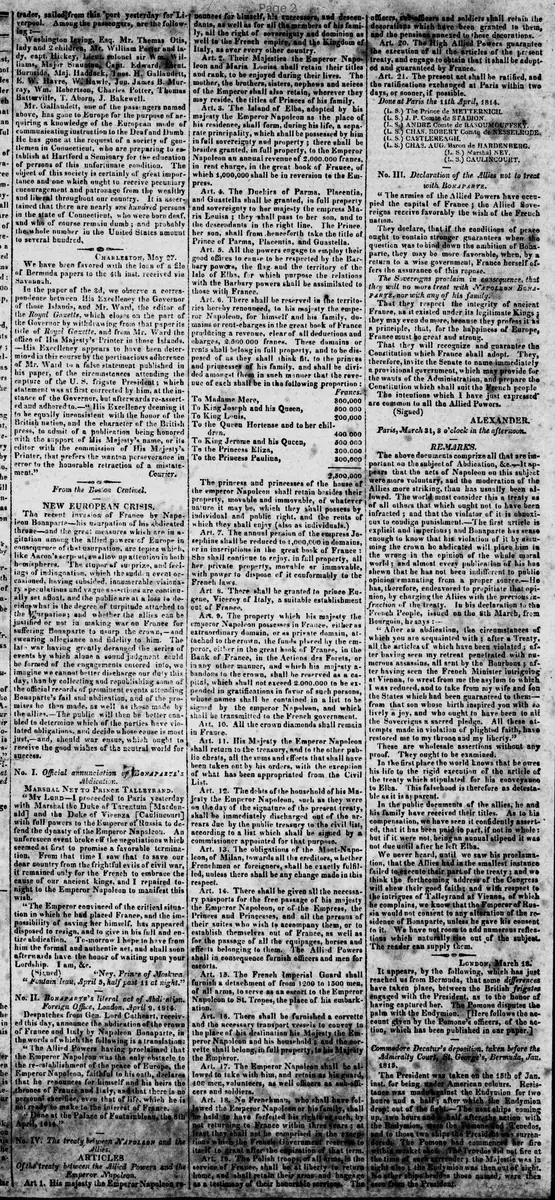
NEW EUROPEAN CRISIS.
The recent invasion of France by Napoleon Bonaparte--his usurpation of his abdicated throne--and the great measures which are in agitation among the allied powers of Europe in consequence of that usurpation, are topics which, like Aaron's serpent, swallow up attention in both hemispheres. The stupor of surprise, and feelings of indignation which the sudden event occasioned, having subsided, innumerable visionary speculations and vague assertions are continually set afloat, and the public are at a loss to decide what is the degree of turpitude attached to the usurpation; and whether the allies can be justified or not in making war on France for suffering Bonaparte to usurp the crown,--and swearing allegiance and fidelity to him. The late war having greatly deranged the series of events by which alone a sound judgment could be formed of the engagements entered into, we imagine we cannot better discharge our duty this day, than by collecting and republishing some of the official records of prominent events attending Bonaparte's fall and abdication, and of the promises he then made, as well as those made by the allies.--The public will then be better enabled to determine which of the parties have violated obligations, and decide whose cause is most just,--and, should war ensue, which ought to receive the good wishes of the neutral world for success.
No. I. Official annunciation of NAPOLEON'S Abdication.
Marshal Ney to Prince Talleyrand.
"My Lord--I proceeded to Paris yesterday with Marshal the Duke of Tarentum [Macdonald] and the Duke of Vicenza [Caulincourt] with full powers to the Emperor of Russia to defend the dynasty of the Emperor Napoleon. An unforeseen event broke off the negotiations which seemed at first to promise a favorable termination. From that time I saw that to save our dear country from the frightful evils of civil war, it remained only for the French to embrace the cause of our ancient kings, and I repaired to-night to the Emperor Napoleon to manifest this wish.
"The Emperor convinced of the critical situation in which he had placed France, and the impossibility of saving her himself, has appeared disposed to resign, and to give in his full and entire abdication. To-morrow I hope to have from him the formal and authentic act, and shall soon afterwards have the honor of waiting upon your Lordship. I am, &c.
(Signed) "Ney, Prince of Moskwa.
"Fontainbleau, April 5, half past 11 at night."
No. II. Bonaparte's literal act of Abdication.
Foreign Office, London. April 9, 1814.
Despatches from Gen. Lord Cathcart, received this day, announce the abdication of the crown of France and Italy by Napoleon Bonaparte, in the words of which the following is a translation:
"The Allied Powers having proclaimed that the Emperor Napoleon was the only obstacle to the re-establishment of the peace of Europe, the Emperor Napoleon, faithful to his oath, declares that he renounces for himself and his heirs the thrones of France and Italy, and that there is no personal sacrifice, even that of life, which he is not ready to make to the interest of France.
Done at the Palace of Fontainebleau the 6th April, 1814."
The treaty between the Allied Powers and the Emperor Napoleon.
ARTICLES
The treaty between the Allied Powers and the Emperor Napoleon.
His majesty the Emperor Napoleon renounces for himself, his successors, and descendants, as well as for all the members of his family, all the right of sovereignty and dominion as well to the French empire, and the Kingdom of Italy, as over every other country.
Art. 2. Their Majesties the Emperor Napoleon and Maria Louisa shall retain their titles and rank, to be enjoyed during their lives. The mother, the brothers, sisters, nephews and nieces of the Emperor shall also retain, wherever they may reside, the titles of Princes of his family.
Art. 3. The Island of Elba, adopted by his majesty the Emperor Napoleon as the place of his residence, shall form, during his life, a separate principality, which shall be possessed by him in full sovereignty and property; there shall be besides granted, in full property, to the Emperor Napoleon an annual revenue of 2,000,000 francs, in rent charge, in the great book of France, of which 1,000,000 shall be in reversion to the Empress.
Art. 4. The Duchies of Parma, Placentia, and Guastalla shall be granted, in full property and sovereignty to her majesty the empress Maria Louisa; they shall pass to her son, and to the descendants in the right line. The Prince, her son, shall from henceforth take the title of Prince of Parma, Placentia, and Guastalla.
Art. 5. All the powers engage to employ their good offices to cause to be respected by the Barbary powers, the flag and the territory of the Island of Elba, for which purpose the relations with the Barbary powers shall be assimilated to those with France.
Art. 6. There shall be reserved in the territories hereby renounced, to his majesty the emperor Napoleon, for himself and his family, domains or rent-charges in the great book of France producing a revenue, clear of all deductions and charges, 2,500,000 francs. These domains or rents shall belong in full property, and to be disposed of as they shall think fit, to the princes and princesses of his family, and shall be divided amongst them in such manner that the revenue of each shall be in the following proportion:
Francs.
To Madame Mere, 300,000
To King Joseph and his Queen, 600,000
To King Louis, 200,000
To the Queen Hortense and to her children, 400,000
To King Jerome and his Queen, 300,000
To the Princess Eliza, 300,000
To the Princess Paulina, 300,000
2,300,000
The princess and princesses of the house of the emperor Napoleon shall retain besides their property, movable and immovable, of whatever nature it may be, which they shall possess by individual and public right, and the rents of which they shall enjoy (also as individuals.)
Art. 7. The annual pension of the empress Josephine shall be reduced to 1,000,000 in domains, or in inscriptions in the great book of France: She shall continue to enjoy, in full property, all her private property, movable or immovable, with power to dispose of it conformably to the French laws.
Art. 8. There shall be granted to prince Eugene, Viceroy of Italy, a suitable establishment out of France.
Art. 9. The property which his majesty the emperor Napoleon possesses in France, either as extraordinary domain, or as private domain, attached to the crown, the funds placed by the emperor, either in the great book of France, in the Bank of France, in the Actions des Forets, or in any other manner, and which his majesty abandons to the crown, shall be reserved as a capital, which shall not exceed 2,000,000 to be expended in gratifications in favor of such persons, whose names shall be contained in a list to be signed by the emperor Napoleon, and which shall be transmitted to the French government.
Art. 10. All the crown diamonds shall remain in France.
Art. 11. His Majesty the Emperor Napoleon shall return to the treasury, and to the other public chests, all the sums and effects that shall have been taken out by his orders, with the exception of what has been appropriated from the Civil List.
Art. 12. The debts of the household of his Majesty the Emperor Napoleon, such as they were on the day of the signature of the present treaty, shall be immediately discharged out of the arrears due by the public treasury to the civil list, according to a list which shall be signed by a commissioner appointed for that purpose.
Art. 13. The obligations of the Mont-Napoleon, of Milan, towards all the creditors, whether Frenchmen or foreigners, shall be exactly fulfilled, unless there shall be any change made in this respect.
Art. 14. There shall be given all the necessary passports for the free passage of his majesty the Emperor Napoleon, or of the Empress, the Princes and Princesses, and all the persons of their suites who wish to accompany them, or to establish themselves out of France, as well as for the passage of all the equipages, horses and effects belonging to them. The Allied Powers shall in consequence furnish officers and men for escorts.
Art. 15. The French Imperial Guard shall furnish a detachment of from 1200 to 1500 men, of all arms, to serve as an escort to the Emperor Napoleon to St. Tropes, the place of his embarkation.
Art. 16. There shall be furnished a corvette and the necessary transport vessels to convey to the place of his destination his Majesty the Emperor Napoleon and his household and the corvette shall belong, in full property, to his Majesty the Emperor.
Art. 17. The Emperor Napoleon shall be allowed to take with him, and retain as his guard, 400 men, volunteers, as well of officers as sub-officers and soldiers.
Art. 18. No Frenchman, who shall have followed the Emperor Napoleon or his family shall be held to have forfeited his rights as such, by not returning to France within three years; at least they shall not be comprised in the exception which the French Government reserves to itself to grant after the expiration of that term.
Art. 19. The Polish troops, of all arms in the service of France, shall be at liberty to return home and shall retain their arms and baggage as a testimony of their honorable services.
Art. 20. The officers, sub-officers and soldiers shall retain the decorations which have been granted to them and the pensions annexed to those decorations.
Art. 21. The High Allied Powers guarantee the execution of all the articles of the present treaty, and engage to obtain that it shall be adopted and guaranteed by France.
Art. 22. The present act shall be ratified, and the ratifications exchanged at Paris within two days, or sooner, if possible.
Done at Paris the 11th April, 1814.
(L. S.) The Prince de METTERNICH
(L. S.) J. P. Comte de STADION.
(L. S.) ANDRE Comte de RASOUMOWSKY.
(L. S.) CHAS. ROBERT Comte de NESSELRODE.
(L. S.) CASTLEREAGH.
(L. S.) CHAS. AUG. Baron de HARDENBERG.
(L. S.) Marshal NEY.
(L. S.) CAULINCOURT.
No. III. Declaration of the Allies not to treat with BONAPARTE.
"The armies of the Allied Powers have occupied the capital of France; the Allied Sovereigns receive favorably the wish of the French nation.
They declare, that if the conditions of peace ought to contain stronger guarantees when the question was to bind down the ambition of Bonaparte, they may be more favorable, when, by a return to a wise government, France herself offers the assurance of this repose.
The Sovereigns proclaim in consequence, that they will no more treat with Napoleon Bonaparte, nor with any of his family.
That they respect the integrity of ancient France, as it existed under its legitimate Kings; they may even do more, because they profess it as a principle, that, for the happiness of Europe, France must be great and strong.
That they will recognize and guarantee the Constitution which France shall adopt. They, therefore, invite the Senate to name immediately a provisional government, which may provide for the wants of the Administration, and prepare the Constitution which shall suit the French people.
The intentions which I have just expressed are common to all the Allied Powers.
(Signed) ALEXANDER.
Paris, March 31, 8 o'clock in the afternoon.
REMARKS.
The above documents comprise all that are important on the subject of Abdication, &c.--It appears that the acts of Napoleon on this subject were more voluntary, and the moderation of the Allies more striking, than has usually been allowed. The world must consider this a treaty as of all others that which ought not to have been infringed: and that the violator of it is obnoxious to condign punishment.--The first article is explicit and imperious; and Bonaparte has sense enough to know that his violation of it by assuming the crown he abdicated will place him in the wrong in the opinion of the whole moral world; and almost every publication of his has shewn that he has not been indifferent to public opinion emanating from a proper source. -He has, therefore, endeavored to propitiate that opinion, by charging the Allies with the previous infraction of the treaty. In his declaration to the French People, issued on the 8th March, from Bourgoin, he says:--
"After an abdication, the circumstances of which you are acquainted with: after a Treaty, all the articles of which have been violated; after having seen my retreat penetrated with my numerous assassins, all sent by the Bourbons; after having seen the French Minister intriguing at Vienna, to wrest from me the asylum to which I was reduced, and to take from my wife and son the States which had been guaranteed to them--from that son whose birth inspired you with so lively a joy, and who ought to have been to all the Sovereigns a sacred pledge. All these attempts made in violation of plighted faith, have restored me to my throne and my liberty."
These are wholesale assertions without any proof. They ought to be examined.
In the first place the world knows that he owes his life to the rigid execution of the article of the treaty which stipulated for his conveyance to Elba. This falsehood is therefore as detestable as it is apparent.
In the public documents of the allies, he and his family have received their titles. As to his compensation, we have seen it confidently asserted, that it has been paid in part, if not in whole: but if it were not, being an annual stipend it was not due until after he left Elba.
We never heard, until we saw his proclamation, that the Allies had in the smallest instance failed to execute their part of the treaty: and we think the forthcoming address of the Congress will shew their good faith; and with respect to the intrigues of Talleyrand at Vienna, of which he complains, we know that the Emperor of Russia would not consent to any alteration of the residence of Bonaparte, unless he gave his consent to it. We have not room to add numerous reflections which naturally rise out of the subject. The reader can supply them.
What sub-type of article is it?
What keywords are associated?
What entities or persons were involved?
Where did it happen?
Foreign News Details
Primary Location
France
Event Date
April 1814
Key Persons
Outcome
napoleon abdicated thrones of france and italy; granted sovereignty over elba with 2,000,000 francs revenue; family received titles, pensions, and territories like parma for maria louisa; allies declared no further treaties with bonaparte or family, guaranteeing ancient france's integrity.
Event Details
Official documents detail Napoleon's abdication on April 6, 1814, at Fontainebleau; treaty signed April 11, 1814, in Paris renouncing sovereignty for himself and family, providing Elba as principality, revenues, and provisions for family; Allies' declaration on March 31, 1814, in Paris refuses to treat with Bonaparte, invites French Senate to form provisional government; remarks debate treaty violations amid Napoleon's recent return.