Thank you for visiting SNEWPapers!
Sign up free
Editorial
September 13, 1796
Gazette Of The United States, & Philadelphia Daily Advertiser
Philadelphia, Philadelphia County, Pennsylvania
What is this article about?
An editorial from the New-York Herald critiques Thomas Paine's pamphlet arguing for England's impending bankruptcy, dismissing his ideas as unoriginal and asserting that bankruptcy would actually strengthen Britain's credit and resources, contrary to French and democratic hopes.
Clipping
OCR Quality
98%
Excellent
Full Text
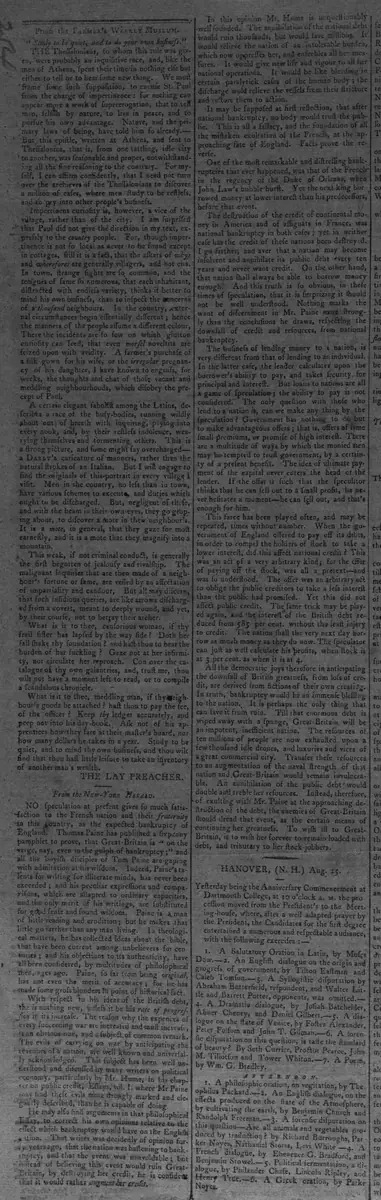
From the New-York Herald.
No speculation at present gives so much satisfaction to the French nation and their fraternity in this country, as the expected bankruptcy of England. Thomas Paine has published a sixpenny pamphlet to prove, that Great-Britain is on the verge, nay, even in the gulph of bankruptcy; and all the boyish disciples of Tom Paine are gaping with admiration at his wisdom. Indeed, Paine's talents for writing for illiterate minds, has never been exceeded; and his peculiar expressions and comparisons, which are adapted to ordinary capacities, and the only merit of his writings, are substituted for good sense and sound wisdom. Paine is a man of little reading and erudition; but he makes that little go farther than any man living. In theological matters, he has collected ideas about the bible, that have been current among unbelievers for centuries; and his objections to its authenticity, have all been considered, by multitudes of philosophical men, ages ago. Paine, so far from being original, has not even the merit of accuracy; for he has made some gross blunders in point of historical fact.
With respect to his ideas of the British debt, there is nothing new, unless it be his rate of progression in its increase. The reason why the expences of every succeeding war are increased and must increase, is an obvious one, and a subject of common remark. The evils of carrying on war by anticipating the revenues of a nation, are well known and universally acknowledged. This subject has been well understood and discussed by many writers on political economy, particularly by Mr. Hume, in his chapter on public credit, Essays, vol. I. where Mr Paine may find these evils more strongly marked and elegantly described, than he is capable of doing.
He may also find arguments in that philosophical Essay, to correct his own opinions relative to the effects which bankruptcy would have on the English nation. That writer was decidedly of opinion forty years ago, that the nation was hastening to bankruptcy, and that the event was unavoidable; but instead of believing this event would ruin Great-Britain, by destroying her credit, he is convinced that it would rather augment her credit.
In this opinion Mr. Hume is unquestionably well founded. The annihilation of the national debt would ruin thousands, but would save millions. It would relieve the nation of an intolerable burden, which now oppresses her, and enfeebles all her measures. It would give new life and vigour to all her national operations. It would be like bleeding in certain paralytic cases of the human body; the discharge would relieve the vessels from their stricture and restore them to action.
It may be supposed at first reflection, that after national bankruptcy, no body would trust the public. This is all a fallacy, and the foundation of all the mistaken exultation of the French, at the approaching fate of England. Facts prove the reverse.
One of the most remarkable and distressing bankruptcies that ever happened, was that of the French in the regency of the Duke of Orleans, when John Law's bubble burst. Yet the next king borrowed money at lower interest than his predecessors, before that event.
The destruction of the credit of continental money in America and of assignats in France, was national bankruptcy in both cases; yet in neither case has the credit of these nations been destroyed.
I go farther, and aver that a nation may become insolvent and annihilate its public debt every ten years and never want credit. On the other hand, that nation shall always be able to borrow money enough. And this truth is so obvious, in these times of speculation, that it is surprising it should not be well understood. Nothing marks the want of discernment in Mr. Paine more strongly than the conclusions he draws, respecting the downfall of credit and resources, from national bankruptcy.
The business of lending money to a nation, is very different from that of lending to an individual. In the latter case, the lender calculates upon the borrower's ability to pay, and takes security for principal and interest. But loans to nations are all a game of speculation; the ability to pay is not considered. The only question with those who lend to a nation is, can we make any thing by the speculation? Government has nothing to do but to make advantageous offers; that is, offers of some small premiums, or promise of high interest. There are a multitude of ways by which the monied men may be tempted to trust government, by a certainty of a present benefit. The idea of ultimate payment of the capital never enters the head of the lender. If the offer is such that the speculator thinks that he can sell out to a small profit, he never hesitates a moment—he can sell out, and that's enough for him.
This farce has been played often, and may be repeated, times without number. When the government of England offered to pay off its debts, in order to compel the holders of stock to take a lower interest, did this affect national credit? This was an act of a very arbitrary kind; for the offer of paying off the stock, was all a pretext—and was so understood. The offer was an arbitrary act to oblige the public creditors to take a less interest than the public had promised. Yet this did not affect public credit. The same trick may be played again, and the interest of the British debt reduced from 3 per cent. without the least injury to credit. The nation shall the very next day borrow as much money as they do now. The speculator can just as well calculate his profits, when stock is at 3 per cent. as when it is at 4.
All the democratic joys therefore in anticipating the downfall of British greatness, from loss of credit, are derived from fictions of their own creating. In truth, bankruptcy would be an immense blessing to the nation. It is perhaps the only thing that can save it from ruin. Till that enormous debt is wiped away with a sponge, Great-Britain will be an impotent, inefficient nation. The resources of ten millions of people are now exhausted upon a few thousand idle drones, and luxuries and vices of a great commercial city. Transfer these resources to an augmentation of the naval strength of that nation and Great-Britain would remain invulnerable. An annihilation of the public debt would double and treble her resources. Instead, therefore, of exulting with Mr. Paine at the approaching destruction of the debt, the enemies of Great-Britain should dread that event, as the certain means of continuing her greatness. To wish ill to Great-Britain, is to wish her forever to remain loaded with debt, and tributary to her stock-jobbers.
No speculation at present gives so much satisfaction to the French nation and their fraternity in this country, as the expected bankruptcy of England. Thomas Paine has published a sixpenny pamphlet to prove, that Great-Britain is on the verge, nay, even in the gulph of bankruptcy; and all the boyish disciples of Tom Paine are gaping with admiration at his wisdom. Indeed, Paine's talents for writing for illiterate minds, has never been exceeded; and his peculiar expressions and comparisons, which are adapted to ordinary capacities, and the only merit of his writings, are substituted for good sense and sound wisdom. Paine is a man of little reading and erudition; but he makes that little go farther than any man living. In theological matters, he has collected ideas about the bible, that have been current among unbelievers for centuries; and his objections to its authenticity, have all been considered, by multitudes of philosophical men, ages ago. Paine, so far from being original, has not even the merit of accuracy; for he has made some gross blunders in point of historical fact.
With respect to his ideas of the British debt, there is nothing new, unless it be his rate of progression in its increase. The reason why the expences of every succeeding war are increased and must increase, is an obvious one, and a subject of common remark. The evils of carrying on war by anticipating the revenues of a nation, are well known and universally acknowledged. This subject has been well understood and discussed by many writers on political economy, particularly by Mr. Hume, in his chapter on public credit, Essays, vol. I. where Mr Paine may find these evils more strongly marked and elegantly described, than he is capable of doing.
He may also find arguments in that philosophical Essay, to correct his own opinions relative to the effects which bankruptcy would have on the English nation. That writer was decidedly of opinion forty years ago, that the nation was hastening to bankruptcy, and that the event was unavoidable; but instead of believing this event would ruin Great-Britain, by destroying her credit, he is convinced that it would rather augment her credit.
In this opinion Mr. Hume is unquestionably well founded. The annihilation of the national debt would ruin thousands, but would save millions. It would relieve the nation of an intolerable burden, which now oppresses her, and enfeebles all her measures. It would give new life and vigour to all her national operations. It would be like bleeding in certain paralytic cases of the human body; the discharge would relieve the vessels from their stricture and restore them to action.
It may be supposed at first reflection, that after national bankruptcy, no body would trust the public. This is all a fallacy, and the foundation of all the mistaken exultation of the French, at the approaching fate of England. Facts prove the reverse.
One of the most remarkable and distressing bankruptcies that ever happened, was that of the French in the regency of the Duke of Orleans, when John Law's bubble burst. Yet the next king borrowed money at lower interest than his predecessors, before that event.
The destruction of the credit of continental money in America and of assignats in France, was national bankruptcy in both cases; yet in neither case has the credit of these nations been destroyed.
I go farther, and aver that a nation may become insolvent and annihilate its public debt every ten years and never want credit. On the other hand, that nation shall always be able to borrow money enough. And this truth is so obvious, in these times of speculation, that it is surprising it should not be well understood. Nothing marks the want of discernment in Mr. Paine more strongly than the conclusions he draws, respecting the downfall of credit and resources, from national bankruptcy.
The business of lending money to a nation, is very different from that of lending to an individual. In the latter case, the lender calculates upon the borrower's ability to pay, and takes security for principal and interest. But loans to nations are all a game of speculation; the ability to pay is not considered. The only question with those who lend to a nation is, can we make any thing by the speculation? Government has nothing to do but to make advantageous offers; that is, offers of some small premiums, or promise of high interest. There are a multitude of ways by which the monied men may be tempted to trust government, by a certainty of a present benefit. The idea of ultimate payment of the capital never enters the head of the lender. If the offer is such that the speculator thinks that he can sell out to a small profit, he never hesitates a moment—he can sell out, and that's enough for him.
This farce has been played often, and may be repeated, times without number. When the government of England offered to pay off its debts, in order to compel the holders of stock to take a lower interest, did this affect national credit? This was an act of a very arbitrary kind; for the offer of paying off the stock, was all a pretext—and was so understood. The offer was an arbitrary act to oblige the public creditors to take a less interest than the public had promised. Yet this did not affect public credit. The same trick may be played again, and the interest of the British debt reduced from 3 per cent. without the least injury to credit. The nation shall the very next day borrow as much money as they do now. The speculator can just as well calculate his profits, when stock is at 3 per cent. as when it is at 4.
All the democratic joys therefore in anticipating the downfall of British greatness, from loss of credit, are derived from fictions of their own creating. In truth, bankruptcy would be an immense blessing to the nation. It is perhaps the only thing that can save it from ruin. Till that enormous debt is wiped away with a sponge, Great-Britain will be an impotent, inefficient nation. The resources of ten millions of people are now exhausted upon a few thousand idle drones, and luxuries and vices of a great commercial city. Transfer these resources to an augmentation of the naval strength of that nation and Great-Britain would remain invulnerable. An annihilation of the public debt would double and treble her resources. Instead, therefore, of exulting with Mr. Paine at the approaching destruction of the debt, the enemies of Great-Britain should dread that event, as the certain means of continuing her greatness. To wish ill to Great-Britain, is to wish her forever to remain loaded with debt, and tributary to her stock-jobbers.
What sub-type of article is it?
Economic Policy
Foreign Affairs
Partisan Politics
What keywords are associated?
Thomas Paine
British Debt
National Bankruptcy
Public Credit
Economic Speculation
French Exultation
What entities or persons were involved?
Thomas Paine
Mr. Hume
Great Britain
France
Duke Of Orleans
John Law
Editorial Details
Primary Topic
Critique Of Thomas Paine's Pamphlet On British Bankruptcy
Stance / Tone
Defensive Of British Economic Resilience And Critical Of Paine's Arguments
Key Figures
Thomas Paine
Mr. Hume
Great Britain
France
Duke Of Orleans
John Law
Key Arguments
Paine's Ideas On British Debt Are Unoriginal And Inaccurate
National Bankruptcy Would Relieve Britain Of Debt Burden And Enhance Credit
Historical Examples Show Nations Recover Credit After Bankruptcy
Lending To Nations Is Speculative, Not Based On Repayment Ability
Bankruptcy Would Strengthen Britain's Naval Power And Resources