Thank you for visiting SNEWPapers!
Sign up free
Editorial
September 27, 1911
The Yakima Herald
Yakima, Yakima County, Washington
What is this article about?
The editorial praises the United States' rapid assimilation of foreign immigrants through public education, which Americanizes them and their descendants. It highlights the role of schools in shaping social, mental, and political traits, and extends this success to U.S. colonies like Cuba, Porto Rico, and the Philippines, fostering better citizenship and government relations.
Clipping
OCR Quality
95%
Excellent
Full Text
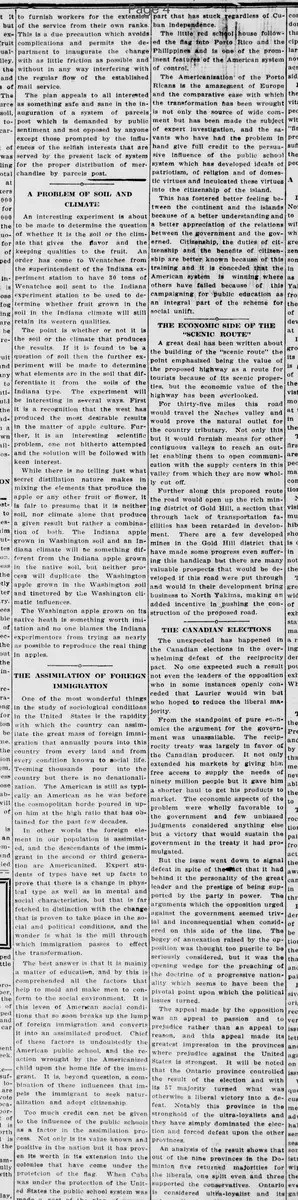
THE ASSIMILATION OF FOREIGN IMMIGRATION
One of the most wonderful things in the study of sociological conditions in the United States is the rapidity with which the country can assimilate the great mass of foreign immigration that annually pours into this country from every land and from every condition known to social life.
Teeming thousands pour into the country but there is no denationalization. The American is still as typically an American as he was before the cosmopolitan horde poured in upon him at the high ratio that has obtained for the past few decades.
In other words the foreign element in our population is assimilated, and the descendants of the immigrant in the second or third generation are Americanized.
Expert students of types have set up facts to prove that there is a change in physical type as well as in mental and social characteristics. but that is far fetched in distinction with the change that is proven to take place in the social and political conditions, and the wonder is what is the mill through which immigration passes to effect the transformation.
The best answer is that it is mainly a matter of education, and by this is comprehended all the factors that help to mold and make men to conform to the social environment. It is this leaven of American social conditions that so soon breaks up the lump of foreign immigration and converts it into an assimilated product. Chief of these factors is undoubtedly the American public school, and the reduction wrought by the Americanized child upon the home life of the immigrant. It is, beyond question, a combination of these influences that impels the immigrant to seek naturalization and adopt citizenship.
Too much credit can not be given to the influence of the public schools as a factor in the assimilation process. Not only is its value known and positive in the nation but it has proven its worth in its extension into the colonies that have come under the protection of the flag.
When Cuba was under the protection of the United States the public school system was introduced and it is the one part that has stuck regardless of Cuban independence.
The little red school house followed the flag into Porto Rico and the Philippines and is one of the prominent features of the American system of control.
The Americanization of the Porto Ricans is the amazement of Europe and the comparative ease with which the transformation has been wrought is not only the source of wide comment but has been made the subject of expert investigation, and the savants who have had the problem in hand give full credit to the persuasive influence of the public school system which has developed ideals of patriotism, of religion and of domestic virtues and inculcated these virtues into the citizenship of the island.
This has fostered better feeling between the continent and the islands because of a better understanding and a better appreciation of the relations between the government and the governed. Citizenship, the duties of citizenship and the benefits of citizenship are better known because of this training and it is conceded that the American system is winning where others have failed because of this campaigning for public education as an integral part of the scheme for social uplift.
One of the most wonderful things in the study of sociological conditions in the United States is the rapidity with which the country can assimilate the great mass of foreign immigration that annually pours into this country from every land and from every condition known to social life.
Teeming thousands pour into the country but there is no denationalization. The American is still as typically an American as he was before the cosmopolitan horde poured in upon him at the high ratio that has obtained for the past few decades.
In other words the foreign element in our population is assimilated, and the descendants of the immigrant in the second or third generation are Americanized.
Expert students of types have set up facts to prove that there is a change in physical type as well as in mental and social characteristics. but that is far fetched in distinction with the change that is proven to take place in the social and political conditions, and the wonder is what is the mill through which immigration passes to effect the transformation.
The best answer is that it is mainly a matter of education, and by this is comprehended all the factors that help to mold and make men to conform to the social environment. It is this leaven of American social conditions that so soon breaks up the lump of foreign immigration and converts it into an assimilated product. Chief of these factors is undoubtedly the American public school, and the reduction wrought by the Americanized child upon the home life of the immigrant. It is, beyond question, a combination of these influences that impels the immigrant to seek naturalization and adopt citizenship.
Too much credit can not be given to the influence of the public schools as a factor in the assimilation process. Not only is its value known and positive in the nation but it has proven its worth in its extension into the colonies that have come under the protection of the flag.
When Cuba was under the protection of the United States the public school system was introduced and it is the one part that has stuck regardless of Cuban independence.
The little red school house followed the flag into Porto Rico and the Philippines and is one of the prominent features of the American system of control.
The Americanization of the Porto Ricans is the amazement of Europe and the comparative ease with which the transformation has been wrought is not only the source of wide comment but has been made the subject of expert investigation, and the savants who have had the problem in hand give full credit to the persuasive influence of the public school system which has developed ideals of patriotism, of religion and of domestic virtues and inculcated these virtues into the citizenship of the island.
This has fostered better feeling between the continent and the islands because of a better understanding and a better appreciation of the relations between the government and the governed. Citizenship, the duties of citizenship and the benefits of citizenship are better known because of this training and it is conceded that the American system is winning where others have failed because of this campaigning for public education as an integral part of the scheme for social uplift.
What sub-type of article is it?
Immigration
Education
Imperialism
What keywords are associated?
Immigration Assimilation
Public Education
Americanization
Colonial Policy
Citizenship Training
What entities or persons were involved?
United States
American Public Schools
Cuba
Porto Rico
Philippines
Immigrants
Editorial Details
Primary Topic
Assimilation Of Foreign Immigrants Through Public Education
Stance / Tone
Praiseworthy Of American Assimilation Process Via Schools
Key Figures
United States
American Public Schools
Cuba
Porto Rico
Philippines
Immigrants
Key Arguments
Rapid Assimilation Of Foreign Immigrants Without Denationalization
Public Schools As Primary Factor In Americanization
Influence Of Americanized Children On Immigrant Homes
Success Of Public Education In U.S. Colonies Like Cuba, Porto Rico, And Philippines
Public Education Fosters Patriotism, Religion, And Domestic Virtues
Improves Relations Between Government And Governed Through Citizenship Training