Thank you for visiting SNEWPapers!
Sign up free
Domestic News
July 15, 1927
The Ely Miner
Ely, Saint Louis County, Minnesota
What is this article about?
Agricultural advice on timing and methods for harvesting soy beans as hay or seed to optimize yield and minimize loss, including cutting, wilting, shocking, and threshing techniques.
Clipping
OCR Quality
98%
Excellent
Full Text
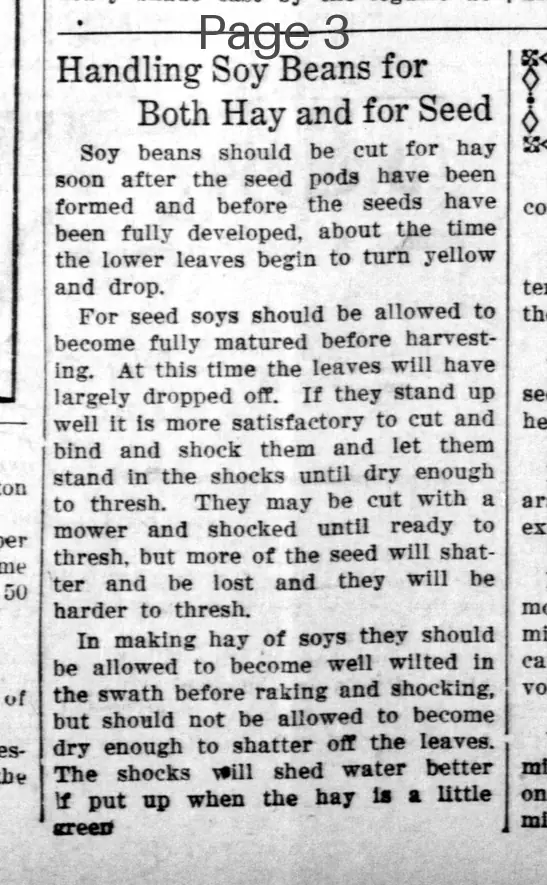
Handling Soy Beans for Both Hay and for Seed
Soy beans should be cut for hay soon after the seed pods have been formed and before the seeds have been fully developed, about the time the lower leaves begin to turn yellow and drop.
For seed soys should be allowed to become fully matured before harvesting. At this time the leaves will have largely dropped off. If they stand up well it is more satisfactory to cut and bind and shock them and let them stand in the shocks until dry enough to thresh. They may be cut with a mower and shocked until ready to thresh, but more of the seed will shatter and be lost and they will be harder to thresh.
In making hay of soys they should be allowed to become well wilted in the swath before raking and shocking, but should not be allowed to become dry enough to shatter off the leaves. The shocks will shed water better if put up when the hay is a little green.
Soy beans should be cut for hay soon after the seed pods have been formed and before the seeds have been fully developed, about the time the lower leaves begin to turn yellow and drop.
For seed soys should be allowed to become fully matured before harvesting. At this time the leaves will have largely dropped off. If they stand up well it is more satisfactory to cut and bind and shock them and let them stand in the shocks until dry enough to thresh. They may be cut with a mower and shocked until ready to thresh, but more of the seed will shatter and be lost and they will be harder to thresh.
In making hay of soys they should be allowed to become well wilted in the swath before raking and shocking, but should not be allowed to become dry enough to shatter off the leaves. The shocks will shed water better if put up when the hay is a little green.
What sub-type of article is it?
Agriculture
What keywords are associated?
Soy Beans
Hay Harvesting
Seed Harvesting
Farming Methods
Wilting
Shocking
Threshing
Domestic News Details
Event Details
Soy beans should be cut for hay soon after seed pods form and before seeds fully develop, when lower leaves yellow and drop. For seed, allow full maturity before harvesting, when leaves drop; cut, bind, shock, and let stand until dry for threshing. For hay, wilt in swath before raking and shocking, but not dry enough to shatter leaves; shocks shed water better if slightly green.