Thank you for visiting SNEWPapers!
Sign up free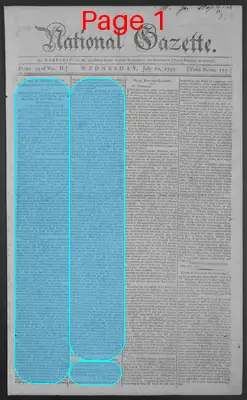
National Gazette
Philadelphia, Philadelphia County, Pennsylvania
What is this article about?
In a March 4, 1793 proclamation from Aux Cayes, St. Domingo, French National Civil Commissioner Stephen Polverel responded to a local citizens' decree by declaring Rolloin, Egnault, and Cotelle guilty of undermining national authority, depriving Egnault of his office, and ordering their arrest and transport to France aboard the frigate Le Surveillant. The document includes critical remarks on the republican measures.
Clipping
OCR Quality
Full Text
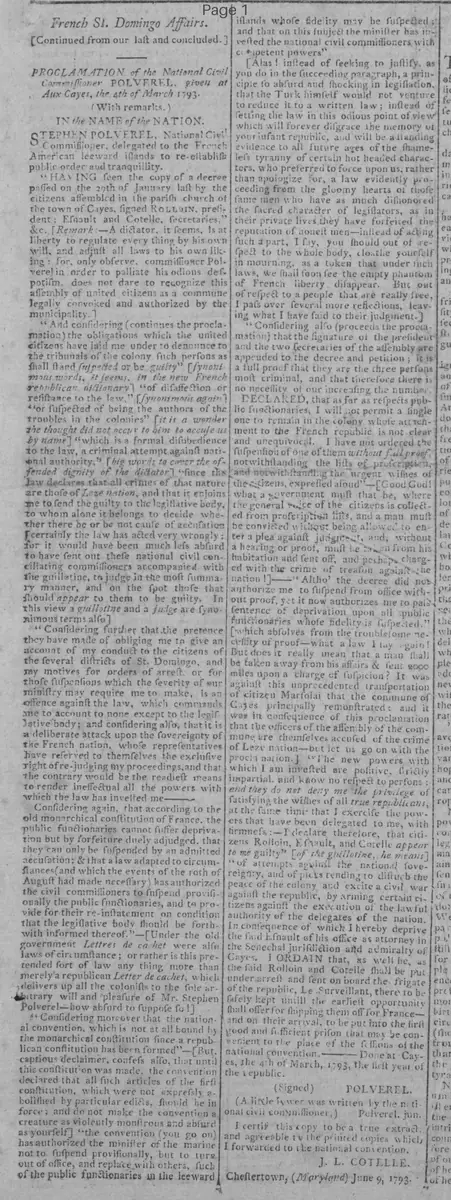
(Continued from our last and concluded.)
PROCLAMATION of the National Civil Commissioner POLVEREL, given at Aux Cayes, the 4th of March 1793.
(With remarks.)
IN the NAME of the NATION.
STEPHEN POLVEREL, National Civil Commissioner, delegated to the French American leeward islands to re-establish public order and tranquillity.
"HAVING seen the copy of a decree passed on the 29th of January last by the citizens assembled in the parish church of the town of Cayes, signed ROLLOIN, pres. Egnault and Cotelle, secretaries," &c. [Remark: A dictator, it seems, is at liberty to regulate every thing by his own will, and adjust all laws to his own liking: for, only observe, commissioner Polverel in order to palliate his odious despotism, does not dare to recognize this assembly of united citizens as a commune legally convoked and authorized by the municipality.]
"And considering (continues the proclamation) the obligations which the united citizens have laid me under to denounce to the tribunals of this colony such persons as shall stand suspected or be guilty [Synonymous words, it seems, in the new French republican dictionary] "of disaffection or resistance to the law," [Synonyms again] "or suspected of being the authors of the troubles in the colonies" it is a wonder the thought did not occur to him to accuse us by name; "which is a formal disobedience to the law, a criminal attempt against national authority." [Big words to cover the offended dignity of the dictator] "Since this law declares that all crimes of that nature are those of lèse nation, and that it enjoins me to send the guilty to the legislative body, to whom alone it belongs to decide whether there be or be not cause of accusation certainly the law has acted very wrongly: for it would have been much less absurd to have sent out these national civil conciliating commissioners accompanied with the guillotine, to judge in the most summary manner, and on the spot those that should appear to them to be guilty. In this view a guillotine and a judge are synonymous terms also
"Considering further that the pretence they have made of obliging me to give an account of my conduct to the citizens of the several districts of St. Domingo, and my motives for orders of arrest, or for those suspensions which the severity of our ministry may require me to make, is an offence against the law, which commands me to account to none except to the legislative body; and considering also, that it is a deliberate attack upon the sovereignty of the French nation, whose representatives have reserved to themselves the exclusive right of re-judging my proceedings, and that the contrary would be the readiest means to render ineffectual all the powers with which the law has invested me
Considering again, that according to the old monarchical constitution of France, the public functionaries cannot suffer deprivation but by forfeiture duly adjudged, that they can only be suspended by an admitted accusation; & that a law adapted to circumstances (and which the events of the 10th of August had made necessary) has authorized the civil commissioners to suspend provisionally the public functionaries, and to provide for their re-instatement on condition that the legislative body should be forthwith informed thereof."—[Under the old government Lettres de cachet were also laws of circumstance; or rather is this pretended sort of law any thing more than merely a republican Letter de cachet, which delivers up all the colonists to the sole arbitrary will and pleasure of Mr. Stephen Polverel—how absurd to suppose so!]
"Considering moreover that the national convention, which is not at all bound by the monarchical constitution since a republican constitution has been formed"—[But, captious declaimer, confess also, that until this constitution was made, the convention declared that all such articles of the first constitution, which were not expressly abolished by particular edicts, should be in force; and do not make the convention a creature as violently monstrous and absurd as yourself] "the convention (you go on) has authorized the minister of the marine not to suspend provisionally, but to turn out of office, and replace with others, such of the public functionaries in the leeward islands whose fidelity may be suspected; and that on this subject the minister has invested the national civil commissioners with competent powers"
Alas! instead of seeking to justify, as you do in the succeeding paragraph, a principle so absurd and shocking in legislation, that the Turk himself would not venture to reduce it to a written law; instead of setting the law in this odious point of view which will forever disgrace the memory of your infant republic, and will be standing evidence to all future ages of the shameless tyranny of certain hot-headed characters, who preferred to force upon us, rather than apologize for, a law evidently proceeding from the gloomy hearts of those same men who have as much dishonored the sacred character of legislators, as in their private lives they have forfeited the reputation of honest men—instead of acting such a part, I say, you should out of respect to the whole body, cloathe yourself in mourning, as a token that under such laws, we shall soon see the empty phantom of French liberty, disappear. But out of respect to a people that are really free, I pass over several more reflections, leaving what I have said to their judgment.]
"Considering also (proceeds the proclamation) that the signature of the president and the two secretaries of the assembly are appended to the decree and petition; it is a full proof that they are the three persons most criminal, and that therefore there is no necessity of our increasing the number.
DECLARED, that as far as respects public functionaries, I will not permit a single one to remain in the colony whose attachment to the French republic is not clear and unequivocal. I have not ordered the suspension of one of them without full proof, notwithstanding the lists of proscription, and notwithstanding the urgent wishes of the citizens, expressed aloud"—[Good God! what a government must that be, where the general voice of the citizens is collected from proscription lists, and a man must be convicted without being allowed to enter a plea against injustice, and, without a hearing or proof, must be taken from his habitation and sent off, and perhaps charged with the crime of treason against the nation!]—"Altho' the decree did not authorize me to suspend from office without proof, yet it now authorizes me to pass sentence of deprivation upon all public functionaries whose fidelity is suspected." which absolves from the troublesome necessity of proof—what a law I say again! But does it really mean that a man shall be taken away from his affairs & sent 3000 miles upon a charge of suspicion? It was against this unprecedented transportation of citizen Marsoiai that the commune of Cayes principally remonstrated: and it was in consequence of this proclamation that the officers of the assembly of the commune are themselves accused of the crime of lèse nation—but let us go on with the proclamation.] "The new powers with which I am invested are positive, really impartial, and know no respect to persons: and they do not deny me the privilege of satisfying the wishes of all true republicans, at the same time that I exercise the powers that have been delegated to me, with firmness:—I declare therefore, that citizens Rolloin, Egnault, and Cotelle appear to me guilty" [of the guillotine, he means] "of attempts against the national sovereignty, and of acts tending to disturb the peace of the colony and excite a civil war against the republic, by arming certain citizens against the execution of the lawful authority of the delegates of the nation.
In consequence of which I hereby deprive the said Egnault of his office as attorney in the Senechal jurisdiction and admiralty of Cayes. I ORDAN that, as well he, as the said Rolloin and Cotelle shall be put under arrest and sent on board the frigate of the republic, Le Surveillant, there to be safely kept until the earliest opportunity shall offer for shipping them off for France— and on their arrival, to be put into the first good and sufficient prison that may be convenient to the place of the sitting of the national convention.—Done at Cayes, the 4th of March, 1793, the first year of the republic.
(Signed)
POLVEREL.
(A little lower was written by the national civil commissioner,) Polverel, jun.
I certify this copy to be a true extract, and agreeable to the printed copies which, I forwarded to the national convention.
J. L. COTELLE.
Chesterstown, (Maryland) June 9, 1793.
What sub-type of article is it?
What keywords are associated?
What entities or persons were involved?
Where did it happen?
Foreign News Details
Primary Location
Aux Cayes, St. Domingo
Event Date
1793 03 04
Key Persons
Outcome
egnault deprived of office as attorney in the senechal jurisdiction and admiralty of cayes; rolloin, egnault, and cotelle ordered arrested and transported to france for imprisonment pending judgment by the national convention.
Event Details
National Civil Commissioner Stephen Polverel issued a proclamation denouncing a January 29 decree by assembled citizens in Cayes, signed by Rolloin, Egnault, and Cotelle, as an attack on national authority. He declared them guilty of lèse nation and acts tending to disturb peace and incite civil war, ordering their arrest and shipment to France aboard Le Surveillant. The text includes extensive critical remarks on the proclamation's authoritarian nature and republican laws enabling suspensions and deportations without proof.