Thank you for visiting SNEWPapers!
Sign up free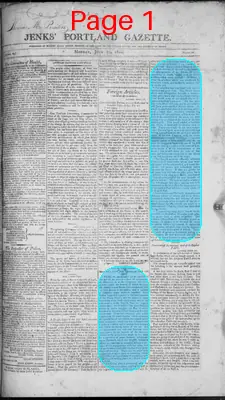
Jenks's Portland Gazette
Portland, Cumberland County, Maine
What is this article about?
Extract from Copenhagen details the tense negotiations leading to an armistice on April 8 after the April 2 battle with British forces under Lord Nelson. Danish resolve and damaged British ships prompt truce. Emperor Paul I's death raises hopes for peace under Alexander I.
Clipping
OCR Quality
Full Text
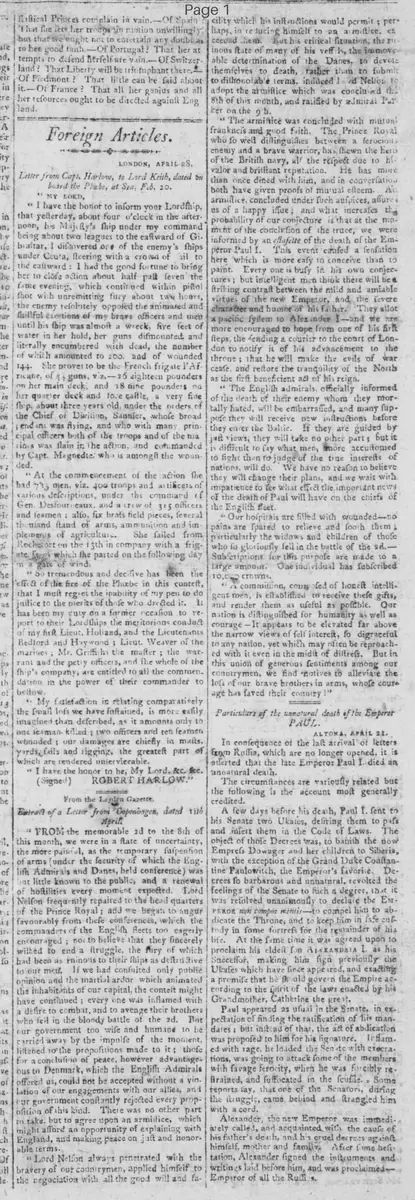
Extract of a Letter from Copenhagen, dated 11th April.
FROM the memorable 2d to the 8th of this month, we were in a state of uncertainty, the more painful, as the temporary suspension of arms (under the security of which the English Admirals and Danes, held conference) was but little known to the public, and a renewal of hostilities every moment expected. Lord Nelson frequently repaired to the head quarters of the Prince Royal; and we began to augur favourably from these conferences, which the commanders of the English fleets too eagerly encouraged; nor to believe that they sincerely wished to end a struggle, the fury of which had been as ruinous to their ships as destructive to our men. If we had consulted only public opinion and the martial ardor which animated the inhabitants of our capital, the contest might have continued; every one was inflamed with a desire to combat, and to avenge their brothers who fell in the bloody battle of the 2d. But our government too wise and humane to be carried away by the impulse of the moment, listened to the propositions made to it; those for a conclusion of peace, however advantageous to Denmark, which the English Admirals offered us, could not be accepted without a violation of our engagements with our allies, and our government constantly rejected every proposition of this kind. There was no other part to take, but to agree upon an armistice, which might afford an opportunity of explaining with England, and making peace on just and honorable terms.
Lord Nelson always penetrated with the bravery of our countrymen, applied himself to the negociation with all the good will and facility which his instructions would permit; perhaps, in reducing himself to an armistice, exceeded them. But his critical situation, the ruinous state of many of his vessels, the immovable determination of the Danes, to devote themselves to death, rather than to submit to dishonorable terms, induced Lord Nelson to adopt the armistice which was concluded the 8th of this month, and ratified by admiral Parker on the 9th.
The armistice was concluded with mutual frankness and good faith. The Prince Royal who so well distinguishes between a ferocious enemy and a brave warrior, has shewn the hero of the British navy, all the respect due to his valor and brilliant reputation. He has more than once dined with him, and in conversation both have given proofs of mutual esteem. An armistice, concluded under such auspices, assures us of a happy issue: and what increases the probability of our conjecture is that at the moment of the conclusion of the truce, we were informed by an estafette of the death of the Emperor Paul I. This event caused a sensation here which is more easy to conceive than to paint. Every one is busy in his own conjectures; but intelligent men think there will be striking contrast between the mild and amiable virtues of the new Emperor, and the severe character and humor of his father. They allot a pacific system to Alexander I—and we are more encouraged to hope from one of his first steps, the sending a courier to the court of London to notify it of his advancement to the throne: that he will make the evils of war cease, and restore the tranquility of the North as the first beneficent act of his reign.
The English admirals, officially informed of the death of their enemy whom they mortally hated, will be embarrassed, and many suppose they will receive new instructions before they enter the Baltic. If they are guided by just views, they will take no other part; but it is difficult to say what men, more accustomed to fight than to judge of the true interests of nations, will do. We have no reason to believe they will change their plans, and we wait with impatience to see what effect these important news of the death of Paul will have on the chiefs of the English fleet.
Our hospitals are filled with wounded—no pains are spared to relieve and sooth them particularly the widows and children of those who so gloriously fell in the battle of the 2d.—Subscriptions for this purpose are made to a large amount. One individual has subscribed 10,000 crowns. A commission, composed of honest intelligent men, is established to receive these gifts, and render them as useful as possible. Our nation is distinguished for humanity as well as courage—It appears to be elevated far above the narrow views of self interest, so disgraceful to any nation, yet which may often be reproached with it even in the midst of distress. But in this union of generous sentiments among our countrymen, we find motives to alleviate the loss of our brave brothers in arms, whose courage has saved their country!
What sub-type of article is it?
What keywords are associated?
What entities or persons were involved?
Where did it happen?
Foreign News Details
Primary Location
Copenhagen
Event Date
2nd To 8th April
Key Persons
Outcome
armistice concluded on 8th april and ratified on 9th; hospitals filled with wounded; subscriptions for widows and children of fallen; death of emperor paul i
Event Details
After the battle of the 2nd, uncertainty prevailed until an armistice was negotiated due to damaged British ships and Danish resolve. Lord Nelson conferred with the Prince Royal, leading to a truce allowing time for honorable peace talks. News of Paul I's death prompted hopes for peace under Alexander I, potentially affecting British plans.