Thank you for visiting SNEWPapers!
Sign up free
The Weekly Miner
Butte, Silver Bow County, Montana
What is this article about?
Historical account of silver and gold ore mining in the Americas, from Spanish conquest discoveries in Mexico (e.g., Potosi 1545) through major 19th-century US gold rushes in California, Colorado, Nevada, and beyond, noting booms, innovations, and setbacks from wars.
Clipping
OCR Quality
Full Text
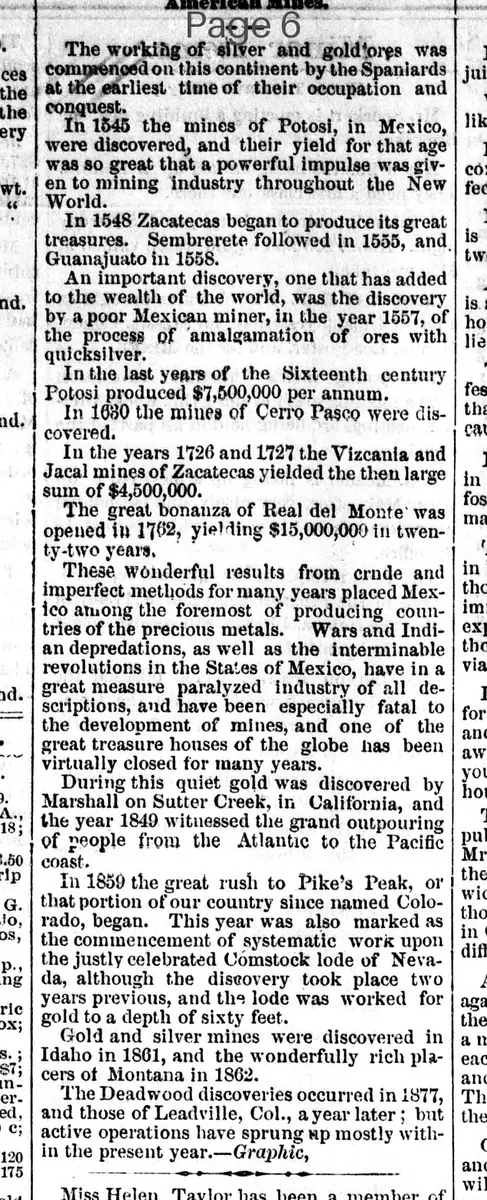
In 1545 the mines of Potosi, in Mexico, were discovered, and their yield for that age was so great that a powerful impulse was given to mining industry throughout the New World.
In 1548 Zacatecas began to produce its great treasures. Sombrerete followed in 1555, and Guanajuato in 1558.
An important discovery, one that has added to the wealth of the world, was the discovery by a poor Mexican miner, in the year 1557, of the process of amalgamation of ores with quicksilver.
In the last years of the Sixteenth century Potosi produced $7,500,000 per annum.
In 1680 the mines of Cerro Pasco were discovered.
In the years 1726 and 1727 the Vizcania and Jacal mines of Zacatecas yielded the then large sum of $4,500,000.
The great bonanza of Real del Monte was opened in 1762, yielding $15,000,000 in twenty-two years.
These wonderful results from crude and imperfect methods for many years placed Mexico among the foremost of producing countries of the precious metals. Wars and Indian depredations, as well as the interminable revolutions in the States of Mexico, have in a great measure paralyzed industry of all descriptions, and have been especially fatal to the development of mines, and one of the great treasure houses of the globe has been virtually closed for many years.
During this quiet gold was discovered by Marshall on Sutter Creek, in California, and the year 1849 witnessed the grand outpouring of people from the Atlantic to the Pacific coast.
In 1859 the great rush to Pike's Peak, or that portion of our country since named Colorado, began. This year was also marked as the commencement of systematic work upon the justly celebrated Comstock lode of Nevada, although the discovery took place two years previous, and the lode was worked for gold to a depth of sixty feet.
Gold and silver mines were discovered in Idaho in 1861, and the wonderfully rich placers of Montana in 1862.
The Deadwood discoveries occurred in 1877, and those of Leadville, Col., a year later; but active operations have sprung up mostly within the present year. -Graphic,
What sub-type of article is it?
What themes does it cover?
What keywords are associated?
What entities or persons were involved?
Where did it happen?
Story Details
Key Persons
Location
Mexico And The American West
Event Date
1545 To 1878
Story Details
Overview of silver and gold mining history in the New World, beginning with Spanish discoveries in Mexico such as Potosi in 1545 and the amalgamation process in 1557, leading to major productions; later paralyzed by wars; followed by US discoveries including California gold in 1848, Colorado in 1859, Comstock lode in 1857, Idaho in 1861, Montana in 1862, Deadwood in 1877, and Leadville in 1878.