Thank you for visiting SNEWPapers!
Sign up free
Morning Star
Limerick, York County, Maine
What is this article about?
The American Temperance Union held its first annual meeting on May 9th at Chatham Street Chapel, with reports on organization, publications, international efforts, and advances in total abstinence and legislative action. Elisha Taylor highlighted achievements like reduced alcohol consumption, reformed inebriates, and economic savings from the temperance reform.
Clipping
OCR Quality
Full Text
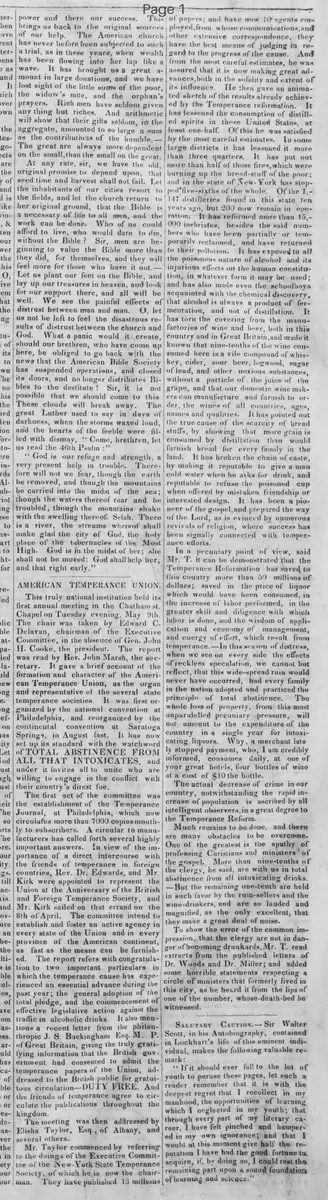
This truly national institution held its first annual meeting in the Chatham st. Chapel on Tuesday evening, May 9th. The chair was taken by Edward C. Delavan, chairman of the Executive Committee, in the absence of Gen. John H. Cooke, the president. The report was read by Rev. John Marsh, the secretary. It gave a brief account of the formation and character of the American Temperance Union, as the organ and representative of the several state temperance societies. It was first organized by the national convention at Philadelphia, and reorganized by the continental convention at Saratoga Springs, in August last. It has now set up its standard with the watchword of TOTAL ABSTINENCE FROM ALL THAT INTOXICATES, and under it invites all to unite who are willing to engage in the conflict with their country's direst foe.
The first act of the committee was the establishment of the Temperance Journal, at Philadelphia, which now circulates more than 7000 copies monthly to subscribers. A circular to manufacturers has called forth several highly important answers. In view of the importance of a direct intercourse with the friends of temperance in foreign countries, Rev. Dr. Edwards, and Mr. Kirk were appointed to represent the Union at the Anniversary of the British and Foreign Temperance Society, and Mr. Kirk sailed on that errand on the 8th of April. The committee intend to establish and foster an active agency in every state of the Union and in every province of the American continent, as fast as the means can be furnished. The report refers with congratulation to two important particulars in which the temperance cause has experienced an essential advance during the past year; the general adoption of the total pledge, and the commencement of effective legislative action against the traffic in alcoholic drinks. It also mentions a recent letter from the philanthropic J. S. Buckingham Esq. M. P. of Great Britain, giving the truly gratifying information that the British government had consented to admit the temperance papers of the Union, addressed to the British public for gratuitous circulation—DUTY FREE. And the friends of temperance agree to circulate the publications throughout the kingdom.
The meeting was then addressed by Elisha Taylor, Esq., of Albany, and several others.
Mr. Taylor commenced by referring to the doings of the Executive Committee of the New-York State Temperance Society, of which he is now the chairman. They have published 13 millions of papers; and have now 10 agents employed, from whose communications, and other extensive correspondence, they have the best means of judging in regard to the progress of the cause. And from the most careful estimates, he was assured that it is now making great advances, both in the solidity and extent of its influence. He then gave an animated sketch of the results already achieved by the Temperance reformation. It has lessened the consumption of distilled spirits in these United States, at least one-half. Of this he was satisfied by the most careful estimates. In some large districts it has lessened it more than three quarters. It has put out more than half of those fires, which were burning up the bread-stuff of the poor; and in the state of New-York has stopped five-sixths of the whole. Of the 1,147 distilleries found in this state ten years ago, but 200 now remain in operation. It has reformed more than 15,000 inebriates, besides the said numbers who have been partially or temporarily reclaimed, and have returned to their pollution. It has exposed to all the poisonous nature of alcohol and its injurious effects on the human constitution, in whatever form it may be used; and has also made even the schoolboys acquainted with the chemical discovery, that alcohol is always a product of fermentation, and not of distillation. It has torn the covering from the manufactories of wine and beer, both in this country and in Great Britain, and made it known that nine-tenths of the wine consumed here is a vile compound of whiskey, cider, sour beer, logwood, sugar of lead, and other noxious substances, without a particle of the juice of the grape, and that our domestic wine makers can manufacture and furnish to order, the wines of all countries, ages, names and qualities. It has pointed out the true cause of the scarcity of bread stuffs, by showing that more grain is consumed by distillation than would furnish bread for every family in the land. It has broken the chain of caste, by making it reputable to give a man cold water when he asks for drink, and reputable to refuse the poisoned cup when offered by mistaken friendship or interested design. It has been a pioneer of the gospel, and prepared the way of the Lord, as is evinced by numerous revivals of religion, where success has been signally connected with temperance efforts.
In a pecuniary point of view, said Mr. T. it can be demonstrated that the Temperance Reformation has saved to this country more than 50 millions of dollars; saved in the price of liquor which would have been consumed, in the increase of labor performed, in the greater skill and diligence with which labor is done, and the wisdom of application and economy of management, and energy of effort, which result from temperance. In this season of distress, when we see on every side the effects of reckless speculation, we cannot but reflect, that this wide-spread ruin would never have occurred, had every family in the nation adopted and practiced the principle of total abstinence. The whole loss of property, from this most unparalleled pecuniary pressure, will not amount to the expenditure of the country in a single year for intoxicating liquors. Why, a merchant lately stopped payment, who, I am credibly informed, consumes daily, at one of your great hotels, four bottles of wine at a cost of $10 the bottle.
The actual decrease of crime in our country, notwithstanding the rapid increase of population is ascribed by all intelligent observers, in a great degree to the Temperance Reform.
Much remains to be done, and there are many obstacles to be overcome. One of the greatest is the apathy of professing Christians and ministers of the gospel. More than nine-tenths of the clergy, he said, are with us in total abstinence from all intoxicating drinks.—But the remaining one-tenth are held in such favor by the rum-sellers and the wine-drinkers, and are so lauded and magnified, as the only excellent, that they make a great deal of noise.
To show the error of the common impression, that the clergy are not in danger of becoming drunkards, Mr. T. read extracts from the published letters of Dr. Woods and Dr. Miller; and added some horrible statements respecting a circle of ministers that formerly lived in this city, as he heard it from the lips of one of the number, whose death-bed he witnessed.
What sub-type of article is it?
What themes does it cover?
What keywords are associated?
What entities or persons were involved?
Where did it happen?
Story Details
Key Persons
Location
Chatham St. Chapel
Event Date
Tuesday Evening, May 9th
Story Details
The Union, organized nationally, reported on its formation, Temperance Journal publication, international representation, plans for agencies, adoption of total pledge, and legislative progress. Taylor detailed reform impacts: halved spirit consumption, closed most distilleries, reformed inebriates, exposed alcohol dangers, economic savings over 50 million dollars, reduced crime, and religious revivals linked to temperance.