Thank you for visiting SNEWPapers!
Sign up free
Story
October 3, 1891
The Dickinson Press
Dickinson, Stark County, North Dakota
What is this article about?
A new antiseptic called cidine, made from naphthol compounds, tested in France. It's a non-toxic white powder soluble in water, effective for wound dressing, surpassing carbolic and boracic acids in antiseptic power.
Clipping
OCR Quality
98%
Excellent
Full Text
New and Harmless Antiseptic.
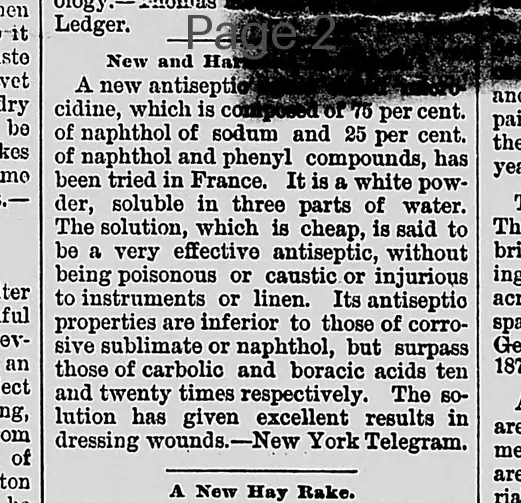
A new antiseptic cidine, which is composed of 75 per cent. of naphthol of sodium and 25 per cent. of naphthol and phenyl compounds, has been tried in France. It is a white powder, soluble in three parts of water. The solution, which is cheap, is said to be a very effective antiseptic, without being poisonous or caustic or injurious to instruments or linen. Its antiseptic properties are inferior to those of corrosive sublimate or naphthol, but surpass those of carbolic and boracic acids ten and twenty times respectively. The solution has given excellent results in dressing wounds.—New York Telegram.
A new antiseptic cidine, which is composed of 75 per cent. of naphthol of sodium and 25 per cent. of naphthol and phenyl compounds, has been tried in France. It is a white powder, soluble in three parts of water. The solution, which is cheap, is said to be a very effective antiseptic, without being poisonous or caustic or injurious to instruments or linen. Its antiseptic properties are inferior to those of corrosive sublimate or naphthol, but surpass those of carbolic and boracic acids ten and twenty times respectively. The solution has given excellent results in dressing wounds.—New York Telegram.
What sub-type of article is it?
Medical Curiosity
Curiosity
What themes does it cover?
Recovery
What keywords are associated?
Antiseptic
Cidine
Naphthol
Wound Dressing
Medical Discovery
Where did it happen?
France
Story Details
Location
France
Story Details
A new antiseptic cidine, composed of naphthol of sodium and other compounds, tested in France as a safe, effective, non-toxic solution for wound dressing, outperforming carbolic and boracic acids.