Thank you for visiting SNEWPapers!
Sign up free
Hill's New Hampshire Patriot
Concord, Merrimack County, New Hampshire
What is this article about?
Biographical account of Virginian brothers Commodore Thomas Ap Catesby Jones and General Roger Jones, their distinguished service in the War of 1812 and Mexican conflicts, and their pioneering agricultural reclamation of worn-out Fairfax County lands through deep plowing, introducing Northern free labor, and boosting regional productivity near Washington, D.C.
Clipping
OCR Quality
Full Text
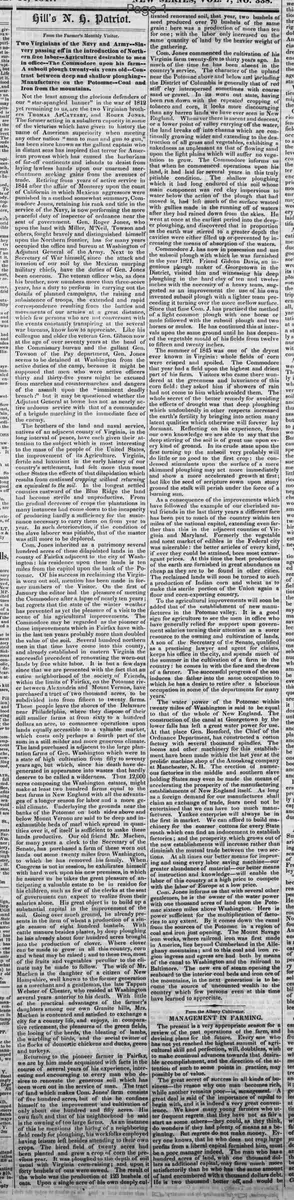
Two Virginians of the Navy and Army—Slavery passing off in the introduction of Northern free labor—Agriculture desirable to men in office—The Commodore upon his farm—A subsoil plough twenty-six years old—Contrast between deep and shallow ploughing—Manufactures on the Potomac—Coal and Iron from the mountains.
Not the least among the glorious defenders of our "star-spangled banner" in the war of 1812 yet remaining to us, are the two Virginian brothers Thomas Ap Catesby, and Roger Jones. The former acting in a subaltern capacity in some of the victories which have given to history the name of American superiority when meeting any other nation "man to man and gun to gun," has been since known as the gallant captain who in distant seas has inspired that terror for American prowess which has caused the barbarians of far-off continents and islands to desist from laying lawless hands upon our unarmed merchantmen seeking gains from the avenues of trade. Retiring from years of active service in 1844 after the affair of Monterey upon the coast of California in which Mexican aggressors were punished in a method somewhat summary, Commodore Jones, retaining his rank and title in the service of the Navy, is now performing the more peaceful duty of inspector of ordnance near the seat of government. Gen. Roger Jones, who upon the land with Miller, M'Neil, Towson and others, fought bravely and distinguished himself upon the Northern frontier, has for many years occupied the office and bureau at Washington of Adjutant General of the Army. Next to the Secretary of War himself, since the attack and invasion of our soil by the Mexican usurping military chiefs, have the duties of Gen. Jones been onerous. The veteran officer who, as does his brother, now numbers more than three-score years, has a duty to perform in carrying out the details of planned campaigns, the raising and subsistence of troops, the extended and rapid correspondence resulting from the battles and movements of our armies at a great distance, which few persons who are not conversant with the events constantly transpiring at the several war bureaus, know how to appreciate. Like his colleague and elder the veteran Gen. Gibson now at the age of over seventy years at the head of the Commissary bureau and the gallant Gen. Towson of the Pay department, Gen. Jones seems to be detained at Washington from the active duties of the camp, because it might be supposed that men who were active officers thirty and thirty-five years might be excused from marches and countermarches and dangers of the assault upon the "imminent deadly breach;" but it may be questioned whether the Adjutant General at home has not as nearly active arduous service with that of a commander of a brigade marching in the immediate face of the enemy.
The brothers of the land and naval service, natives of an adjacent county of Virginia, in the long interval of peace, have each given their attention to the subject which is most interesting to the mass of the people of the United States, the improvement of its Agriculture. Virginia, fertile and luxuriant in the early history of our country's settlement, had felt more than most other States the effects of that dilapidation which results from continued cropping without returning an equivalent to the soil. In the longest settled counties eastward of the Blue Ridge the land had become sterile and unproductive. From the gradual decrease of crops the plantations in many instances had come down to the incapacity of producing hardly a sufficiency for the sustenance necessary to carry them on from year to year. In such deterioration, if the condition of the slave laborer was pitiable, that of the master was still more to be deplored.
Com. Jones inherited as a patrimony several hundred acres of these dilapidated lands in the county of Fairfax adjacent to the city of Washington: his residence upon these lands is ten miles from the capitol upon the bank of the Potomac. Of his success in reclaiming the Virginia worn out soil, mention has been made in former numbers of the Visitor. On the first of January the editor had the pleasure of meeting the Commodore after a lapse of nearly ten years; but regrets that the state of the winter weather has prevented as yet the pleasure of a visit to the scene of his agricultural improvements. The Commodore may be regarded as the pioneer of those improvements which in Fairfax have within the last ten years probably more than doubled the value of the soil. Several hundred northern men in that time have come into this county, and already established in eastern Virginia the successful precedent of renovating the worn-out lands by free white labor. It is but a few days since that we are presented with the fact that an entire neighborhood of the society of Friends, within the limits of Fairfax, on the Potomac river between Alexandria and Mount Vernon, have purchased a tract of two thousand acres, to be subdivided into from fifteen to twenty farms. These people leave the shores of the Delaware near Philadelphia, where they dispose of their still smaller farms at from sixty to a hundred dollars an acre, to commence operations upon lands equally accessible to a valuable market, which costs only perhaps a fourth part of the sum in a still milder and more generous climate. The land purchased is adjacent to the large plantation farms of Gen. Washington which were in a state of high cultivation from fifty to seventy years ago, but which, since his death have degenerated in appearance into wastes that hardly deserve to be called a wilderness. Thus 12,000 acres composing the Washington estates, might make at least two hundred farms equal to the best farms in New England with all the advantages of a longer season for labor and a more genial climate. Underlaying the grounds near the banks of the Potomac on both sides above and below Mount Vernon are said to be deep and inexhaustible beds of marl which spread in quantities over it, of itself is sufficient to make these lands productive. Our old friend Mr. Machen, for many years a clerk to the Secretary of the Senate, has purchased a farm of these worn out lands out some twenty miles from Washington, to which he has removed his family. When Congress is not in session, he exhilarates himself with hard work upon his new premises, in which he assures us he takes the great pleasure of anticipating a valuable estate to be in residue for his children, such as few of the clerks at the seat of government can expect to realize from their salaries alone. His great object is to build up a substantial capital in the improvement of the soil. Going over much ground, he already presents in the item of wheat a production of a single season of eight hundred bushels. With cattle manure besides plaster, by deep ploughing he has already about four hundred acres brought into the production of clover. Where clover can be made to grow in all this country, corn and wheat may be raised; and to these two, most of the fruits and vegetables peculiar to the climate may be made to follow. The wife of Mr. Machen is the daughter of a citizen of New Hampshire, well known to the former generation as a merchant and a gentleman, the late Tappan Webster of Chester, who resided at Washington several years anterior to his death. With little of the practical advantages of the farmer's daughters among our own Granite hills, Mrs. Machen is contented and satisfied to exchange a city for a country life, and enjoys, in comparative retirement, the pleasures of the green fields, the lowing of the herds, the bleating of lambs, the warbling of birds, and the social twitter of the flocks of domestic chickens and ducks, geese and turkeys.
Returning to the pioneer farmer in Fairfax we are by him made acquainted with facts in the course of several years of his experience, interesting and encouraging to every man who desires to renovate the generous soil which has been worn out in the service of man. The tract of land which makes Com. Jones' farm consists of five hundred acres, but of this he confines himself to the improvement and cultivation of only about one hundred and fifty acres. His own fault and that of his neighborhood he said is the owning of too large farms. As an instance of this he mentions the hiring of a neighboring field ready for ploughing, his workfolks employed having leisure left besides attending to their own crops. The hired field of twenty acres had been planted and grew a crop of corn the previous year. It was ploughed to the depth of soil usual with Virginia corn-raising; and upon it forty bushels of oats were sowed. The result of the whole was the production of 123 bushels of oats. Upon a single acre of his own deeply cultivated renovated soil, that year, two bushels of seed produced over 70 bushels of the same grain: here was a production of more than ten for one; with the labor only increased on the same quantity of land by the heavier weight of the gathering.
Com. Jones commenced the cultivation of his Virginia farm twenty-five to thirty years ago. In much of the time he has been absent in the country's service. The character of the upland near the Potomac above and below and including the District of Columbia is generally that of red stiff clay interspersed sometimes with coarse sand or gravel. In its worn out state, having been run down with the repeated cropping of tobacco and corn, it looks more discouraging than any barren lands we have ever seen in New England. Whenever there is ascent and descent, or a lower point of valley carrying off the water, the land breaks off into chasms which are continually growing wider and extending to the destruction of all grass and vegetables, exhibiting a nakedness as unpleasant as that of flowing sand upon the light plains which will suffer no vegetation to grow. The Commodore informs us that when he commenced operations upon his land, it had laid for several years in this truly pitiable condition. The shallow ploughing which it had long endured of this soil whose main component was red clay impervious to water below the action of the plough that had moved it, had let much of the surface wasted with gullies made in the running off of waters after they had rained down from the skies. He went at once at the earliest period into the deeper ploughing, and discovered that in proportion as the earth was stirred to a greater depth the cavities were either filled up or prevented by increasing the means of absorption of the waters.
Commodore J. has now in possession and use the subsoil plough with which he was furnished in the year 1821. Friend Gideon Davis, an ingenious plough maker of Georgetown in the District, visited him and witnessing his deep ploughing in the hard clay of ten and twelve inches with the necessity of a heavy team, suggested as an improvement the use of his own invented subsoil plough with a lighter team preceding it turning over the more mellow surface. Since that time Com. J. has practised the method of a light common plough with one horse or mule followed with the subsoil plough and two horses or mules. He has continued this at intervals upon the same ground until he has deepened the vegetable mould of his fields from twelve to fifteen and twenty inches.
The summer of 1845 was one of the driest ever known in Virginia: whole fields of corn were crisped and spoiled. The Commodore that year had a field upon the highest and driest part of his farm. Visitors who came there wondered at the greenness and luxuriance of this corn field: they asked him if showers of rain had not come to him which avoided them. The whole secret of the better remedy for avoiding the effects of drought was that deep ploughing which undoubtedly in other respects increased the earth's fertility by bringing into action many latent qualities which otherwise will forever lay dormant. Reflecting on his experience, from our own knowledge we are able to say that the deep stirring of the soil is of great use upon every kind of ground. In its crude state upon the first turning up the subsoil very probably will do little or no good to the first crop: the condensed stimulants upon the surface of a mere skimmed ploughing may act more immediately and show a more accelerated growth at first: but like the seed of scripture sown upon stony ground the stalk will perish under the force of a burning sun.
As a consequence of the improvements which have followed the example of our cherished naval friend in the last thirty years a different face has been put to much of the country within ten miles of the national capitol, extending even farther than this in the adjacent counties of Virginia and Maryland. Formerly the vegetable and meat market of edibles in the Federal city was miserable: the better articles of every kind, if ever they could be attained, bore most extravagant prices. At this time the best productions of the earth are furnished in great abundance as cheap as they are to be found in other cities. The reclaimed lands will soon be turned to such a production of Indian corn and wheat as to make this sterile portion of the Union again a flour and corn-exporting country.
To the agricultural improvements will soon be added that of the establishment of new manufactures in the Potomac valley. It is a good sign for agriculture to see the men in office who have generally relied for support upon government salaries turning their attention as a surer resource to the owning and cultivation of lands. A son of the Secretary of the Senate, qualified as a practising lawyer and agent for claims, keeps his office in the city, and spends much of the summer in the cultivation of a farm in the country: he comes in with the face and the dress of a farmer. The successful progress of the son induces the father into the same occupation to which he has a desire to retire after a laborious occupation in some of the departments for many years.
The water power of the Potomac within twenty miles of Washington is said to be equal to that of the whole of New England. The construction of the canal at Georgetown by the lower falls has left a great water power for use. At that place Gen. Bomford, the Chief of the Ordnance Department, has constructed a cotton factory with several thousand spindles. The looms and other machinery for this establishment have been made within the last year at the prolific machine shop of the Amoskeag company at Manchester, N. H. The erection of numerous factories in the middle and southern slave holding States may even be made the means of accelerating the prosperity of the manufacturing establishments of New England itself. As long as a foreign demand for our manufactures shall claim an exchange of trade, fears need not be entertained that we can have too much manufactures. Yankee enterprise will always be in the first in market. We can afford to build machinery for the coarser cottons for every State south which can find an inducement to establish factories; and the prosperity which grows out of the new establishments will increase rather than diminish the mutual trade between the two sections. At all times our better means for improving and using every labor saving machine—our greater abundance of material—our better means of instruction and knowledge—will enable the labor of this country at a high price to compete with the labor of Europe at a low price.
Com. Jones informs us that with several other gentlemen, he is the owner of the water power with one thousand acres of land upon the Potomac sixteen miles above Washington. Here is power sufficient for the multiplication of factories to any extent. By it comes down the canal from the sources of the Potomac in a region of coal and iron just opening. The Mount Savage iron works, where railroad iron was first made in America, lies beyond Cumberland in the Alleghany mountains; and to this coal and iron region ingress and egress are had both by means of the canal to Washington and the railroad to Baltimore. The new era of steam opening the seaboard to the interior coal beds and iron ore of the mountains, in the next generation is to become the source of uncounted wealth to the country which few persons even at this time have learned to appreciate.
What sub-type of article is it?
What themes does it cover?
What keywords are associated?
What entities or persons were involved?
Where did it happen?
Story Details
Key Persons
Location
Fairfax County, Virginia; Potomac River; Washington, D.C.
Event Date
War Of 1812; 1845
Story Details
Brothers Thomas Ap Catesby Jones (Commodore, Navy) and Roger Jones (General, Army) distinguished themselves in the War of 1812 and Mexican conflicts. In retirement, they reclaimed worn-out Virginia lands in Fairfax County using deep plowing with a subsoil plough from 1821, introducing Northern free labor, yielding high crop returns like 70 bushels of oats per acre. This pioneered regional agricultural revival, attracting settlers and boosting markets, alongside emerging manufactures and resource exploitation.