Thank you for visiting SNEWPapers!
Sign up free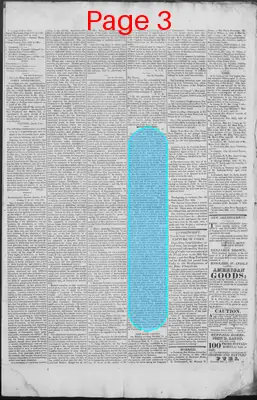
New Hampshire Statesman
Concord, Merrimack County, New Hampshire
What is this article about?
In Philadelphia, the trial of Joseph Haskell and Charles Farnsworth for piracy and mutiny on the schooner Tatler, involving the killing of the mate and wounding of Captain Garland, concluded with a not guilty verdict after multiple jury impasses and a retrial.
Clipping
OCR Quality
Full Text
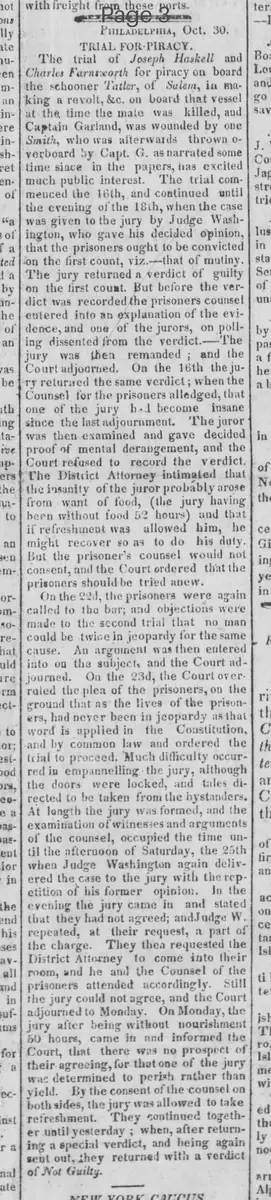
TRIAL FOR PIRACY.
The trial of Joseph Haskell and Charles Farnsworth for piracy on board the schooner Tatler, of Salem, in making a revolt, &c. on board that vessel at the time the mate was killed, and Captain Garland, was wounded by one Smith, who was afterwards thrown overboard by Capt. G. as narrated some time since in the papers, has excited much public interest. "The trial commenced the 16th, and continued until the evening of the 18th, when the case was given to the jury by Judge Washington, who gave his decided opinion, that the prisoners ought to be convicted on the first count, viz.—that of mutiny. The jury returned a verdict of guilty on the first count. But before the verdict was recorded the prisoners counsel entered into an explanation of the evidence, and one of the jurors, on polling dissented from the verdict.—The jury was then remanded; and the Court adjourned. On the 19th the jury returned the same verdict; when the Counsel for the prisoners alleged, that one of the jury had become insane since the last adjournment. The juror was then examined and gave decided proof of mental derangement, and the Court refused to record the verdict. The District Attorney intimated that the insanity of the juror probably arose from want of food, (the jury having been without food 52 hours) and that if refreshment was allowed him, he might recover so as to do his duty. But the prisoner's counsel would not consent, and the Court ordered that the prisoners should be tried anew.
On the 22d, the prisoners were again called to the bar; and objections were made to the second trial that no man could be twice in jeopardy for the same cause. An argument was then entered into on the subject, and the Court adjourned. On the 23d, the Court overruled the plea of the prisoners, on the ground that as the lives of the prisoners, had never been in jeopardy as that word is applied in the Constitution, and by common law and ordered the trial to proceed. Much difficulty occurred in empannelling the jury, although the doors were locked, and tales directed to be taken from the bystanders. At length the jury was formed, and the examination of witnesses and arguments of the counsel, occupied the time until the afternoon of Saturday, the 25th when Judge Washington again delivered the case to the jury with the repetition of his former opinion. In the evening the jury came in and stated that they had not agreed; and Judge W. repeated, at their request, a part of the charge. They then requested the District Attorney to come into their room, and he and the Counsel of the prisoners attended accordingly. Still the jury could not agree, and the Court adjourned to Monday. On Monday, the jury after being without nourishment 50 hours, came in and informed the Court, that there was no prospect of their agreeing, for that one of the jury was determined to perish rather than yield. By the consent of the counsel on both sides, the jury was allowed to take refreshment. They continued together until yesterday; when, after returning a special verdict, and being again sent out, they returned with a verdict of Not Guilty.
What sub-type of article is it?
What keywords are associated?
What entities or persons were involved?
Where did it happen?
Domestic News Details
Primary Location
Philadelphia
Event Date
October 16 26
Key Persons
Outcome
verdict of not guilty; earlier incident: mate killed, captain garland wounded, smith thrown overboard
Event Details
Trial for piracy and mutiny on schooner Tatler of Salem; first trial ended due to juror's alleged insanity after 52 hours without food; retrial overruled double jeopardy plea; second jury deliberated over 50 hours with difficulties, ultimately acquitted prisoners.