Thank you for visiting SNEWPapers!
Sign up free
Daily National Intelligencer
Washington, District Of Columbia
What is this article about?
Baltimore follows Charleston and New York by appointing ward committees to solicit subscriptions for Savannah fire sufferers and requests $10,000 city appropriation, which councils decline citing charter limitations. Article discusses precedents and advocates individual over municipal generosity.
Clipping
OCR Quality
Full Text
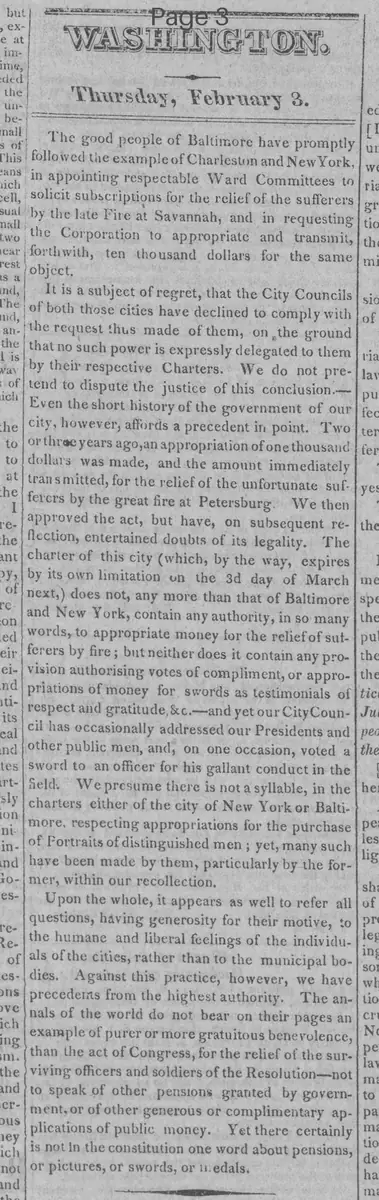
Thursday, February 3.
The good people of Baltimore have promptly followed the example of Charleston and New York, in appointing respectable Ward Committees to solicit subscriptions for the relief of the sufferers by the late Fire at Savannah, and in requesting the Corporation to appropriate and transmit, forthwith, ten thousand dollars for the same object.
It is a subject of regret, that the City Councils of both those cities have declined to comply with the request thus made of them, on the ground that no such power is expressly delegated to them by their respective Charters. We do not pretend to dispute the justice of this conclusion.—Even the short history of the government of our city, however, affords a precedent in point. Two or three years ago, an appropriation of one thousand dollars was made, and the amount immediately transmitted, for the relief of the unfortunate sufferers by the great fire at Petersburg. We then approved the act, but have, on subsequent reflection, entertained doubts of its legality. The charter of this city (which, by the way, expires by its own limitation on the 3d day of March next,) does not, any more than that of Baltimore and New York, contain any authority, in so many words, to appropriate money for the relief of sufferers by fire; but neither does it contain any provision authorising votes of compliment, or appropriations of money for swords as testimonials of respect and gratitude, &c.—and yet our City Council has occasionally addressed our Presidents and other public men, and, on one occasion, voted a sword to an officer for his gallant conduct in the field. We presume there is not a syllable, in the charters either of the city of New York or Baltimore, respecting appropriations for the purchase of Portraits of distinguished men; yet, many such have been made by them, particularly by the former, within our recollection.
Upon the whole, it appears as well to refer all questions, having generosity for their motive, to the humane and liberal feelings of the individuals of the cities, rather than to the municipal bodies. Against this practice, however, we have precedents from the highest authority. The annals of the world do not bear on their pages an example of purer or more gratuitous benevolence, than the act of Congress, for the relief of the surviving officers and soldiers of the Revolution—not to speak of other pensions granted by government, or of other generous or complimentary applications of public money. Yet there certainly is not in the constitution one word about pensions, or pictures, or swords, or medals.
What sub-type of article is it?
What keywords are associated?
Where did it happen?
Domestic News Details
Primary Location
Baltimore
Event Date
Thursday, February 3.
Outcome
city councils of baltimore, new york, and charleston declined to appropriate funds due to charter limitations; subscriptions solicited by ward committees; precedent of $1,000 appropriation for petersburg fire noted with doubts on legality.
Event Details
Baltimore residents appoint ward committees to solicit subscriptions for relief of Savannah fire sufferers and request $10,000 from the Corporation, following examples of Charleston and New York. Councils decline citing lack of charter authority. Article reflects on similar past appropriations and suggests relying on individual generosity over municipal bodies, citing congressional precedents.