Thank you for visiting SNEWPapers!
Sign up free
Alexandria Daily Advertiser
Alexandria, Virginia
What is this article about?
The Danish Government issues a declaration condemning Britain's sudden invasion of neutral Denmark in 1807, rejecting a coercive alliance and affirming resolve to defend honor despite expected losses, appealing to European justice.
Clipping
OCR Quality
Full Text
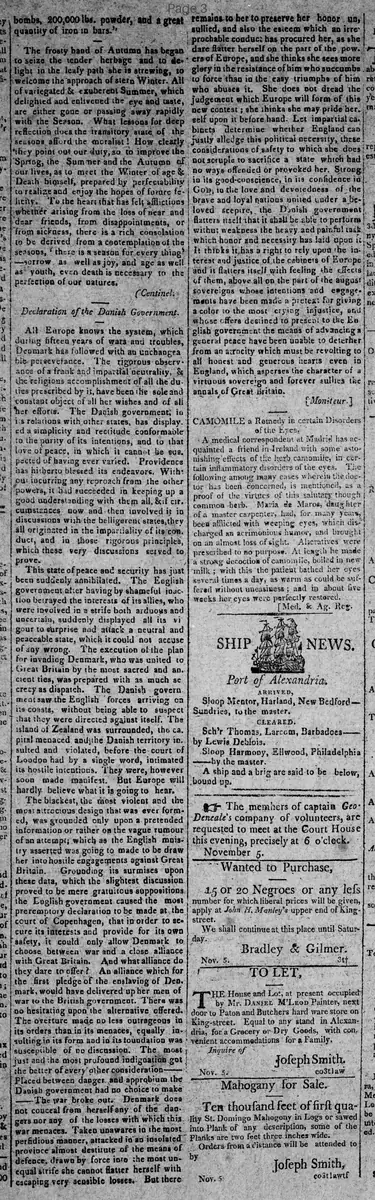
All Europe knows the system, which during fifteen years of wars and troubles, Denmark has followed with an unchanged and persevering perseverance. The rigorous observance of a frank and impartial neutrality, & the religious accomplishment of all the duties prescribed by it, have been the sole and constant object of all her wishes and of all her efforts. The Danish government, in its relations with other states, has displayed a simplicity and rectitude conformable to the purity of its intentions, and to that love of peace, in which it cannot be suspected of having ever varied. Providence has hitherto blessed its endeavors. Without incurring any reproach from the other powers, it had succeeded in keeping up a good understanding with them all, & if circumstances now and then involved it in discussions with the belligerent states, they all originated in the impartiality of its conduct, and in those rigorous principles, which these very discussions served to prove.
This state of peace and security has just been suddenly annihilated. The English government after having by shameful junction betrayed the interests of its allies, who were involved in a strife both arduous and uncertain, suddenly displayed all its vigor to surprise and attack a neutral and peaceable state, which it could not accuse of any wrong. The execution of the plan for invading Denmark, who was united to Great Britain by the most sacred and ancient ties, was prepared with as much secrecy as dispatch. The Danish government saw the English forces arriving on its coasts, without being able to suspect that they were directed against itself. The island of Zealand was surrounded, the capital menaced and the Danish territory insulted and violated, before the court of London had by a single word, intimated its hostile intentions. They were, however soon made manifest. But Europe will hardly believe what it is going to hear. The blackest, the most violent and the most atrocious design that was ever formed, was grounded only upon a pretended information or rather on the vague rumour of an attempt; which as the English ministry asserted was going to be made to draw her into hostile engagements against Great Britain. Grounding its surmises upon these data, which the slightest discussion proved to be mere gratuitous suppositions, the English government caused the most peremptory declaration to be made at the court of Copenhagen, that in order to secure its interests and provide for its own safety, it could only allow Denmark to choose between war and a close alliance with Great Britain. And what alliance do they dare to offer? An alliance which for the first pledge of the enslaving of Denmark, would have delivered up her men of war to the British government. There was no hesitating upon the alternative offered. The overture made no less outrageous in its orders than in its menaces, equally insulting in its form and in its foundation was susceptible of no discussion. The most just and the most profound indignation got the better of every other consideration. Placed between danger and approbrium the Danish government had no choice to make. The war broke out. Denmark does not conceal from herself any of the dangers nor any of the losses with which this war menaces. Taken unawares in the most perfidious manner, attacked in an insulated province almost destitute of the means of defence, drawn by force into the most unequal strife she cannot flatter herself with escaping very sensible losses. But there remains to her to preserve her honor unsullied, and also the esteem which an irreproachable conduct has procured her, as she dares flatter herself on the part of the powers of Europe, and she thinks she sees more glory in the resistance of him who succumbs to force than in the easy triumph of him who abuses it. She does not dread the judgment which Europe will form of this new contest; she thinks she may pride herself upon it before hand. Let impartial cabinets determine whether England can justly allege this political necessity, these considerations of safety to which she does not scruple to sacrifice a state which had no ways offended or provoked her. Strong in its good-conscience, in its confidence in God, in the love and devotedness of the brave and loyal nations united under a beloved sceptre, the Danish government flatters itself that it shall be able to perform without weakness the heavy and painful task which honor and necessity has laid upon it. It thinks it has a right to rely upon the interest and justice of the cabinets of Europe and it flatters itself with feeling the effects of them, above all on the part of the august sovereigns whose intentions and engagements have been made a pretext for giving a color to the most crying injustice, and whose offers destined to present to the English government the means of advancing a general peace have been unable to deter her from an atrocity which must be revolting to all honest and generous hearts even in England, which asperses the character of a virtuous sovereign and forever sullies the annals of Great Britain.
[Moniteur.]
What sub-type of article is it?
What keywords are associated?
Where did it happen?
Foreign News Details
Primary Location
Denmark
Outcome
the war broke out; denmark anticipates sensible losses but aims to preserve honor and esteem from europe.
Event Details
Denmark's government declares its long-standing neutrality shattered by Britain's sudden invasion of Zealand and Copenhagen, based on unfounded rumors of Danish alignment against Britain. Britain demanded Denmark choose war or an alliance surrendering its warships, leading to rejection and outbreak of war.