Thank you for visiting SNEWPapers!
Sign up free
Editorial
September 5, 1804
Virginia Argus
Richmond, Virginia
What is this article about?
Editorial from Salem Register criticizes recent British naval aggressions on U.S. merchant vessels, including the Cambrian frigate's actions in New York harbor. Warns against entering a new commercial treaty like Jay's, advocating for maintaining neutral trade rights without concessions to belligerents.
Clipping
OCR Quality
95%
Excellent
Full Text
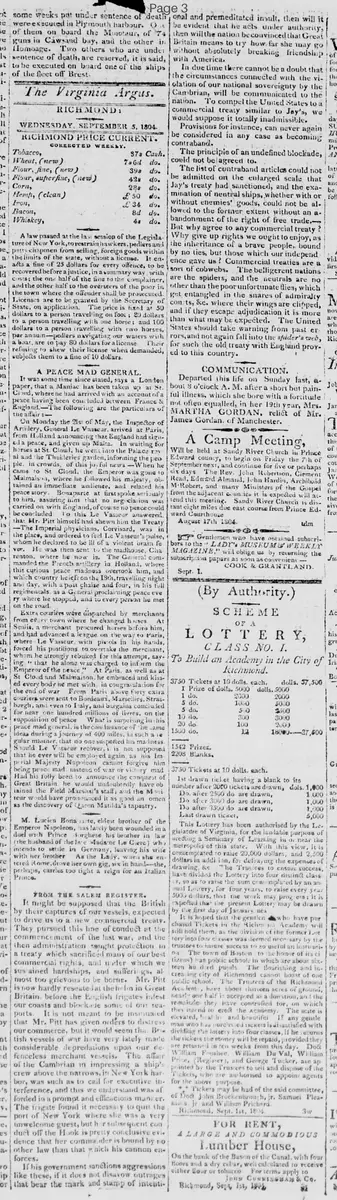
FROM THE SALEM REGISTER.
It might be supposed that the British by their captures of our vessels, expected to drive us to a new commercial treaty. They pursued this line of conduct at the commencement of the last war, and the then administration sought protection in a treaty which sacrificed many of our best commercial rights, and under which we sustained hardships, and sufferings, almost too grievous to be borne. Mr. Pitt is now hardly seated at the helm in Great Britain, before the English frigates infest our coasts and blockade some of our seaports. It is not meant to be insinuated that Mr. Pitt has given orders to distress our commerce, but it would seem that British vessels of war have very lately made considerable depredations upon our defenceless merchant vessels. The affair of the Cambrian in impressing a ship's crew above the narrows, in New York harbour, was such as to call for executive interference, and this we understand was afforded in a prompt and efficacious manner. The frigate found it necessary to quit the port of New York where she was a very unwelcome guest, but her subsequent conduct off the Hook is pretty conclusive evidence that her commander is bound by no other law than that which his cannon enforces.
If his government sanctions aggressions like these, if it does not disavow outrages that bear the mark and stamp of intentional and premeditated insult, then will it be evident that he acts under authority then will the nation be convinced that Great Britain means to try how far she may go without absolutely breaking friendship with America.
In due time there cannot be a doubt that the circumstances connected with the violation of our national sovereignty by the Cambrian, will be communicated to the nation.
To compel the United States to a commercial treaty similar to Jay's, we would suppose it totally inadmissible. Provisions for instance, can never again be considered in any case as becoming contraband. The principle of an undefined blockade, could not be agreed to. The list of contraband articles could not be admitted on the enlarged scale that Jay's treaty had sanctioned, and the examination of neutral ships, whether with or without enemies' goods, could not be allowed to the former extent without an abandonment of the right of free trade.
But why agree to any commercial treaty? Why give up rights we ought to enjoy, as the inheritance of a brave people, bound by no ties, but those which our independence gave us? Commercial treaties are a sort of cobwebs. The belligerent nations are the spiders, and the neutrals are no other than the poor unfortunate flies, which get entangled in the snares of admiralty courts, &c. where their wings are clipped, and if they escape adjudication it is more than what may be expected. The United States should take warning from past errors, and not again fall into the spider's web, for such the old treaty with England proved to this country.
It might be supposed that the British by their captures of our vessels, expected to drive us to a new commercial treaty. They pursued this line of conduct at the commencement of the last war, and the then administration sought protection in a treaty which sacrificed many of our best commercial rights, and under which we sustained hardships, and sufferings, almost too grievous to be borne. Mr. Pitt is now hardly seated at the helm in Great Britain, before the English frigates infest our coasts and blockade some of our seaports. It is not meant to be insinuated that Mr. Pitt has given orders to distress our commerce, but it would seem that British vessels of war have very lately made considerable depredations upon our defenceless merchant vessels. The affair of the Cambrian in impressing a ship's crew above the narrows, in New York harbour, was such as to call for executive interference, and this we understand was afforded in a prompt and efficacious manner. The frigate found it necessary to quit the port of New York where she was a very unwelcome guest, but her subsequent conduct off the Hook is pretty conclusive evidence that her commander is bound by no other law than that which his cannon enforces.
If his government sanctions aggressions like these, if it does not disavow outrages that bear the mark and stamp of intentional and premeditated insult, then will it be evident that he acts under authority then will the nation be convinced that Great Britain means to try how far she may go without absolutely breaking friendship with America.
In due time there cannot be a doubt that the circumstances connected with the violation of our national sovereignty by the Cambrian, will be communicated to the nation.
To compel the United States to a commercial treaty similar to Jay's, we would suppose it totally inadmissible. Provisions for instance, can never again be considered in any case as becoming contraband. The principle of an undefined blockade, could not be agreed to. The list of contraband articles could not be admitted on the enlarged scale that Jay's treaty had sanctioned, and the examination of neutral ships, whether with or without enemies' goods, could not be allowed to the former extent without an abandonment of the right of free trade.
But why agree to any commercial treaty? Why give up rights we ought to enjoy, as the inheritance of a brave people, bound by no ties, but those which our independence gave us? Commercial treaties are a sort of cobwebs. The belligerent nations are the spiders, and the neutrals are no other than the poor unfortunate flies, which get entangled in the snares of admiralty courts, &c. where their wings are clipped, and if they escape adjudication it is more than what may be expected. The United States should take warning from past errors, and not again fall into the spider's web, for such the old treaty with England proved to this country.
What sub-type of article is it?
Foreign Affairs
Trade Or Commerce
War Or Peace
What keywords are associated?
British Aggressions
Commercial Treaty
Jay's Treaty
Neutral Rights
Maritime Depredations
Cambrian Frigate
U.S. Commerce
What entities or persons were involved?
Mr. Pitt
British Government
Cambrian Frigate
Jay's Treaty
United States
Editorial Details
Primary Topic
British Naval Aggressions On U.S. Commerce And Opposition To New Commercial Treaties
Stance / Tone
Critical Of British Actions, Against Concessions In Treaties
Key Figures
Mr. Pitt
British Government
Cambrian Frigate
Jay's Treaty
United States
Key Arguments
British Captures Aim To Force A New Commercial Treaty
Past Treaty Sacrificed U.S. Rights And Caused Hardships
Cambrian's Impressment And Actions Violate U.S. Sovereignty
Government Must Disavow Such Aggressions Or Reveal Intent To Pressure U.S.
No New Treaty Should Allow Contraband Provisions, Undefined Blockades, Or Expanded Searches
Commercial Treaties Trap Neutrals Like Flies In Spiders' Webs
U.S. Should Assert Independence And Avoid Past Errors