Thank you for visiting SNEWPapers!
Sign up free
The Enquirer
Richmond, Henrico County, Virginia
What is this article about?
A self-identified Virginia Republican expresses confusion over party labels amid the 1816 presidential election, staunchly supports James Monroe over James Madison, criticizes the corrupt congressional caucus and intrigue favoring Madison, and urges voters to discern the true public will despite factional divisions.
Clipping
OCR Quality
Full Text
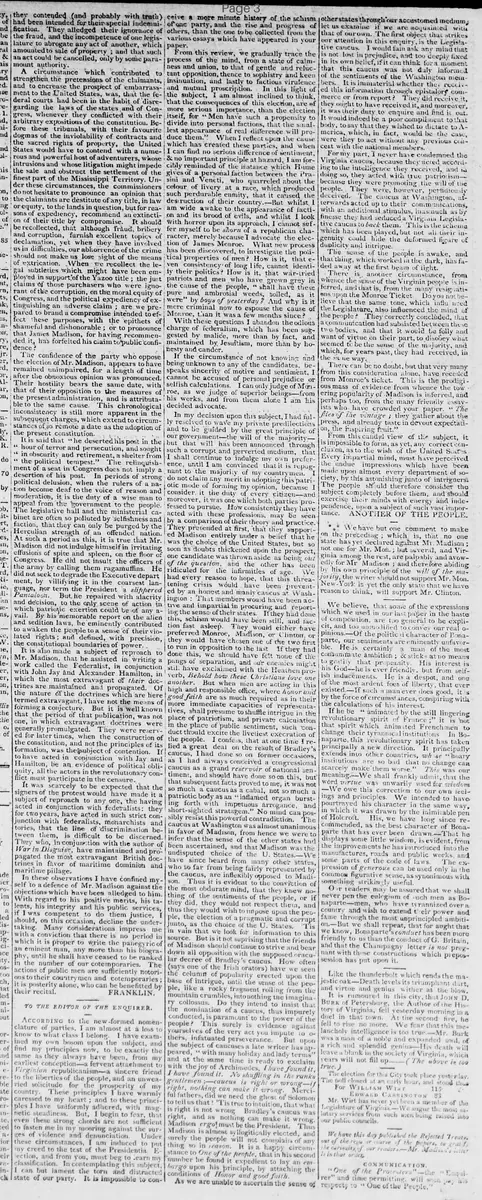
According to the new-formed nomenclature of parties, I am almost at a loss to know to what class I belong. I have examined my own bosom upon the subject, and find my principles now, to be exactly the same as they always have been, from my earliest conception--a fervent attachment to Virginian republicanism--a sincere friend to the liberties of the people, and an unwearied solicitude for the prosperity of my country. These principles I have warmly caressed to my heart: and to these principles I have uniformly adhered, with magnetic steadiness. But, I begin to fear, that even these strong chords are not sufficient to fasten me in my mooring against the surges of violence and denunciation. Under these circumstances, I am induced to put my creed to the test of the Presidential Election, and from you, must beg to earn my classification. In contemplating this subject, I can but lament the torn and distracted state of our party. It is impossible to conceive a more minute history of the schism of one party, and the rise and progress of others, than the one to be collected from the various essays which have appeared in your paper.
From this review, we gradually trace the process of the mind, from a state of calmness and union, to that of gentle and reluctant opposition, thence to sophistry and keen insinuation, and lastly to factious virulence and mutual proscription. In this light of the subject, I am almost inclined to think, that the consequences of this election, are of more serious importance, than the election itself, for "Men have such a propensity to divide into personal factions, that the smallest appearance of real difference will produce them." When I reflect upon the cause which has created these parties, and when I can find no serious difference of sentiment, & no important principle at hazard, I am forcibly reminded of the instance which Hume gives of a personal faction between the Prasini and Veneti, who quarreled about the colour of livery at a race, which produced such perdurable enmity, that it caused the destruction of their country.--But whilst I am wide awake to the appearance of faction and its brood of evils, and whilst I look with horror upon its approach, I cannot suffer myself to be shorn of a republican character, merely because I advocate the election of James Monroe. What new process has been discovered, to investigate the political properties of men? How is it, that even consistency of long life, cannot identity their politics? How is it, that war-tried patriots and men who have grown grey in the cause of the people, "shall have these pure and ambrosial weeds, soiled, as it were" by boys of yesterday? And why is it more criminal now to espouse the cause of Monroe, than it was a few months since?
With these questions I abandon the odious charge of federalism, which has been suggested by malice, more than by fact, and maintained by Jesuitism, more than by honesty and candor.
If the circumstance of not knowing and being unknown to any of the candidates, bespeaks sincerity of motive and sentiment, I cannot be accused of personal prejudice or selfish calculations. I can only judge of Monroe, as we judge of superior beings--from his works, and from them alone I am his decided advocate.
In my decision upon this subject, I had fully resolved to wave my private predilections and to be guided by the great principle of our government--the will of the majority-- but that will has been announced through such a corrupt and perverted medium, that I shall continue to indulge my own preference, until I am convinced that it is repugnant to the majority of my countrymen. I do not claim any merit in adopting this patriotic mode of forming my opinion, because I consider it the duty of every citizen--and moreover, it was one which both parties professed to pursue. How consistently they have acted with these professions, may be seen by a comparison of their theory and practice.
They pretended at first, that they supported Madison entirely under a belief that he was the choice of the United States, but so soon as doubts thickened upon the prospect, one candidate was thrown aside as being out of the question, and the other has been ridiculed for the infirmities of age. We had every reason to hope, that this threatening crisis would have been prevented by an honest and manly caucus at Washington: That members would have been active and impartial in procuring and reporting the sense of their states. If they had done this, schism would have been still, and faction fast asleep. They would either have preferred Monroe, Madison, or Clinton, or they would have chosen one of the two first to run in opposition to the last. If they had done this, we should have felt none of the pangs of separation, and our enemies might still have exclaimed with the Heathen proverb, Behold how these Christians love one another. But when men are acting in this high and responsible office, where honor and good faith are as much required as in their more immediate capacities of representatives, shall presume to shuffle intrigue in the place of patriotism, and private calculation in the place of public sentiment, such conduct should excite the liveliest execration of the people. I confess, that at one time I relied a great deal on the result of Bradley's caucus. I had done so on former occasions, as I had always conceived a congressional caucus as a grand reservoir of national sentiment, and should have done so on this, but that subsequent facts proved to me, it was not so much a caucus as a cabal, not so much a patriotic body as an "inflamed organ bursting forth with impetuous arrogance, and short-sighted stratagem." No mind can possibly resist this powerful contradiction. The caucus at Washington was almost unanimous in favor of Madison, from hence we were to infer that the sense of the other states had been ascertained, and that Madison was the undisputed choice of the U. States. We have since heard from many other states, who so far from being fairly represented by the caucus, are inflexibly opposed to Madison. Thus it is evident to the conviction of the most obdurate mind, that they knew nothing of the sentiments of the people, or if they did, they would not respect them, and thus they would wish to impose upon the people, the election of a pragmatic and corrupt junto, as the choice of the U. States. 'Tis in vain that we look for information to this source. But is it not surprising that the friends of Madison should continue to strive and bear down all opposition with the supposed oracular decree of Bradley's caucus. How often (says one of the Irish orators) have we seen the column of popularity erected upon the base of intrigue, until the sense of the people, like a rocky fragment rolling from the mountain crumbles, into nothing the imaginary colossus. Do they intend to insist that the nomination of a caucus, thus impurely conducted, is paramount to the power of the people? This surely is evidence against yourselves of the very act you impute to others, infatuated perseverance. But upon the subject of caucuses a late writer has appeared, "with many holiday and lady terms" and at the same time is ready to exclaim with the joy of Archimedes, I have found it, I have found it. No shuffling in the ranks gentlemen; caucuses right or wrong--if right, nothing can make it wrong. Merciful fathers, did we need the ghost of Solomon to tell us that! 'Tis true to intuition, that what is right is not wrong. Bradley's caucus was right, and as nothing can make it wrong. Madison ergo! must be the President. Thus Madison is almost syllogistically elected, and surely the people will not complain of any thing so in reason. It is a happy circumstance to one of the people, that in his second number he found it expedient to lay an embargo upon his principle, by attaching the conditions of Honor and good faith.
As we are unable to ascertain the sense of other states through our accustomed medium let us examine if we are acquainted with that of our own. The first object that strikes our attention in this enquiry, is the Legislative caucus. I would fain ask any mind that is not lost in prejudice, and too deeply fixed in its own belief, if it can think for a moment that this caucus was not duly informed of the sentiments of the Washington members. It is immaterial whether they received this information through epistolary commerce or from report? They did receive it, they ought to have received it, and moreover, it was their duty to enquire and find it out. It would indeed be a poor compliment to that body, to say that they wished to dictate to America, which, in fact, would be the case, were they to act without any previous concert with the national members.
For my part, I never have condemned the Virginia caucus, because they acted according to the intelligence they received, and in doing so, they acted with true patriotism-- because they were promoting the will of the people. They were, however, perfidiously deceived. The caucus at Washington, afterwards acted up to their communications, with an additional stimulus, inasmuch as by finesse they had seduced a Virginia Legislative caucus to back them. This is the scheme which has been played, but not all their ingenuity could hide the deformed figure of duplicity and intrigue.
The sense of the people is awake, and that thing, which worked in the dark, has faded away at the first beam of light.
There is, another circumstance, from whence the sense of the Virginia people is inferred, and that is, from the many resignations upon the Monroe Ticket. Do you not believe that the same tone, which influenced the Legislature, also influenced the mind of the people? They correctly concluded, that a communication had subsisted between these two bodies, and that it would be folly and want of virtue on their part, to disobey what seemed to be the sense of the majority, and which, for years past, they had received, in the same way.
There can be no doubt, but that very many from this consideration alone, have receded from Monroe's ticket. This is the prodigious mass of evidence from whence the towering popularity of Madison is inferred, and perhaps too, from the many friendly essayists who have crowded your paper. "The flesh of the vintage; they gather about the press, and already taste in devout expectation, the inspiring fruit."
From this candid view of the subject, it is impossible to form, as yet, any correct conclusion, as to the wish of the United States. Every impartial mind, must have perceived the undue impressions which have been made upon almost every department of society, by this astonishing junto of intriguers. The people should therefore consider the subject completely before them, and should exercise their minds with energy and independence, upon a subject of such vast importance.
ANOTHER OF THE PEOPLE.
What sub-type of article is it?
What themes does it cover?
What keywords are associated?
What entities or persons were involved?
Letter to Editor Details
Author
Another Of The People.
Recipient
To The Editor Of The Enquirer.
Main Argument
the writer defends his lifelong republican principles and support for james monroe in the presidential election, rejecting accusations of federalism and criticizing the corrupt congressional caucus that unrepresentative-ly favored james madison over the true will of the people and majority sentiment.
Notable Details