Thank you for visiting SNEWPapers!
Sign up free
Story
July 25, 1913
The Ogden Standard
Ogden, Weber County, Utah
What is this article about?
Instructional piece on cultivating courtesy in children through gentle deference to inferiors like servants, respect for elders, and proper social interactions, referencing Southern traditions with black nurses. (187 characters)
Clipping
OCR Quality
98%
Excellent
Full Text
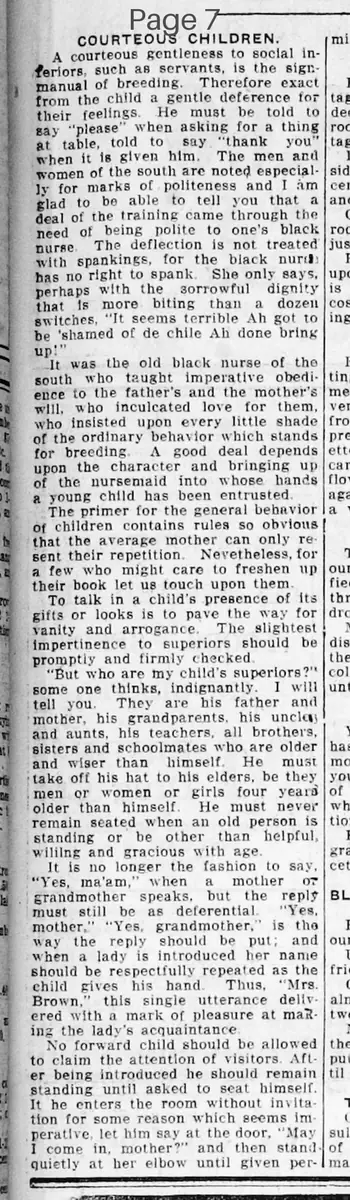
COURTEOUS CHILDREN.
A courteous gentleness to social inferiors, such as servants, is the sign manual of breeding. Therefore exact from the child a gentle deference for their feelings. He must be told to say "please" when asking for a thing at table, told to say "thank you" when it is given him. The men and women of the south are noted especially for marks of politeness and I am glad to be able to tell you that a deal of the training came through the need of being polite to one's black nurse The deflection is not treated with spankings, for the black nurse has no right to spank She only says, perhaps with the sorrowful dignity that is more biting than a dozen switches, "It seems terrible Ah got to be 'shamed of de chile Ah done bring up!"
It was the old black nurse of the south who taught imperative obedience to the father's and the mother's will, who inculcated love for them, who insisted upon every little shade of the ordinary behavior which stands for breeding. A good deal depends upon the character and bringing up of the nursemaid into whose hands a young child has been entrusted.
The primer for the general behavior of children contains rules so obvious that the average mother can only resent their repetition. Nevertheless, for a few who might care to freshen up their book let us touch upon them.
To talk in a child's presence of its gifts or looks is to pave the way for vanity and arrogance. The slightest impertinence to superiors should be promptly and firmly checked
"But who are my child's superiors?" some one thinks, indignantly. I will tell you. They are his father and mother, his grandparents, his uncles and aunts, his teachers, all brothers, sisters and schoolmates who are older and wiser than himself. He must take off his hat to his elders, be they men or women or girls four years older than himself. He must never remain seated when an old person is standing or be other than helpful, willing and gracious with age.
It is no longer the fashion to say, "Yes, ma'am," when a mother Or grandmother speaks, but the reply must still be as deferential "Yes, mother." "Yes. grandmother," is the way the reply should be put; and when a lady is introduced her name should be respectfully repeated as the child gives his hand Thus. "Mrs. Brown," this single utterance delivered with a mark of pleasure at making the lady's acquaintance
No forward child should be allowed to claim the attention of visitors After being introduced he should remain standing until asked to seat himself. It he enters the room without invitation for some reason which seems imperative, let him say at the door, "May I come in, mother?" and then stand quietly at her elbow until given permission to state his requirements.
A courteous gentleness to social inferiors, such as servants, is the sign manual of breeding. Therefore exact from the child a gentle deference for their feelings. He must be told to say "please" when asking for a thing at table, told to say "thank you" when it is given him. The men and women of the south are noted especially for marks of politeness and I am glad to be able to tell you that a deal of the training came through the need of being polite to one's black nurse The deflection is not treated with spankings, for the black nurse has no right to spank She only says, perhaps with the sorrowful dignity that is more biting than a dozen switches, "It seems terrible Ah got to be 'shamed of de chile Ah done bring up!"
It was the old black nurse of the south who taught imperative obedience to the father's and the mother's will, who inculcated love for them, who insisted upon every little shade of the ordinary behavior which stands for breeding. A good deal depends upon the character and bringing up of the nursemaid into whose hands a young child has been entrusted.
The primer for the general behavior of children contains rules so obvious that the average mother can only resent their repetition. Nevertheless, for a few who might care to freshen up their book let us touch upon them.
To talk in a child's presence of its gifts or looks is to pave the way for vanity and arrogance. The slightest impertinence to superiors should be promptly and firmly checked
"But who are my child's superiors?" some one thinks, indignantly. I will tell you. They are his father and mother, his grandparents, his uncles and aunts, his teachers, all brothers, sisters and schoolmates who are older and wiser than himself. He must take off his hat to his elders, be they men or women or girls four years older than himself. He must never remain seated when an old person is standing or be other than helpful, willing and gracious with age.
It is no longer the fashion to say, "Yes, ma'am," when a mother Or grandmother speaks, but the reply must still be as deferential "Yes, mother." "Yes. grandmother," is the way the reply should be put; and when a lady is introduced her name should be respectfully repeated as the child gives his hand Thus. "Mrs. Brown," this single utterance delivered with a mark of pleasure at making the lady's acquaintance
No forward child should be allowed to claim the attention of visitors After being introduced he should remain standing until asked to seat himself. It he enters the room without invitation for some reason which seems imperative, let him say at the door, "May I come in, mother?" and then stand quietly at her elbow until given permission to state his requirements.
What sub-type of article is it?
Etiquette Instruction
Child Rearing Advice
What themes does it cover?
Family
Moral Virtue
Social Manners
What keywords are associated?
Courteous Children
Child Etiquette
Politeness
Black Nurse
Southern Manners
Where did it happen?
The South
Story Details
Location
The South
Story Details
Advice on teaching children courteous behavior, including politeness to servants, deference to elders, proper responses, and introductions, highlighting the role of Southern black nurses in instilling obedience and breeding.