Thank you for visiting SNEWPapers!
Sign up free
Jackson Advocate
Jackson, Hinds County, Mississippi
What is this article about?
Clifford Beers, after three years in an insane asylum following a 1900 suicide attempt, recovered and founded the mental hygiene movement. His book 'A Mind That Found Itself' exposed cruel treatments, leading to reforms viewing mental illness like physical illness, with many recoveries possible.
Clipping
OCR Quality
Full Text
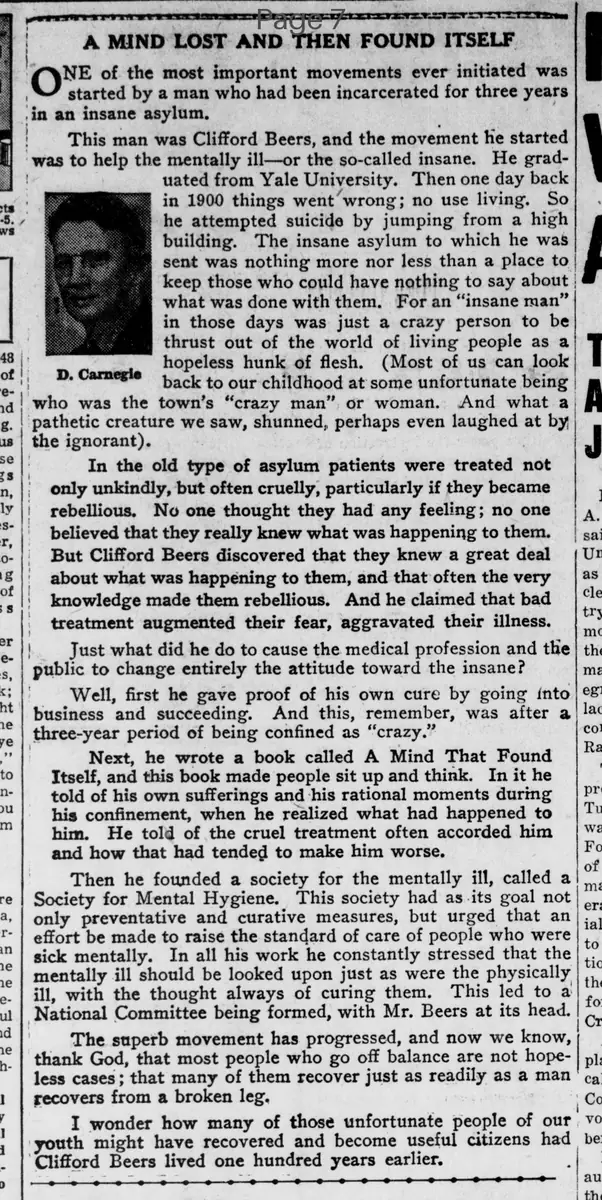
One of the most important movements ever initiated was started by a man who had been incarcerated for three years in an insane asylum.
This man was Clifford Beers, and the movement he started was to help the mentally ill—or the so-called insane. He graduated from Yale University. Then one day back in 1900 things went wrong; no use living. So he attempted suicide by jumping from a high building.
The insane asylum to which he was sent was nothing more nor less than a place to keep those who could have nothing to say about what was done with them. For an "insane man in those days was just a crazy person to be thrust out of the world of living people as a hopeless hunk of flesh. (Most of us can look back to our childhood at some unfortunate being who was the town's "crazy man" or woman. And what a pathetic creature we saw, shunned, perhaps even laughed at by the ignorant).
In the old type of asylum patients were treated not only unkindly, but often cruelly, particularly if they became rebellious. No one thought they had any feeling; no one believed that they really knew what was happening to them.
But Clifford Beers discovered that they knew a great deal about what was happening to them, and that often the very knowledge made them rebellious. And he claimed that bad treatment augmented their fear, aggravated their illness.
Just what did he do to cause the medical profession and the public to change entirely the attitude toward the insane?
Well, first he gave proof of his own cure by going into business and succeeding. And this, remember, was after a three-year period of being confined as "crazy."
Next, he wrote a book called A Mind That Found Itself, and this book made people sit up and think. In it he told of his own sufferings and his rational moments during his confinement, when he realized what had happened to him. He told of the cruel treatment often accorded him and how that had tended to make him worse.
Then he founded a society for the mentally ill, called a Society for Mental Hygiene. This society had as its goal not only preventative and curative measures, but urged that an effort be made to raise the standard of care of people who were sick mentally. In all his work he constantly stressed that the mentally ill should be looked upon just as were the physically ill, with the thought always of curing them. This led to a National Committee being formed, with Mr. Beers at its head.
The superb movement has progressed, and now we know, thank God, that most people who go off balance are not hopeless cases; that many of them recover just as readily as a man recovers from a broken leg.
I wonder how many of those unfortunate people of our youth might have recovered and become useful citizens had Clifford Beers lived one hundred years earlier.
What sub-type of article is it?
What themes does it cover?
What keywords are associated?
What entities or persons were involved?
Where did it happen?
Story Details
Key Persons
Location
Insane Asylum
Event Date
1900
Story Details
Clifford Beers, after a suicide attempt in 1900, was confined for three years in an insane asylum where he experienced cruel treatment. He recovered, succeeded in business, wrote 'A Mind That Found Itself' exposing abuses, and founded the Society for Mental Hygiene to improve care for the mentally ill, leading to a national committee and reforms treating mental illness like physical illness.