Thank you for visiting SNEWPapers!
Sign up free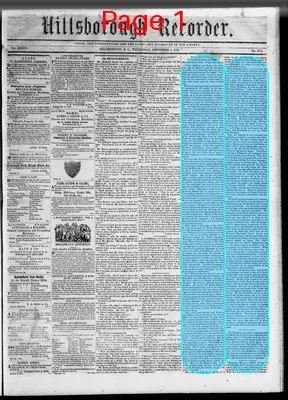
Editorial
September 3, 1856
The Hillsborough Recorder
Hillsboro, Orange County, North Carolina
What is this article about?
Editorial from New York Express urging Southern Whigs to support Millard Fillmore in 1856 election for Union peace, criticizing Buchanan's sectional policies on Kansas and Cuba, dismissing Fremont's chances, and warning against prolonged abolition agitation.
Merged-components note: Continuation of the editorial from New York Express on politics and Southern readers.
Clipping
OCR Quality
95%
Excellent
Full Text
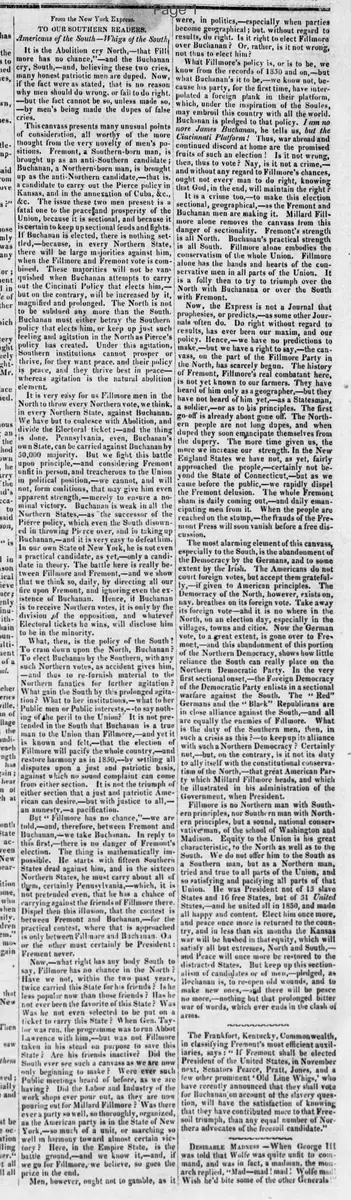
From the New York Express
TO OUR SOUTHERN READERS.
Americans of the South—Whigs of the South:
It is the Abolition cry North,—that Fillmore
has no chance," and the Buchanan
cry, South,—and, believing these two cries,
many honest patriotic men are duped. Now,
if the fact were as stated, that is no reason
why men should do wrong, or fail to do right.
but the fact cannot be so, unless made so,
—by men's being made the dupes of false
cries.
This canvass presents many unusual points
of consideration, all worthy of the more
thought from the very novelty of men's po-
sitions. Fremont, a Southern-born man, is
brought up as an anti-Southern candidate;
Buchanan, a Northern-born man, is brought
up as the anti-Northern candidate, that is.
a candidate to carry out the Pierce policy in
Kansas, and in the annexation of Cuba, &c.
&c. The issue these two men present is a
fatal one to the peace and prosperity of the
Union, because it is sectional, and because it
is certain to keep up sectional feuds and fights.
If Buchanan is elected, there is nothing set-
tled, because, in every Northern State,
there will be large majorities against him,
when the Fillmore and Fremont vote is com-
bined. These majorities will not be van-
quished when Buchanan attempts to carry
out the Cincinnati Policy that elects him,—
but on the contrary, will be increased by it.
magnified and prolonged. The North is not
to be subdued any more than the South.
Buchanan must either betray the Southern
policy that elects him, or keep up just such
feeling and agitation in the North as Pierce's
policy has created. Under this agitation,
Southern institutions cannot prosper or
thrive, for they want peace, and their policy
is peace, and they thrive best in peace
whereas agitation is the natural abolition
element.
It is very easy for us Fillmore men in the
North to throw every Northern vote, we think,
in every Northern State, against Buchanan.
We have but to coalesce with Abolition, and
divide the Electoral ticket; and the thing
is done. Pennsylvania, even, Buchanan's
own State, can be carried against Buchanan by
50,000 majority. But we fight this battle
upon principle,—and considering Fremont
unfit in person, and treacherous to the Union
in political position,—we cannot, and will
not, form coalitions, that may give him even
apparent strength,—merely to ensure a no-
nominal victory. Buchanan is weak in all the
Northern States,—as the successor of the
Pierce policy, which even the South disowned
in throwing Pierce over, and in taking up
Buchanan,—and it is very easy to defeat him.
In our own State of New York, he is not even
a practical candidate, as yet, only a candi-
date in theory. The battle here is really be-
tween Fillmore and Fremont,—and we show
that we think so, daily, by directing all our
fire upon Fremont, and ignoring even the ex-
istence of Buchanan. Hence, if Buchanan
is to receive Northern votes, it is only by the
division of the opposition, and whatever
Electoral tickets he wins, will disclose him
to be in the minority.
What, then, is the policy of the South?
To cram down upon the North, Buchanan?
To elect Buchanan by the Southern, with any
such Northern votes, as accident gives him,
—and thus to re-furnish material to the
Northern fanatics for farther agitation?
What gain the South by this prolonged agita-
tion? What to her institutions,—what to her
Public men or Public interests,—to say noth-
ing of the peril to the Union? It is not pre-
tended in the South that Buchanan is a true
man to the Union than Fillmore—and yet it
is known and felt,—that the election of
Fillmore will pacify the whole country.—and
restore harmony as in 1850,—by settling all
disputes upon a just and patriotic basis,
against which no sound complaint can come
from either section. It is not the triumph of
either section that a just and patriotic American
can desire.—but with justice to all.—
an amnesty,—a pacification.
But "Fillmore has no chance,"—we are
told, and, therefore, between Fremont and
Buchanan, we take Buchanan. In reply to
this first, there is no danger of Fremont's
election. The thing is mathematically im-
possible. He starts with fifteen Southern
States dead against him, and in the sixteen
Northern States, he must carry about all of
them, certainly Pennsylvania, which, it is
not pretended even, that he has a chance of
carrying against the friends of Fillmore there.
Dispel then this illusion, that the contest is
between Fremont and Buchanan,—for the
practical contest, where that is approached
is only between Fillmore and Buchanan. One
or the other must certainly be President:
Fremont never.
Now,—what right has any body South to
say, Fillmore has no chance in the North
Have we not, within the two past years,
twice carried this State for his friends? Is he
less popular now than those friends? Has he
not ever been the favorite of this State? Was
he not even selected to be put on a
ticket to carry this State? When Gen. Tay-
lor was run, the programme was to run Abbot
Lawrence with him,—but was not Fillmore
taken in his stead on purpose to save this
State? Are his friends inactive? Did the
South ever see such a canvass as we are now
only beginning to make? Were ever such
Public meetings heard of before, as we are
having? Did the Labor and Industry of the
work shops ever pour out, as they are now
pouring out for Millard Fillmore? Was there
ever a party so well, so thoroughly, organized,
as the American party is in the State of New
York,—so much of a unit, or marching so
well in harmony toward almost certain vic-
tory? Here, in the Empire State, is the
battle ground, and we know it,—and, if
we go for Fillmore, we believe, so goes the
prize in the end.
Men, however, ought not to gamble, as it
were, in politics, especially when parties
become geographical; but, without regard to
results, do right. Is it right to elect Fillmore
over Buchanan? Or, rather, is it not wrong,
not thus to elect him?
What Fillmore's policy is, or is to be, we
know from the records of 1850 and on, but
what Buchanan's it to be, we know not, be-
cause his party, for the first time, have inter-
polated a foreign plank in their platform,
which, under the inspiration of the Soules,
may embroil this country with all the world.
Buchanan is pledged to that policy. I am no
more James Buchanan, he tells us, but the
Cincinnati Platform! Thus, war abroad and
continued discord at home are the promised
fruits of such an election! Is it not wrong,
then, thus to vote? Nay, is it not a crime,—
and without any regard to Fillmore's chances,
ought not every man to do right, knowing
that God, in the end, will maintain the right?
It is a crime too,—to make this election
sectional, geographical,—as the Fremont and
Buchanan men are making it. Millard Fill-
more alone removes the canvass from this
danger of sectionality. Fremont's strength
is all North. Buchanan's practical strength
is all South. Fillmore alone embodies the
conservatism of the whole Union. Fillmore
alone has the hands and hearts of the con-
servative men in all parts of the Union. It
is a folly then to try to triumph over the
North with Buchanan or over the South
with Fremont.
Now, the Express is not a Journal that
prophesies, or predicts, as some other Jour-
nals often do. Do right without regard to
results, has ever been our maxim, and our
policy. Hence, we have no predictions to
make,—but we have a right to say, the can-
vass, on the part of the Fillmore Party in
the North, has scarcely begun. The history
of Fremont. Fillmore's real combatant here,
is not yet known to our farmers. They have
heard of him only as a geographer,—but they
have not heard of him yet,—as a Statesman,
a soldier, or as to his principles. The first
go-off is already about gone off. The North- hern people are not long dupes, and when
duped they soon emancipate themselves from
the dupery. The more time given us, the
more we increase our strength. In the New
England States we have not, as yet, fairly
approached the people,—certainly not be-
yond the State of Connecticut,—but as we
came before the public, we rapidly dispel
the Fremont delusion. The whole Fremont
sham is daily coming out,—and daily eman-
ciating men from it. When the people are
reached on the stump,—the frauds of the Fre-
Mont Press will soon vanish before a free dis-
cussion.
The most alarming element of this canvass,
especially to the South, is the abandonment of
the Democracy by the Germans, and to some
extent by the Irish. The Americans do not
court foreign votes, but accept them grateful-
ly,—if given to American principles. The
Democracy of the North, however, exists on,
nay, breathes on its foreign vote. Take away
its foreign vote—and it is no where in the
North, on an election day, especially in the
villages, towns and cities. Now the German
vote, to a great extent, is gone over to Fremont,
—and this abandonment of this portion
of the Northern Democracy, shows how little
reliance the South can really place on the
Northern Democratic Party. In the very
first sectional onset,—the Foreign Democracy
of the Democratic Party enlists in a sectional
warfare against the South. The "Red"
Germans and the "Black" Republicans are
in close alliance against the South, and all
are equally the enemies of Fillmore. What
is the duty of the Southern men, then, in
such a crisis as this? To keep up its alliance
with such a Northern Democracy? Certainly
not,—but, on the contrary, is it not its duty
to ally itself with the constitutional conserva-
tism of the North,—that great American Party
which Millard Fillmore heads, and which
he illustrated in his administration of the
Government, when President.
Fillmore is no Northern man with South-
tern principles, nor Southern man with North-
ern principles, but a sound, national conser-
vative man, of the school of Washington and
Madison. Equity to the Union is his great
characteristic, to the North as well as to the
South. We do not offer him to the South as
a Southern man, but as a Northern man.
tried and true to all parts of the Union, and
so satisfying and pacifying all parts of that
Union. He was President not of 15 slave
States and 16 Free States, but of 31 United
States,—and he united all in 1850, and made
all happy and content. Elect him once more,
and peace once more is returned to the coun-
try, and in less than six months the Kansas
war will be hushed in that equity, which will
satisfy all but extremes, North and South,——
and Peace will once more be restored to the
distracted States. But keep up this section-
alism of candidates or of men, pledged, as
Buchanan is, to re-open old wounds, and to
make new ones,—and there will be peace
no more,—nothing but that prolonged bitter
war of words, which ever ends in the clash of
arms.
The Frankfort, Kentucky, Commonwealth,
in classifying Fremont's most efficient auxil-
jaries, says; "If Fremont shall be elected
President of the United States, in November
next, Senators Pearce, Pratt, Jones, and a
few other prominent 'Old Line Whigs,' who
have recently announced that they shall vote
for Buchanan on account of the slavery ques-
tion, will have the satisfaction of knowing
that they have contributed more to that Free-
soil triumph, than any equal number of Northern
advocates of the freesoil candidate."
Desirable Madness—When George III
was told that Wolfe was quite unfit to com-
mand, and was in fact, a madman, the mon-
arch replied, "Mad—mad! mad—Wolfe mad!
Wish he'd bite some of the other Generals"
TO OUR SOUTHERN READERS.
Americans of the South—Whigs of the South:
It is the Abolition cry North,—that Fillmore
has no chance," and the Buchanan
cry, South,—and, believing these two cries,
many honest patriotic men are duped. Now,
if the fact were as stated, that is no reason
why men should do wrong, or fail to do right.
but the fact cannot be so, unless made so,
—by men's being made the dupes of false
cries.
This canvass presents many unusual points
of consideration, all worthy of the more
thought from the very novelty of men's po-
sitions. Fremont, a Southern-born man, is
brought up as an anti-Southern candidate;
Buchanan, a Northern-born man, is brought
up as the anti-Northern candidate, that is.
a candidate to carry out the Pierce policy in
Kansas, and in the annexation of Cuba, &c.
&c. The issue these two men present is a
fatal one to the peace and prosperity of the
Union, because it is sectional, and because it
is certain to keep up sectional feuds and fights.
If Buchanan is elected, there is nothing set-
tled, because, in every Northern State,
there will be large majorities against him,
when the Fillmore and Fremont vote is com-
bined. These majorities will not be van-
quished when Buchanan attempts to carry
out the Cincinnati Policy that elects him,—
but on the contrary, will be increased by it.
magnified and prolonged. The North is not
to be subdued any more than the South.
Buchanan must either betray the Southern
policy that elects him, or keep up just such
feeling and agitation in the North as Pierce's
policy has created. Under this agitation,
Southern institutions cannot prosper or
thrive, for they want peace, and their policy
is peace, and they thrive best in peace
whereas agitation is the natural abolition
element.
It is very easy for us Fillmore men in the
North to throw every Northern vote, we think,
in every Northern State, against Buchanan.
We have but to coalesce with Abolition, and
divide the Electoral ticket; and the thing
is done. Pennsylvania, even, Buchanan's
own State, can be carried against Buchanan by
50,000 majority. But we fight this battle
upon principle,—and considering Fremont
unfit in person, and treacherous to the Union
in political position,—we cannot, and will
not, form coalitions, that may give him even
apparent strength,—merely to ensure a no-
nominal victory. Buchanan is weak in all the
Northern States,—as the successor of the
Pierce policy, which even the South disowned
in throwing Pierce over, and in taking up
Buchanan,—and it is very easy to defeat him.
In our own State of New York, he is not even
a practical candidate, as yet, only a candi-
date in theory. The battle here is really be-
tween Fillmore and Fremont,—and we show
that we think so, daily, by directing all our
fire upon Fremont, and ignoring even the ex-
istence of Buchanan. Hence, if Buchanan
is to receive Northern votes, it is only by the
division of the opposition, and whatever
Electoral tickets he wins, will disclose him
to be in the minority.
What, then, is the policy of the South?
To cram down upon the North, Buchanan?
To elect Buchanan by the Southern, with any
such Northern votes, as accident gives him,
—and thus to re-furnish material to the
Northern fanatics for farther agitation?
What gain the South by this prolonged agita-
tion? What to her institutions,—what to her
Public men or Public interests,—to say noth-
ing of the peril to the Union? It is not pre-
tended in the South that Buchanan is a true
man to the Union than Fillmore—and yet it
is known and felt,—that the election of
Fillmore will pacify the whole country.—and
restore harmony as in 1850,—by settling all
disputes upon a just and patriotic basis,
against which no sound complaint can come
from either section. It is not the triumph of
either section that a just and patriotic American
can desire.—but with justice to all.—
an amnesty,—a pacification.
But "Fillmore has no chance,"—we are
told, and, therefore, between Fremont and
Buchanan, we take Buchanan. In reply to
this first, there is no danger of Fremont's
election. The thing is mathematically im-
possible. He starts with fifteen Southern
States dead against him, and in the sixteen
Northern States, he must carry about all of
them, certainly Pennsylvania, which, it is
not pretended even, that he has a chance of
carrying against the friends of Fillmore there.
Dispel then this illusion, that the contest is
between Fremont and Buchanan,—for the
practical contest, where that is approached
is only between Fillmore and Buchanan. One
or the other must certainly be President:
Fremont never.
Now,—what right has any body South to
say, Fillmore has no chance in the North
Have we not, within the two past years,
twice carried this State for his friends? Is he
less popular now than those friends? Has he
not ever been the favorite of this State? Was
he not even selected to be put on a
ticket to carry this State? When Gen. Tay-
lor was run, the programme was to run Abbot
Lawrence with him,—but was not Fillmore
taken in his stead on purpose to save this
State? Are his friends inactive? Did the
South ever see such a canvass as we are now
only beginning to make? Were ever such
Public meetings heard of before, as we are
having? Did the Labor and Industry of the
work shops ever pour out, as they are now
pouring out for Millard Fillmore? Was there
ever a party so well, so thoroughly, organized,
as the American party is in the State of New
York,—so much of a unit, or marching so
well in harmony toward almost certain vic-
tory? Here, in the Empire State, is the
battle ground, and we know it,—and, if
we go for Fillmore, we believe, so goes the
prize in the end.
Men, however, ought not to gamble, as it
were, in politics, especially when parties
become geographical; but, without regard to
results, do right. Is it right to elect Fillmore
over Buchanan? Or, rather, is it not wrong,
not thus to elect him?
What Fillmore's policy is, or is to be, we
know from the records of 1850 and on, but
what Buchanan's it to be, we know not, be-
cause his party, for the first time, have inter-
polated a foreign plank in their platform,
which, under the inspiration of the Soules,
may embroil this country with all the world.
Buchanan is pledged to that policy. I am no
more James Buchanan, he tells us, but the
Cincinnati Platform! Thus, war abroad and
continued discord at home are the promised
fruits of such an election! Is it not wrong,
then, thus to vote? Nay, is it not a crime,—
and without any regard to Fillmore's chances,
ought not every man to do right, knowing
that God, in the end, will maintain the right?
It is a crime too,—to make this election
sectional, geographical,—as the Fremont and
Buchanan men are making it. Millard Fill-
more alone removes the canvass from this
danger of sectionality. Fremont's strength
is all North. Buchanan's practical strength
is all South. Fillmore alone embodies the
conservatism of the whole Union. Fillmore
alone has the hands and hearts of the con-
servative men in all parts of the Union. It
is a folly then to try to triumph over the
North with Buchanan or over the South
with Fremont.
Now, the Express is not a Journal that
prophesies, or predicts, as some other Jour-
nals often do. Do right without regard to
results, has ever been our maxim, and our
policy. Hence, we have no predictions to
make,—but we have a right to say, the can-
vass, on the part of the Fillmore Party in
the North, has scarcely begun. The history
of Fremont. Fillmore's real combatant here,
is not yet known to our farmers. They have
heard of him only as a geographer,—but they
have not heard of him yet,—as a Statesman,
a soldier, or as to his principles. The first
go-off is already about gone off. The North- hern people are not long dupes, and when
duped they soon emancipate themselves from
the dupery. The more time given us, the
more we increase our strength. In the New
England States we have not, as yet, fairly
approached the people,—certainly not be-
yond the State of Connecticut,—but as we
came before the public, we rapidly dispel
the Fremont delusion. The whole Fremont
sham is daily coming out,—and daily eman-
ciating men from it. When the people are
reached on the stump,—the frauds of the Fre-
Mont Press will soon vanish before a free dis-
cussion.
The most alarming element of this canvass,
especially to the South, is the abandonment of
the Democracy by the Germans, and to some
extent by the Irish. The Americans do not
court foreign votes, but accept them grateful-
ly,—if given to American principles. The
Democracy of the North, however, exists on,
nay, breathes on its foreign vote. Take away
its foreign vote—and it is no where in the
North, on an election day, especially in the
villages, towns and cities. Now the German
vote, to a great extent, is gone over to Fremont,
—and this abandonment of this portion
of the Northern Democracy, shows how little
reliance the South can really place on the
Northern Democratic Party. In the very
first sectional onset,—the Foreign Democracy
of the Democratic Party enlists in a sectional
warfare against the South. The "Red"
Germans and the "Black" Republicans are
in close alliance against the South, and all
are equally the enemies of Fillmore. What
is the duty of the Southern men, then, in
such a crisis as this? To keep up its alliance
with such a Northern Democracy? Certainly
not,—but, on the contrary, is it not its duty
to ally itself with the constitutional conserva-
tism of the North,—that great American Party
which Millard Fillmore heads, and which
he illustrated in his administration of the
Government, when President.
Fillmore is no Northern man with South-
tern principles, nor Southern man with North-
ern principles, but a sound, national conser-
vative man, of the school of Washington and
Madison. Equity to the Union is his great
characteristic, to the North as well as to the
South. We do not offer him to the South as
a Southern man, but as a Northern man.
tried and true to all parts of the Union, and
so satisfying and pacifying all parts of that
Union. He was President not of 15 slave
States and 16 Free States, but of 31 United
States,—and he united all in 1850, and made
all happy and content. Elect him once more,
and peace once more is returned to the coun-
try, and in less than six months the Kansas
war will be hushed in that equity, which will
satisfy all but extremes, North and South,——
and Peace will once more be restored to the
distracted States. But keep up this section-
alism of candidates or of men, pledged, as
Buchanan is, to re-open old wounds, and to
make new ones,—and there will be peace
no more,—nothing but that prolonged bitter
war of words, which ever ends in the clash of
arms.
The Frankfort, Kentucky, Commonwealth,
in classifying Fremont's most efficient auxil-
jaries, says; "If Fremont shall be elected
President of the United States, in November
next, Senators Pearce, Pratt, Jones, and a
few other prominent 'Old Line Whigs,' who
have recently announced that they shall vote
for Buchanan on account of the slavery ques-
tion, will have the satisfaction of knowing
that they have contributed more to that Free-
soil triumph, than any equal number of Northern
advocates of the freesoil candidate."
Desirable Madness—When George III
was told that Wolfe was quite unfit to com-
mand, and was in fact, a madman, the mon-
arch replied, "Mad—mad! mad—Wolfe mad!
Wish he'd bite some of the other Generals"
What sub-type of article is it?
Partisan Politics
Slavery Abolition
War Or Peace
What keywords are associated?
1856 Election
Fillmore Support
Southern Whigs
Sectional Agitation
Union Preservation
Buchanan Policy
Fremont Delusion
Kansas Issue
American Party
What entities or persons were involved?
Millard Fillmore
James Buchanan
John C. Fremont
Franklin Pierce
Southern Whigs
American Party
New York Express
George Iii
James Wolfe
Editorial Details
Primary Topic
Urging Southern Support For Fillmore In 1856 Election To Preserve Union
Stance / Tone
Strongly Pro Fillmore, Anti Buchanan And Anti Fremont, Advocating National Unity Over Sectionalism
Key Figures
Millard Fillmore
James Buchanan
John C. Fremont
Franklin Pierce
Southern Whigs
American Party
New York Express
George Iii
James Wolfe
Key Arguments
Fillmore's Election Will Restore Peace And Harmony As In 1850
Buchanan's Policies Will Prolong Sectional Agitation And Harm Southern Institutions
Fremont Has No Mathematical Chance Of Winning
Northern Fillmore Supporters Refuse Coalitions With Abolitionists On Principle
Southern Alliance With Northern Democrats Is Unreliable Due To Foreign Vote Shifts
Voting For Buchanan Risks War Abroad And Discord At Home Via Cincinnati Platform
Fillmore Embodies Conservatism Of The Entire Union