Thank you for visiting SNEWPapers!
Sign up free
Letter to Editor
January 29, 1866
The Evening Telegraph
Philadelphia, Philadelphia County, Pennsylvania
What is this article about?
Letter argues that capital dominates labor, causing inequities, but workers should resist Sunday labor through Sabbath laws, ballot box, and civil rights, not strikes. References Milton, Bible, and John Quincy Adams' stand against Sunday sessions.
Clipping
OCR Quality
98%
Excellent
Full Text
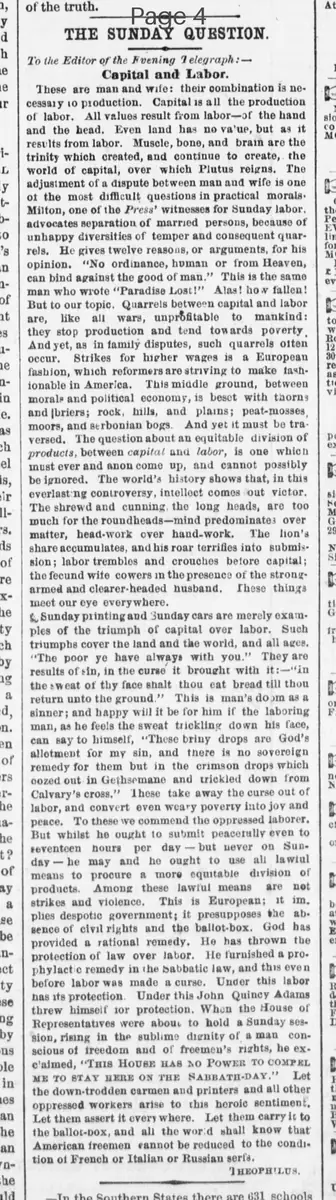
THE SUNDAY QUESTION.
To the Editor of the Evening Telegraph:-
Capital and Labor.
These are man and wife: their combination is necessary to production. Capital is all the production of labor. All values result from labor-of the hand and the head. Even land has no value, but as it results from labor. Muscle, bone, and brain are the trinity which created, and continue to create, the world of capital, over which Plutus reigns. The adjustment of a dispute between man and wife is one of the most difficult questions in practical morals. Milton, one of the Press' witnesses for Sunday labor, advocates separation of married persons, because of unhappy diversities of temper and consequent quarrels. He gives twelve reasons, or arguments, for his opinion. "No ordinance, human or from Heaven, can bind against the good of man." This is the same man who wrote "Paradise Lost!" Alas! how fallen!
But to our topic. Quarrels between capital and labor are, like all wars, unprofitable to mankind: they stop production and tend towards poverty. And yet, as in family disputes, such quarrels often occur. Strikes for higher wages is a European fashion, which reformers are striving to make fashionable in America. This middle ground, between morals and political economy, is beset with thorns and briers; rock, hills, and plains; peat-mosses, moors, and serbonian bogs. And yet it must be traversed. The question about an equitable division of products, between capital and labor, is one which must ever and anon come up, and cannot possibly be ignored. The world's history shows that, in this everlasting controversy, intellect comes out victor. The shrewd and cunning, the long heads, are too much for the roundheads-mind predominates over matter, head-work over hand-work. The lion's share accumulates, and his roar terrifies into submission: labor trembles and crouches before capital; the fecund wife cowers in the presence of the strong armed and clearer-headed husband. These things meet our eye everywhere.
Sunday printing and Sunday cars are merely examples of the triumph of capital over labor. Such triumphs cover the land and the world, and all ages. "The poor ye have always with you." They are results of sin, in the curse it brought with it:-"in the sweat of thy face shalt thou eat bread till thou return unto the ground." This is man's doom as a sinner; and happy will it be for him if the laboring man, as he feels the sweat trickling down his face, can say to himself, "These briny drops are God's allotment for my sin, and there is no sovereign remedy for them but in the crimson drops which oozed out in Gethsemane and trickled down from Calvary's cross." These take away the curse out of labor, and convert even weary poverty into joy and peace. To these we commend the oppressed laborer.
But whilst he ought to submit peaceably even to seventeen hours per day -but never on Sunday-he may and he ought to use all lawful means to procure a more equitable division of products. Among these lawful means are not strikes and violence. This is European; it implies despotic government; it presupposes the absence of civil rights and the ballot-box. God has provided a rational remedy. He has thrown the protection of law over labor. He furnished a prophylactic remedy in the Sabbatic law, and this even before labor was made a curse. Under this labor has its protection. Under this John Quincy Adams threw himself for protection. When the House of Representatives were about to hold a Sunday session, rising in the sublime dignity of a man conscious of freedom and of freemen's rights, he exclaimed, "THIS HOUSE HAS NO POWER TO COMPEL ME TO STAY HERE ON THE SABBATH-DAY."
Let the down-trodden carmen and printers and all other oppressed workers arise to this heroic sentiment. Let them assert it everywhere. Let them carry it to the ballot-box, and all the world shall know that American freemen cannot be reduced to the condition of French or Italian or Russian serfs.
THEOPHILUS.
To the Editor of the Evening Telegraph:-
Capital and Labor.
These are man and wife: their combination is necessary to production. Capital is all the production of labor. All values result from labor-of the hand and the head. Even land has no value, but as it results from labor. Muscle, bone, and brain are the trinity which created, and continue to create, the world of capital, over which Plutus reigns. The adjustment of a dispute between man and wife is one of the most difficult questions in practical morals. Milton, one of the Press' witnesses for Sunday labor, advocates separation of married persons, because of unhappy diversities of temper and consequent quarrels. He gives twelve reasons, or arguments, for his opinion. "No ordinance, human or from Heaven, can bind against the good of man." This is the same man who wrote "Paradise Lost!" Alas! how fallen!
But to our topic. Quarrels between capital and labor are, like all wars, unprofitable to mankind: they stop production and tend towards poverty. And yet, as in family disputes, such quarrels often occur. Strikes for higher wages is a European fashion, which reformers are striving to make fashionable in America. This middle ground, between morals and political economy, is beset with thorns and briers; rock, hills, and plains; peat-mosses, moors, and serbonian bogs. And yet it must be traversed. The question about an equitable division of products, between capital and labor, is one which must ever and anon come up, and cannot possibly be ignored. The world's history shows that, in this everlasting controversy, intellect comes out victor. The shrewd and cunning, the long heads, are too much for the roundheads-mind predominates over matter, head-work over hand-work. The lion's share accumulates, and his roar terrifies into submission: labor trembles and crouches before capital; the fecund wife cowers in the presence of the strong armed and clearer-headed husband. These things meet our eye everywhere.
Sunday printing and Sunday cars are merely examples of the triumph of capital over labor. Such triumphs cover the land and the world, and all ages. "The poor ye have always with you." They are results of sin, in the curse it brought with it:-"in the sweat of thy face shalt thou eat bread till thou return unto the ground." This is man's doom as a sinner; and happy will it be for him if the laboring man, as he feels the sweat trickling down his face, can say to himself, "These briny drops are God's allotment for my sin, and there is no sovereign remedy for them but in the crimson drops which oozed out in Gethsemane and trickled down from Calvary's cross." These take away the curse out of labor, and convert even weary poverty into joy and peace. To these we commend the oppressed laborer.
But whilst he ought to submit peaceably even to seventeen hours per day -but never on Sunday-he may and he ought to use all lawful means to procure a more equitable division of products. Among these lawful means are not strikes and violence. This is European; it implies despotic government; it presupposes the absence of civil rights and the ballot-box. God has provided a rational remedy. He has thrown the protection of law over labor. He furnished a prophylactic remedy in the Sabbatic law, and this even before labor was made a curse. Under this labor has its protection. Under this John Quincy Adams threw himself for protection. When the House of Representatives were about to hold a Sunday session, rising in the sublime dignity of a man conscious of freedom and of freemen's rights, he exclaimed, "THIS HOUSE HAS NO POWER TO COMPEL ME TO STAY HERE ON THE SABBATH-DAY."
Let the down-trodden carmen and printers and all other oppressed workers arise to this heroic sentiment. Let them assert it everywhere. Let them carry it to the ballot-box, and all the world shall know that American freemen cannot be reduced to the condition of French or Italian or Russian serfs.
THEOPHILUS.
What sub-type of article is it?
Persuasive
Ethical Moral
Religious
What themes does it cover?
Social Issues
Religion
Politics
What keywords are associated?
Capital And Labor
Sunday Labor
Sabbath Protection
Ballot Box
Strikes Opposition
John Quincy Adams
Religious Remedy
What entities or persons were involved?
Theophilus
Editor Of The Evening Telegraph
Letter to Editor Details
Author
Theophilus
Recipient
Editor Of The Evening Telegraph
Main Argument
capital dominates labor like a husband over wife, leading to inequities, but workers should submit peacefully except on sunday, using sabbath laws, civil rights, and the ballot box for fairer division, rejecting strikes as un-american.
Notable Details
References Milton's Advocacy For Marital Separation And 'Paradise Lost'
Quotes Bible: 'In The Sweat Of Thy Face Shalt Thou Eat Bread'
Mentions Gethsemane And Calvary's Cross
Quotes John Quincy Adams: 'This House Has No Power To Compel Me To Stay Here On The Sabbath Day.'