Thank you for visiting SNEWPapers!
Sign up free
Grant County Herald
Lancaster, Grant County, Wisconsin
What is this article about?
A letter to Secretary of War Simon Cameron urges using freed slaves to fight rebels in the South, citing historical precedents from Braddock's War and the War of 1812 where adapting to enemy tactics succeeded. It argues against returning fugitive slaves to rebel masters, as they are confiscated property, to sustain Northern support and end slavery.
Clipping
OCR Quality
Full Text
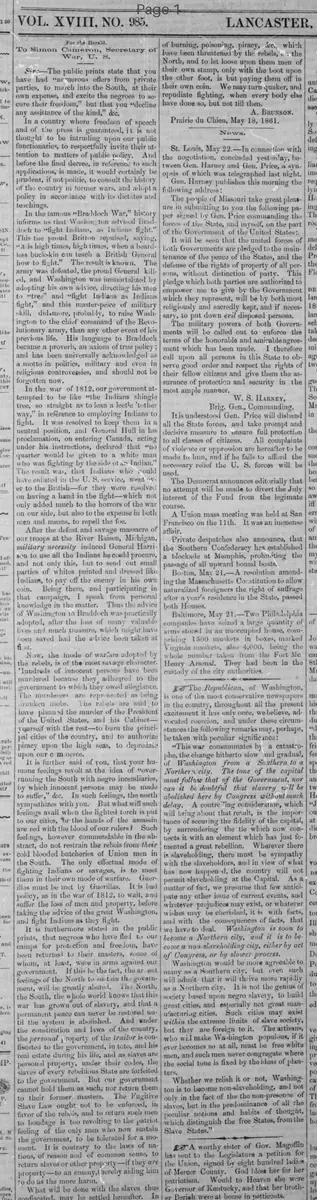
For the Herald.
To Simon Cameron, Secretary of War, U. S.
Sir:—The public prints state that you have had "numerous offers from private parties, to march into the South, at their own expense, and excite the negroes to secure their freedom," but that you "decline any assistance of the kind," &c.
In a country where freedom of speech and of the press is guaranteed, it is not thought to be intruding upon our public functionaries, to respectfully invite their attention to matters of public policy. And before the final decree, in reference to such applications, is made, it would certainly be prudent, if not politic, to consult the history of the country in former wars, and adopt a policy in accordance with its dictates and teachings.
In the famous "Braddock War," history informs us that Washington advised Braddock to "fight Indians, as Indians fight." This the proud Briton repulsed, saying, "it is high times, high times, when a beardless buckskin can teach a British General how to fight." The result is known. The army was defeated, the proud General killed, and Washington was immortalized by adopting his own advice, directing his men to "tree" and "fight Indians as Indians fight," and this master-piece of military skill, did more, probably, to raise Washington to the chief command of the Revolutionary army, than any other event of his previous life. His language to Braddock became a proverb, an axiom of true policy: and has been universally acknowledged as a motto in politics, military and even in religious controversies, and should not be forgotten now.
In the war of 1812, our government attempted to be like "the Indians shingle tree, so straight as to lean a leetle 'tother way," in reference to employing Indians to fight. It was resolved to keep them in a neutral position, and General Hull in his proclamation, on entering Canada, acting under his instructions, declared that "no quarter would be given to a white man who was fighting by the side of an Indian." The result was, that Indians who would have enlisted in the U. S. service, went over to the British—for they were resolved on having a hand in the fight—which not only added much to the horrors of the war on our side, but also to the expense in both men and means, to repel the foe.
After the defeat and savage massacre of our troops at the River Raisin, Michigan, military necessity induced General Harrison to use all the Indians he could procure, and not only this, but to send out small parties of whites painted and dressed like Indians, to pay off the enemy in his own coin. Being there, and participating in that campaign, I speak from personal knowledge in the matter. Thus the advice of Washington to Braddock was practically adopted, after the loss of many valuable lives and much treasure, which might have been saved had the advice been taken at first.
Now, the mode of warfare adopted by the rebels, is of the most savage character. Hundreds of innocent persons have been murdered because they adhered to the government to which they owed allegiance. The murderers are represented as being drunken mobs. The rebels are said to have planned the murder of the President of the United States, and his Cabinet—yourself with the rest—to burn the principal cities of the country, and to authorize piracy upon the high seas, to depredate upon our commerce.
It is further said of you, that your humane feelings revolt at the idea of "over-running the South with negro incendiaries, by which innocent persons may be made to suffer," &c. In such feelings, the north sympathizes with you. But what will such feelings avail when the lighted torch is put to our cities, by the hands of the assassin are red with the blood of our rulers? Such feelings, however commendable in the abstract, do not restrain the rebels from their cold blooded butcheries of Union men in the South. The only effectual mode of fighting Indians or savages, is to meet them in their own mode of warfare. Guerrillas must be met by Guerrillas. It is bad policy, as in the war of 1812, to wait, and suffer the loss of men and property, before taking the advice of the great Washington, and fight Indians as they fight.
It is furthermore stated in the public prints, that negroes who have fled to our camps for protection and freedom, have been returned to their masters, some of whom, at least, were in arms against our government. If this be the fact, the ardent feelings of the North to sustain the government, will be greatly abated. The North, the South, the whole world knows that this war has grown out of slavery, and that a permanent peace can never be restored until the system is abolished. And under the constitution and laws of the country, the personal property of the traitor is confiscated to the government, in toto, and his real estate during his life, and as slaves are personal property, under their codes, the slaves of every rebellious State are forfeited to the government. But our government cannot hold them as such, nor return them to their former masters. The Fugitive Slave Law ought not to be enforced, in favor of the rebels, and to return such men to bondage is too revolting to the patriot feeling of the only men who now sustain the government, to be tolerated for a moment. It is contrary to the laws of nations, of reason and of common sense, to return slaves or other property—if they are property—to an enemy, thereby aiding him to do us the more harm.
What will be done with the slaves thus confiscated, may be settled hereafter. In case of slaves captured on the high seas, in Slavers, they are sent to Africa. The same can be done in this case, and probably will be.
The South begun this war, and it may take its consequences, and no horrors of a servile insurrection can exceed the horrors of burning, poisoning, piracy, &c. which have been threatened by the rebels, on the North, and to let loose upon them men of their own stamp, only with the boot upon the other foot, is but paying them off in their own coin. We may turn quaker, and repudiate fighting, when every body else have done so, but not till then.
A. Brunson.
Prairie du Chien, May 18, 1861.
What sub-type of article is it?
What themes does it cover?
What keywords are associated?
What entities or persons were involved?
Letter to Editor Details
Author
A. Brunson
Recipient
Simon Cameron, Secretary Of War, U. S.
Main Argument
the u.s. government should employ freed slaves to fight rebels by inciting insurrections in the south and cease returning fugitive slaves to rebel masters, as historical precedents from past wars show that adapting to savage tactics is necessary, and slaves of traitors are confiscated property.
Notable Details