Thank you for visiting SNEWPapers!
Sign up free
Editorial
March 12, 1876
New York Dispatch
New York, New York County, New York
What is this article about?
The editorial counters European monarchist criticism of U.S. War Secretary Belknap's corruption by citing numerous scandals involving European royals and aristocrats, emphasizing American public's strong demand for justice as evidence of republican virtue over monarchical impunity.
Clipping
OCR Quality
98%
Excellent
Full Text
BELKNAP AND EUROPEAN MONARCHISTS.
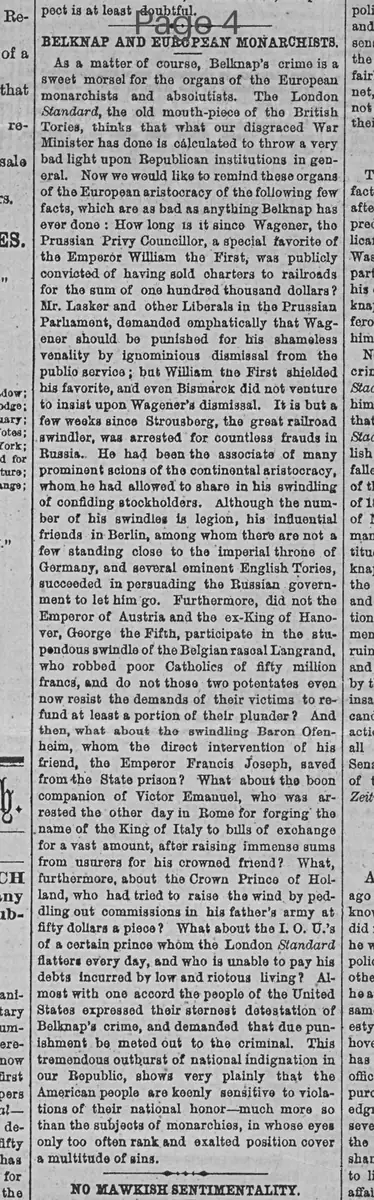
As a matter of course, Belknap's crime is a sweet morsel for the organs of the European monarchists and absolutists. The London Standard, the old mouth-piece of the British Tories, thinks that what our disgraced War Minister has done is calculated to throw a very bad light upon Republican institutions in general. Now we would like to remind these organs of the European aristocracy of the following few facts, which are as bad as anything Belknap has ever done: How long is it since Wagener, the Prussian Privy Councillor, a special favorite of the Emperor William the First, was publicly convicted of having sold charters to railroads for the sum of one hundred thousand dollars? Mr. Lasker and other Liberals in the Prussian Parliament, demanded emphatically that Wagener should be punished for his shameless venality by ignominious dismissal from the public service; but William the First shielded his favorite, and even Bismarck did not venture to insist upon Wagener's dismissal. It is but a few weeks since Strousberg, the great railroad swindler, was arrested for countless frauds in Russia. He had been the associate of many prominent scions of the continental aristocracy, whom he had allowed to share in his swindling of confiding stockholders. Although the number of his swindles is legion, his influential friends in Berlin, among whom there are not a few standing close to the imperial throne of Germany, and several prominent English Tories, succeeded in persuading the Russian government to let him go. Furthermore, did not the Emperor of Austria and the ex-King of Hanover, George the Fifth, participate in the stupendous swindle of the Belgian rascal Langrand, who robbed poor Catholics of fifty million francs, and do not those two potentates even now resist the demands of their victims to refund at least a portion of their plunder? And then, what about the swindling Baron Ofenheim, whom the direct intervention of his friend, the Emperor Francis Joseph, saved from the State prison? What about the boon companion of Victor Emanuel, who was arrested the other day in Rome for forging the name of the King of Italy to bills of exchange for a vast amount, after raising immense sums from usurers for his crowned friend? What, furthermore, about the Crown Prince of Holland, who had tried to raise the wind by peddling out commissions in his father's army at fifty dollars a piece? What about the I. O. U.'s of a certain prince whom the London Standard flatters every day, and who is unable to pay his debts incurred by low and riotous living? Almost with one accord the people of the United States expressed their sternest detestation of Belknap's crime, and demanded that due punishment be meted out to the criminal. This tremendous outburst of national indignation in our Republic, shows very plainly that the American people are keenly sensitive to violations of their national honor - much more so than the subjects of monarchies, in whose eyes only too often rank and exalted position cover a multitude of sins.
As a matter of course, Belknap's crime is a sweet morsel for the organs of the European monarchists and absolutists. The London Standard, the old mouth-piece of the British Tories, thinks that what our disgraced War Minister has done is calculated to throw a very bad light upon Republican institutions in general. Now we would like to remind these organs of the European aristocracy of the following few facts, which are as bad as anything Belknap has ever done: How long is it since Wagener, the Prussian Privy Councillor, a special favorite of the Emperor William the First, was publicly convicted of having sold charters to railroads for the sum of one hundred thousand dollars? Mr. Lasker and other Liberals in the Prussian Parliament, demanded emphatically that Wagener should be punished for his shameless venality by ignominious dismissal from the public service; but William the First shielded his favorite, and even Bismarck did not venture to insist upon Wagener's dismissal. It is but a few weeks since Strousberg, the great railroad swindler, was arrested for countless frauds in Russia. He had been the associate of many prominent scions of the continental aristocracy, whom he had allowed to share in his swindling of confiding stockholders. Although the number of his swindles is legion, his influential friends in Berlin, among whom there are not a few standing close to the imperial throne of Germany, and several prominent English Tories, succeeded in persuading the Russian government to let him go. Furthermore, did not the Emperor of Austria and the ex-King of Hanover, George the Fifth, participate in the stupendous swindle of the Belgian rascal Langrand, who robbed poor Catholics of fifty million francs, and do not those two potentates even now resist the demands of their victims to refund at least a portion of their plunder? And then, what about the swindling Baron Ofenheim, whom the direct intervention of his friend, the Emperor Francis Joseph, saved from the State prison? What about the boon companion of Victor Emanuel, who was arrested the other day in Rome for forging the name of the King of Italy to bills of exchange for a vast amount, after raising immense sums from usurers for his crowned friend? What, furthermore, about the Crown Prince of Holland, who had tried to raise the wind by peddling out commissions in his father's army at fifty dollars a piece? What about the I. O. U.'s of a certain prince whom the London Standard flatters every day, and who is unable to pay his debts incurred by low and riotous living? Almost with one accord the people of the United States expressed their sternest detestation of Belknap's crime, and demanded that due punishment be meted out to the criminal. This tremendous outburst of national indignation in our Republic, shows very plainly that the American people are keenly sensitive to violations of their national honor - much more so than the subjects of monarchies, in whose eyes only too often rank and exalted position cover a multitude of sins.
What sub-type of article is it?
Constitutional
Crime Or Punishment
Foreign Affairs
What keywords are associated?
Belknap Scandal
European Monarchist Corruption
Republican Institutions
Political Venality
National Honor
What entities or persons were involved?
Belknap
London Standard
Wagener
Emperor William The First
Bismarck
Strousberg
Emperor Of Austria
Ex King Of Hanover George The Fifth
Langrand
Baron Ofenheim
Emperor Francis Joseph
Victor Emanuel
Crown Prince Of Holland
Editorial Details
Primary Topic
Defense Of Republican Institutions Against European Monarchist Criticism Of Belknap Scandal
Stance / Tone
Defensive Of American Republic And Critical Of European Monarchist Corruption
Key Figures
Belknap
London Standard
Wagener
Emperor William The First
Bismarck
Strousberg
Emperor Of Austria
Ex King Of Hanover George The Fifth
Langrand
Baron Ofenheim
Emperor Francis Joseph
Victor Emanuel
Crown Prince Of Holland
Key Arguments
Belknap's Crime Is Exploited By European Monarchists To Discredit Republican Institutions
Wagener Sold Railroad Charters For $100,000 But Was Shielded By Emperor William
Strousberg Committed Railroad Frauds But Was Released Due To Influential Friends
Emperor Of Austria And Ex King Of Hanover Participated In Langrand's Swindle Of 50 Million Francs
Baron Ofenheim Was Saved From Prison By Emperor Francis Joseph
Victor Emanuel's Companion Forged The King's Name On Bills Of Exchange
Crown Prince Of Holland Sold Army Commissions For $50 Each
A Certain Prince Flatters By London Standard But Cannot Pay Debts From Riotous Living
American People Showed Strong Indignation And Demand For Punishment Of Belknap
This Demonstrates Greater Sensitivity To National Honor In The Republic Than In Monarchies