Thank you for visiting SNEWPapers!
Sign up free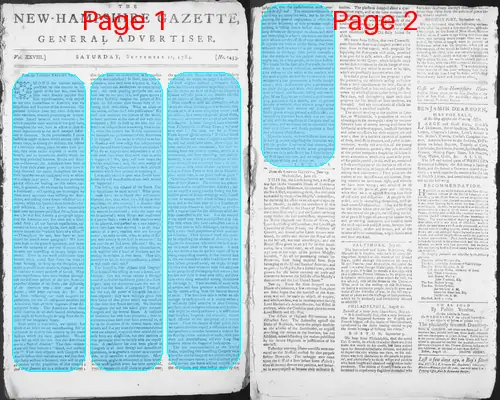
The New Hampshire Gazette And General Advertiser
Portsmouth, Exeter, Rockingham County, New Hampshire
What is this article about?
A letter from London critiques British press deceptions about American affairs during and after the Revolutionary War, refuting claims of U.S. disunion, financial ruin, and impending collapse, while affirming American unity, resilience, and commitment to independence.
Merged-components note: Continuous article from the London Evening Post, presented as an opinion piece signed 'LUCIUS', fitting letter_to_editor; text flows directly across pages.
Clippings
1 of 2
OCR Quality
Full Text
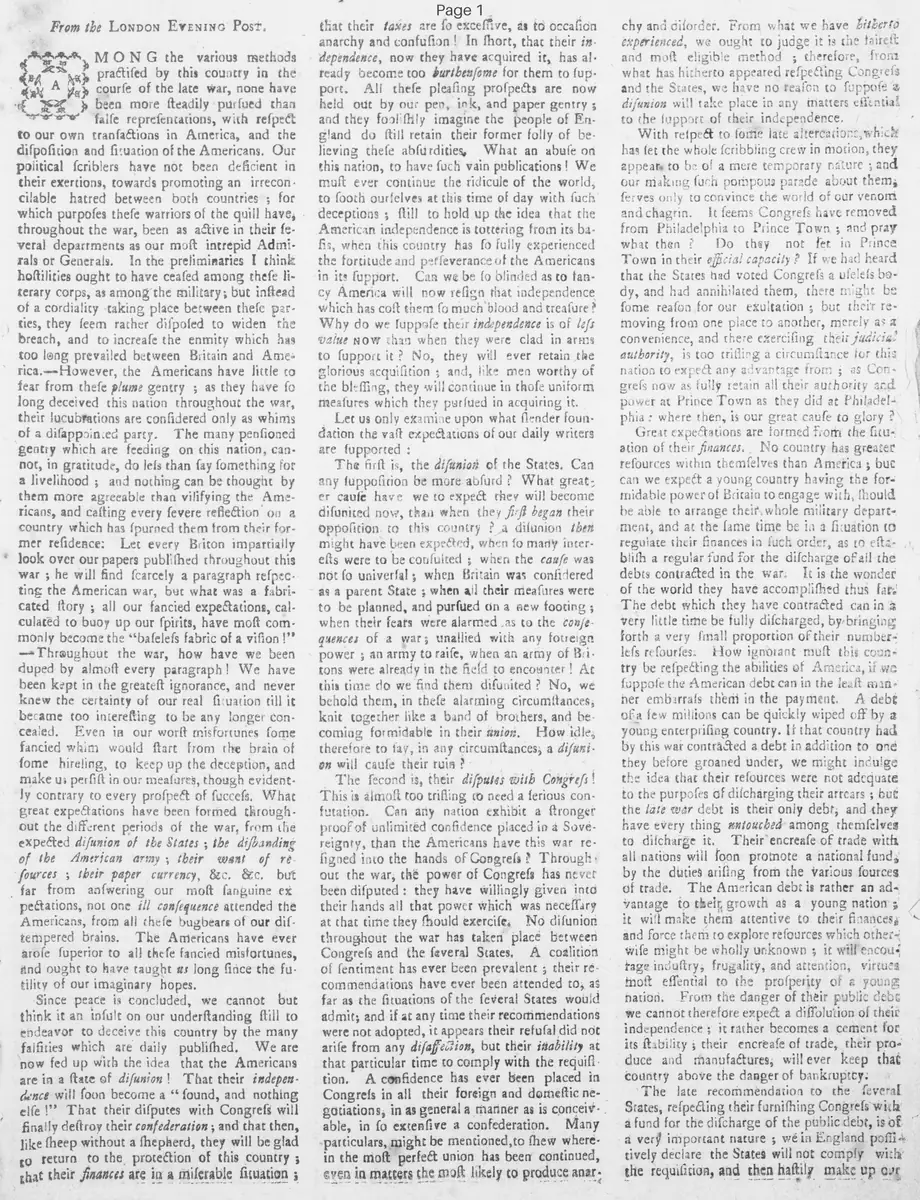
Among the various methods practised by this country in the course of the late war, none have been more steadily pursued than false representations, with respect to our own transactions in America, and the disposition and situation of the Americans. Our political scribblers have not been deficient in their exertions, towards promoting an irreconcilable hatred between both countries; for which purposes these warriors of the quill have, throughout the war, been as active in their several departments as our most intrepid Admirals or Generals. In the preliminaries I think hostilities ought to have ceased among these literary corps, as among the military; but instead of a cordiality taking place between these parties, they seem rather disposed to widen the breach, and to increase the enmity which has too long prevailed between Britain and America.--However, the Americans have little to fear from these plume gentry; as they have so long deceived this nation throughout the war, their lucubrations are considered only as whims of a disappointed party. The many pensioned gentry which are feeding on this nation, cannot, in gratitude, do less than say something for a livelihood; and nothing can be thought by them more agreeable than vilifying the Americans, and casting every severe reflection on a country which has spurned them from their former residence: Let every Briton impartially look over our papers published throughout this war: he will find scarcely a paragraph respecting the American war, but what was a fabricated story; all our fancied expectations, calculated to buoy up our spirits, have most commonly become the "baseless fabric of a vision!" -Throughout the war, how have we been duped by almost every paragraph! We have been kept in the greatest ignorance, and never knew the certainty of our real situation till it became too interesting to be any longer concealed. Even in our worst misfortunes some fancied whim would start from the brain of some hireling, to keep up the deception, and make us persist in our measures, though evidently contrary to every prospect of success. What great expectations have been formed throughout the different periods of the war, from the expected disunion of the States; the disbanding of the American army; their want of resources; their paper currency, &c. &c. but far from answering our most sanguine expectations, not one ill consequence attended the Americans, from all these bugbears of our distempered brains. The Americans have ever arose superior to all these fancied misfortunes, and ought to have taught us long since the futility of our imaginary hopes.
Since peace is concluded, we cannot but think it an insult on our understanding still to endeavor to deceive this country by the many falsities which are daily published. We are now fed up with the idea that the Americans are in a state of disunion! That their independence will soon become a "sound, and nothing else!" That their disputes with Congress will finally destroy their confederation; and that then, like sheep without a shepherd, they will be glad to return to the protection of this country; that their finances are in a miserable situation; that their taxes are so excessive, as to occasion anarchy and confusion! In short, that their independence, now they have acquired it, has already become too burdensome for them to support.
All these pleasing prospects are now held out by our pen, ink, and paper gentry; and they foolishly imagine the people of England do still retain their former folly of believing these absurdities. What an abuse on this nation, to have such vain publications! We must ever continue the ridicule of the world, to sooth ourselves at this time of day with such deceptions: still to hold up the idea that the American independence is tottering from its basis, when this country has so fully experienced the fortitude and perseverance of the Americans in its support. Can we be so blinded as to fancy America will now resign that independence which has cost them so much blood and treasure? Why do we suppose their independence is of less value now than when they were clad in arms to support it? No, they will ever retain the glorious acquisition; and, like men worthy of the blessing, they will continue in those uniform measures which they pursued in acquiring it.
Let us only examine upon what slender foundation the vast expectations of our daily writers are supported:
The first is, the disunion of the States. Can any supposition be more absurd? What greater cause have we to expect they will become disunited now, than when they first began their opposition to this country? a disunion then might have been expected, when so many interests were to be consulted: when the cause was not so universal: when Britain was considered as a parent State; when all their measures were to be planned, and pursued on a new footing: when their fears were alarmed as to the consequences of a war, unallied with any foreign power; an army to raise, when an army of Britons were already in the field to encounter! At this time do we find them disunited? No, we behold them, in these alarming circumstances, knit together like a band of brothers, and becoming formidable in their union. How idle, therefore to say, in any circumstances, a disunion will cause their ruin?
The second is, their disputes with Congress!
This is almost too trifling to need a serious confutation. Can any nation exhibit a stronger proof of unlimited confidence placed in a Sovereignty, than the Americans have this war reposed into the hands of Congress? Throughout the war, the power of Congress has never been disputed: they have willingly given into their hands all that power which was necessary at that time they should exercise. No disunion throughout the war has taken place between Congress and the several States. A coalition of sentiment has ever been prevalent: their recommendations have ever been attended to, as far as the situations of the several States would admit: and if at any time their recommendations were not adopted, it appears their refusal did not arise from any disaffection, but their inability at that particular time to comply with the requisition. A confidence has ever been placed in Congress in all their foreign and domestic negotiations, in as general a manner as is conceivable, in so extensive a confederation. Many particulars, might be mentioned, to shew wherein the most perfect union has been continued, even in matters the most likely to produce anarchy and disorder. From what we have hitherto experienced, we ought to judge it is the fairest and most eligible method; therefore, from what has hitherto appeared respecting Congress and the States, we have no reason to suppose a disunion will take place in any matters essential to the support of their independence.
With respect to some late altercations, which has set the whole scribbling crew in motion, they appear to be of a mere temporary nature; and our making such pompous parade about them, serves only to convince the world of our venom and chagrin. It seems Congress have removed from Philadelphia to Prince Town; and pray what then?
Do they not sit in Prince Town in their official capacity? If we had heard that the States had voted Congress a useless body, and had annihilated them, there might be some reason for our exultation: but their removing from one place to another, merely as a convenience, and there exercising their judicial authority, is too trifling a circumstance for this nation to expect any advantage from; as Congress now as fully retain all their authority and power at Prince Town as they did at Philadelphia: where then, is our great cause to glory?
Great expectations are formed from the situation of their finances. No country has greater resources within themselves than America: but can we expect a young country having the formidable power of Britain to engage with, should be able to arrange their whole military department, and at the same time be in a situation to regulate their finances in such order, as to establish a regular fund for the discharge of all the debts contracted in the war. It is the wonder of the world they have accomplished thus far. The debt which they have contracted can in a very little time be fully discharged, by bringing forth a very small proportion of their numberless resources. How ignorant must this country be respecting the abilities of America, if we suppose the American debt can in the least manner embarrass them in the payment. A debt of a few millions can be quickly wiped off by a young enterprising country. If that country had by this war contracted a debt in addition to one they before groaned under, we might indulge the idea that their resources were not adequate to the purposes of discharging their arrears; but the late war debt is their only debt, and they have every thing ambitious among themselves to discharge it. Their increase of trade with all nations will soon promote a national fund, by the duties arising from the various sources of trade. The American debt is rather an advantage to their growth as a young nation; it will make them attentive to their finances, and force them to explore resources which otherwise might be wholly unknown; it will encourage industry, frugality, and attention, virtues most essential to the prosperity of a young nation. From the danger of their public debts we cannot therefore expect a dissolution of their independence; it rather becomes a cement for its stability; their increase of trade, their produce and manufactures, will ever keep that country above the danger of bankruptcy:
The late recommendation to the several States, respecting their furnishing Congress with a fund for the discharge of the public debt, is of a very important nature; we in England positively declare the States will not comply with the requisition, and then hastily make up our
judgment, that the confederation must consequently be dissolved. The recommendation it is true is not yet complied with, but far from drawing the general consequences. it establishes me in the sentiment of their permanent union ; nothing is lasting that is hastily done; their long debates on the proper measures. and their not complying in a hurry, convinces me that all their actions are the effects of cool deliberation. It appears the sense of all the States, that some measures must be adopted to put Congress in a situation to discharge their public contracts ; but the measures for this purpose cannot, nor ought not, by a free people, to be done hastily. We herein see the spirit of a free people. by their debates on money institutions, uncontrouled they debate on the utility of the measure. and the most eligible method for it's execution : the wisdom of a free government is hereby conspicuous ; their deliberations give a permanency to their doings, and when their measures are once adopted, they become lasting and conclusive. Money supplies are reckoned a most interesting transaction in a nation, and no greater security is evident, than when a people grant their supplies with caution and deliberation. Hasty grants always portend a dissolution ; our conclusions therefore from their not yet complying with the requisition of Congress must be erroneous, and we cannot but be convinced that their long debates will finally produce a fixed and adequate establishment. Upon the whole, we have hitherto been kept in such ignorance respecting the American war, and the present situation of that country, that I have not wondered at the many paragraphs which are daily published ; but I hope in future we shall open our eyes, and no longer become the dupes of folly and deception.
LUCIUS.
What sub-type of article is it?
What themes does it cover?
What keywords are associated?
What entities or persons were involved?
Letter to Editor Details
Author
Lucius.
Main Argument
british press continues to deceive the public with false narratives of american disunion, financial collapse, and weakened independence post-war, but these claims are baseless; america remains united, resourceful, and committed to its sovereignty.
Notable Details